It’s All Relative
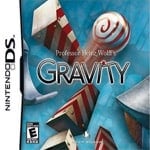
When you think of the Nintendo DS, you likely consider it first and foremost for its great library of handheld games, not for its technical prowess. But did you know the DS can actually pull off realistic, ragdoll physics? Back in December 2007, the homebrew scene produced a cutting-edge physics sandbox (Pocket Physics) on DS, and now publishers are expanding on that model. Deep Silver has recently released Professor Heinz Wolff’s Gravity, and we took this science experiment through its paces to see what we could create.

Actually, Gravity has less to do with letting players create their own physics scenarios and more of a focus on solving preset puzzles. There are 100 physics-based puzzles in total, along with five sandbox areas and three mini-games. That may sound like a lot of content, but depending on your knack for working out these sorts of conundrums, you could easily breeze through the game in about two to three hours.
Each level presents you with a switch that must be activated in order to end the level. A ball or other object is released from a specific area of a level, and you’ll then need to use various items in order to create a sequence that will trigger the end switch – a Rube Goldberg machine if you will.
The puzzles are clever, often eliciting a smile as you work them out, though the level of challenge jumps around quite a bit. For the most part, the physics in the game work quite well. However, items used to solve puzzles are also bound by the game’s physic during the placement process, and this causes all sorts of frustration throughout the game.
Additionally, the game’s interface and controls are extremely counter-intuitive; if you’re left-handed, you might as well forget this game exists. You’ll be required to use the stylus, faces buttons, and D-pad – in most cases, simultaneously. There is no left-handed configuration, and as a southpaw, I found myself having to become a contortionist in order to play this game.
To solve Gravity’s puzzles, you’ll need to make use of a limited selection of objects on hand within each level. To use these objects, you simply tap anywhere on the touch screen to open up the game’s object window, then select whatever items you want to use by dragging them onto an area of the level. Sounds easy enough…

In order to change the direction in which an object sits, you’re required to use the left and right directional inputs on the D-pad. You can’t remove your stylus from the screen, however, because, again, items used from your toolbox are also bound by the game’s physics. The result? A messy interface that’s almost at complete odds with everything that’s inherently fun about the DS as a gaming device
As an example, I had to hold objects with my stylus, using my thumb, index, and middle finger – the way I normally do – while simultaneously using my pinky and ring finger to adjust how objects were sitting, all while battling the game’s bouncy physics. I eventually came to terms with the game’s mechanics, but it was never comfortable and managed to suck out a good deal of the fun of solving puzzles. Perhaps right-handed gamers will have better luck with Gravity.
That said, each puzzle is unique and offers an enjoyable challenge that tasks players to – pardon the phrase – “think outside the box.” We’re not sure if Professor Wolff (yes, he’s a real person of some renown within scholarly circles) had any real hand in creating the gameplay for Gravity, though he does offer his insights about physics and video games on the game’s official website.

In addition to the main game, Gravity gives you five sandbox areas to play with, unlocked after every 20 puzzle levels completed. They’re simple levels with various objects strewn about that offer players the opportunity to tinker with the game’s physics engine. It’s a neat, little novelty, and though the physics generally work fine here, they’re not on par with Oxtob’s Pocket Physics (the homebrew application referred to earlier in this article). Objects are often jittery and unwieldy, and the levels aren’t designed to give you much actual freedom with which to experiment.

Wrapping up Gravity’s package is the Party Mode, which is comprised of three mini-games. The first of the three minis is Tallest Tower, and here you’re tasked with using objects to create as tall a structure as possible within an allotted time. Since you’ll be placing objects using the exact same interface as Gravity’s main puzzle levels, Tallest Tower ranks in as a total bust.
The second mini-game is called Up ‘N’ Over, and here you’ll, thankfully, be using only the stylus to shoot balls into baskets for points. Rather than being limited by time, Up ‘N’ Over simply limits the number of balls you have to work with. You use the stylus to aim a cannon toward baskets, then pull away from the cannon to build up power; release and your ball goes flying.
The last of the three mini-games is Clear the Decks. Like Up ‘N’ Over, you’ll use a cannon to lob balls, but this time your goal is to hit colored blocks. You are randomly given balls of varying colors, and only blocks of the same color can be cleared when hit. Unfortunately, none of the minis are all that entertaining, and the novelty is very short-lived.
It doesn’t help that Gravity’s production values are ultra-simplistic and a bit lifeless. Eerie music pervades most levels, but it’s not nearly enough to spike Gravity with even a modicum of excitement. Sound effects are plain, and the experience overall feels more like a series of dry experiments than a game. Backgrounds are attractive, but aside from gameplay objects moving about the screen, everything looks and feels very static – ironic for a physics-based game.
Professor Heinz Wolff’s Gravity is a novel idea for a DS puzzle game, and it could have been something quite special. There are glimpses of World of Goo here, and the music and art style seem to suggest the developers were looking to hit a similar gaming motif. However, the end product is very plain Jane, and a poorly conceived interface makes working out puzzles a frustrating, and often painful, process. The game is mildly entertaining for the meager few hours it lasts, but if you’re into the homebrew scene, you’ve already got access to something far more entertaining – and free, I might add.
RATING OUT OF 5 RATING DESCRIPTION 2.9 Graphics
Backgrounds are attractive, though they look as if they’re stock templates, rather than being designed specifically for Gravity. 2.0 Control
Lefties are given no love here whatsoever, though we suspect right-handed players will find ample frustration as well. 2.2 Music / Sound FX / Voice Acting
Sound effects have no “umph,” the music is very generic, and the overall fidelity is less than stellar. 2.5
Play Value
Barring an almost broken interface, the puzzles are interesting while they last.
2.4 Overall Rating – Poor
Not an average. See Rating legend above for a final score breakdown.
Game Features: