Tap and Flick Your Way
to Rhythm Greatness
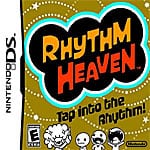
Although Nintendo’s current-generation game catalog is a bone of contention among contemporary gamers, occasionally a title comes along that restores the commitment that Nintendo has to its core audience. If WiiMusic was Nintendo’s must-have music game for the casual audience, than Rhythm Heaven is the title that all hardcore rhythm enthusiasts must own. It features plenty of rhythm-inspired mini-games that are modeled after the WarioWare brand of craziness, and the precision required to play this game is absolutely insane.

The format of the game is simple. You play a singular rhythm-based mini-game, and then you get a ranking ranging from “Try Again” and “OK” to “Superb” and “Perfect”. As long as the ranking is “OK” or above, you will be able to unlock the subsequent mini-game. The game does not have branching paths or alternate unlock methods, but I have to say that the linear structure works fairly well here. The mini-games increase in difficulty as you go on, so having an alternate progression wouldn’t make much sense here.
But of course, as with any handheld rhythm game, the control is what really sells this game. You hold the game vertically (like you would for BrainAge or Ninja Gaiden) and use the touch screen exclusively for control. There are only two different actions that you can take to control the game, which are to tap and flick. The tap motion is pretty straightforward, but the flick will require some practice. The game compares the flick motion to making the tail of a check mark, which is fairly accurate. But being able to control your flick motion will take some time, so don’t be afraid of the flick practice mode; I know I spent some considerable time there myself.
However, even though there are only two different control inputs in the game, each mini-game requires different actions, and the controls change for each one. For instance, the Glee Club mini-game requires you to hold down the stylus on the screen and tap it when you want your onscreen character to open their mouth. However, a game like Shoot ‘Em Up requires you to tap the screen quickly to repeat a beat and shoot down enemies. Although both of these mini-games use the same tapping principal, it is used in extremely different ways. Luckily, there is a thorough tutorial that is presented before each mini-game, so you won’t ever be thrust into a game without a solid idea of what to do.

Even though there are plenty of mini-games in Rhythm Heaven to keep you busy, once you finally do unlock all the games, the actual challenge begins. Rhythm Heaven has a medal system that awards players for getting high or perfect scores on individual mini-games. When you earn a medal, you can use it to unlock bonus mini-games found in the extras menu. You can unlock “Endless” games to play with that resemble other mini-games from the main game, or you can unlock special Rhythm Toys, like a swipe-able business card or musical telephone.
However, the best of these extras has to be the Jukebox (which is accessible via the Café menu.) When you score perfectly on a mini-game, you will unlock the song that goes with the game. And believe me, these songs are catchy. The Jukebox mode is definitely a huge plus in the game, and you can even shuffle songs around you have unlocked and just listen to the music.

While we’re on the topic of music, another thing about this title that really impressed me was the variety of tunes in the game. Since the game’s music was all attributed to Japanese producer TSUNKU, I sort of expected the tunes to have a similar sound. However, nothing could be further from the truth. From the synth-pop sounds that accompany Shoot ’em Up to the mellow melodies of Love Lab, the tunes definitely expand upon TSUNKU’s repertoire and are generally quite appealing. Although some of the English translations sound a little weird in songs with lyrics (compared to the original Japanese), these minor issues are forgivable.

The only issue that some may have with Rhythm Heaven is its difficulty. The game requires precise timing and movement, and you can fail a mini-game by just being off by mere fractions of a second. This is most evident in a mini-game like Rhythm Rally, where the main play mechanic involves striking a ping pong ball in time with the beat. Sounds simple right? Well, in Rhythm Heaven precision is the name of the game, and if you flick it with too long or too short of a stroke, the ball will go out. And forget about it if you are a moment or two offbeat; the ball will just whiz right past you.
Even though the difficulty is punishing, Rhythm Heaven does have a built-in buffer if you find one game just too difficult to beat. After you fail to get a passing rank three times in a row, the café icon on the main menu will light up. From there you can talk to the Barista and he’ll ask you if you want him to unlock the next mini-game. You can always return to the mini-game you couldn’t beat (or any mini-game for that matter), so this is a good way to move past a frustrating mini-game and will really help those who find some of the more precision-focused mini-games a bit too challenging.
One really defining characteristic of Rhythm Heaven is its visuals. One thing that struck me about Rhythm Heaven was how simplistic the visuals are; comparisons to WarioWare Touched are inevitable. For example, during the Glee Club mini-game, the visuals only consist of three hand-drawn choir members and a conductor. There is no color, and each character has a simplistic black outline that moves in time with the music. Although this is a bit of an extreme example, the visuals are always very simple, and no matter whether you are playing the singularly-colored Fillbots or brightly colored Fan Club, you will be continuously surprised by this game’s ever-changing look.
Even though many people have questioned Nintendo’s efforts to appease their core audience this generation, Rhythm Heaven proves that they are still capable of giving so-called hardcore fans a gaming experience worth remembering. Punishingly difficult, yet ostentatiously cute, Rhythm Heaven is the epitome of what a handheld music-based game should be. Forget guitar grips or funky cheerleaders! You won’t find a more engaging or entertaining music experience for the DS. And why would you? This is Rhythm Heaven, after all!
RATING OUT OF 5 RATING DESCRIPTION 4.3 Graphics
The game’s style varies depending on the mini-game, but bright colors and a hand drawn style dominate most of the visual landscape. 4.3 Control
The flick gesture is a little hard to perfect, but the tapping works just fine. Each mini-game has a lengthy practice mode, so even if you don’t get the controls right away, you can practice as much as you need to. 4.8 Music / Sound FX / Voice Acting
The soundtrack, which is produced entirely by Japanese producer TSUNKU, is awesome. This is one of the few games you may want to keep in your DS purely so you can listen to the tunes later. 4.0
Play Value
With more than 50 total mini-games and plenty of unlockable bonus content, you will be tapping and flicking until you become a Rhythm Master!
4.4 Overall Rating – Great
Not an average. See Rating legend above for a final score breakdown.
Game Features: