Power and Might from the Far East
The Age of Empires series certainly didn’t start off at the pinnacle of RTS perfection, but it has improved greatly with age over the past decade. In 2005, the third installment brought with it a new depth and continued the natural evolution of the series with a jump from the middle ages to colonialism. Last year the Warchiefs expansion pack let players experience the game as a handful of different Native American civilizations. This time around in The Asian Dynasties, the second expansion for Age of Empires III, you’ll be traveling across the ocean to the Far East where new conquests await in Japan, China, and India.
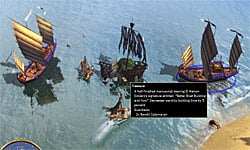
Each of the three new civilizations has its own five-mission campaign which follows a unique fictional tale that draws heavily from historical aspects of the selected Asian culture. The Japanese campaign puts players in the shoes of a general who must wage battle between his own internal struggles in the search for the truth about his adopted father and the war raging around him. In the Chinese campaign, you’ll brave both land and the high seas with the treasure fleet the Ming Dynasty seeks to expand beyond its borders. The Indian campaign will have you playing a turncoat in the British East India Company as you launch a rebellion against the foreign occupiers. Though somewhat predictable in some cases, each story is quite compelling. The campaigns are relatively short if played straight through, but you can always spend a little more time hitting all of the bonus objectives and building up your civilization.
While every other PC title in the series was developed by Ensemble Studios, the reins for this expansion were handed off to Big Huge Games – developers of Rise of Nations and Rise of Legends. Rest assured: Asian Dynasties is both consistent with and improves on the classic Age of Empires III gameplay. Two years later – and with all the quickly-evolving graphics technology – the game’s visuals just don’t hold up as well as they once did, and much of the same audio is recycled. Any doubts about whether the expansion is a good purchase so late in the game’s life cycle will quickly melt away, however, once you quickly become immersed in the cultural tales and epic conflicts while building your civilizations.
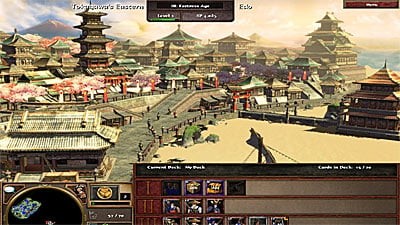
The differences between the Japanese, Chinese, and Indian civilizations is more pronounced than those in the original game. Each has its own distinct features in terms of units, buildings, and technologies, but there are some interesting differences in terms of how they play. The developers took special care to make each new civilization further stand out from one another as a unique entity, while keeping them balanced with the existing playable civilizations from the core game.
The Japanese army relies heavily on samurai warriors for strength, but the new Daimyo are an extremely powerful and versatile addition to the battlefield. They can train units anywhere on the field, making it possible to form up small armies in a flash anywhere they are needed. Daimyo also serve as home city shipment points, and can grant bonuses to the troops in their nearby vicinity. Japan civilizations cannot hunt for food, but they can gather fruits, go fishing, and erect shrines to provide meager sustenance for their armies. As a result, it’s slightly harder to amass large armies quickly.
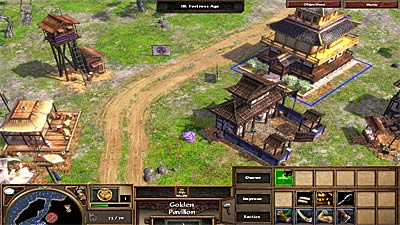
When playing as the Chinese, you’ll see another interesting twist. The majority of Combat units are trained at a single structure: the War Academy. Rather than training individuals units, players can only train groups of units at a time. These small banner armies usually consist of a few melee units in the front with ranged units in the back arranged in different combinations. Individual units from a group can be selected manually and grouped differently if you choose. The Chinese also have the highest population cap of the three new civilizations, allowing for massive numbers. Their monks have totally sweet kung-fu abilities as well.
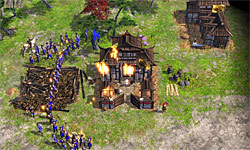
Like China, the Indians can also quickly amass large armies. Their villagers cost wood instead of food and they receive a free villager with every home city shipment. The military might of India mainly lies in its use of a variety of camels and enormous elephant-based units to crush buildings, maim infantry, and menacingly thunder across the battlefield. It’s awesome seeing them charge into an oncoming melee cluster of enemy units.
Wonders played a significant role in the first two Age of Empires games, but they were surprisingly absent in the third game. Fortunately, Big Huge Games brought them back by making them a requirement to advance your civilization to the different ages. Every civilization has a selection of its own wonders to choose from to provide advantages in economics or on the battlefield. The selection of which wonders to build plays a big part in Asian Dynasties, and in many cases it will determine which strategy you’ll have to follow. Some Wonders allows temporary cease-fires, provide combat bonus, and spawn units, while others give economic advantages or allow for unit healing. Another excellent addition in this expansion is the consulate, which gives Asian civilizations the ability to form allegiances with European civilizations for numerous advantages. In exchange for export resources, players can recruit power mercenary units or obtain foreign technologies to tip the tide of the war.
Aside from three new campaigns consisting of 15 scenarios in total, Asian Dynasties incorporates a ton of new content in the form of civ-specific units and abilities, additional maps, new cards, multi-player gameplay modes, and the wonderful return of Wonders, among other perks. It still looks about the same, it plays roughly the same, and ultimately it’s just more of the same quality Age of Empires gaming fans have come to enjoy, only with three expansive new Asian civilizations to explore.
Features:
RATING OUT OF 5 RATING DESCRIPTION 3.8 Graphics
A bit antiquated on the whole, but solid. The updated Asian-themed visual styles are a nice touch. 3.0 Control
Not a lot of improvement in terms of A.I. or other control issues from AoE III. 3.5 Music / Sound FX / Voice Acting
Fun civ-unique battlefield speech with decent voice acting. 4.5 Play Value
There’s a lot of new stuff in this package which makes it an engrossing addition to the core game. Great for new players and AoE III veterans alike. 4.0 Overall Rating – Great
Not an average. See Rating legend above for a final score breakdown.