Yes, Society is to Blame
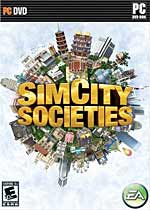
Every so often, we find a game that is a clear victim of troubled branding. The latest example is Tilted Mill’s pitiable spin-off, SimCity Societies. Here we have a game that is clearly not attempting to ape the existing games in Maxis’ famed SimCity franchise, but is still ostensibly similar, without any clear label to illuminate what makes it so different.
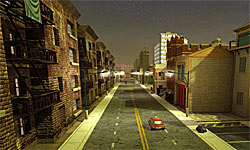
If this were some kind of Grand Theft Auto clone, EA could call it “Streets of SimCity” and people would understand. Had it been a flight simulator, it could have been “SimCity Skies” and the packaging could have made everything clear. But a quick perusal of the back of Societies’ box reveals that this is, in fact, a city building simulator, with the titular distinction being the ability to create cities according to different themed “society” types.
But all is not as it seems in the house that Will Wright built. Societies offers a take on city building that much more closely resembles the many popular amusement simulators like Roller Coaster Tycoon and Zoo Tycoon. No longer do you view the action from a distant god-like view, and no longer are you concerned with taxing your citizens, organizing large zones, or other managerial matters.
Instead, players are presented with a closer view of the action and find themselves responsible for the happiness and safety of the many little people bustling about, the familiar and lovable Sims. These Sims visit various venues to pick up their moods, they go to work when they’re feeling productive, and they’ll suffer if their needs aren’t met. A happy and productive population is the key to continued success.
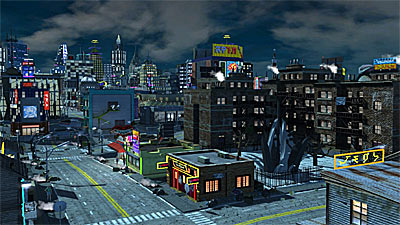
You’ll need to build your city from the ground up, placing individual buildings, and laying out road ways. Each unit you place will drain or produce a certain amount of resources from any of six categories, as well as producing money and various other effects. Different societies will rely on different primary resources, and this will affect the types of units you can build and the look of your city.
All this customization is complimented by a more intimate view of the city. There are a ton of units to choose from, and it’s possible to build some very diverse looking cities and even individual neighborhoods with their own personality and flavor. The graphics are fairly detailed with a cartoony style very much in line with The Sims, as is the audio and particularly the gibberish language that the locals speak. Unfortunately, as the cities become crowded and developed, performance becomes a major issue, even on beefier systems, and those toeing the minimum requirements may wish to approach with caution.
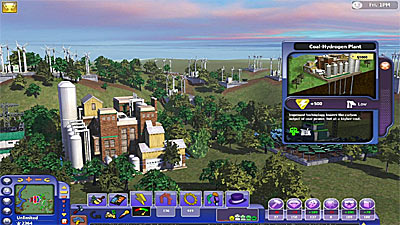
Unfortunately, maintenance is a bit too simple, and managing your city will come too easily after a little experimentation. Once you’ve scraped up a solid workforce and a steady flow of income, any deficit can be quickly overcome by throwing up a few buildings. Most of these problems will be solved instantaneously, with exception of crime, which takes a bit longer to fight.
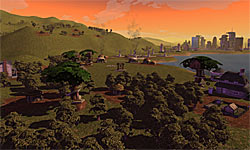
Placement is unimportant for the most part. This is probably an error in judgment on the part of the designers. If I need more Prosperity, I can build a bunch of fountains in the middle of the forest on the other side of the map, and my problem is still solved. While workplaces and venues still need to be accessible by roads, even this is largely simplified. You can pretty much throw buildings wherever you want, and as long as they exist in the right proportions, your city will function.
After a while the cities seem to run themselves, with abundant, clean energy seemingly readily available, and little micromanagement needed to keep afloat. Simply balance the books and watch the money roll in. The developers have addressed this issue in their latest patch, offering extreme new difficulty modes. These make the game far less forgiving, but they don’t complicate the experience in any meaningful way.
To help break up the monotony, Societies awards medals to players who reach certain sets of goals. For instance, there might be a medal for a city that has reached a population of over 10,000 and uses 400 of a given resource and has a given number of happy people. The way these goals are designed makes them pretty attainable by just being patient and building, and don’t really add a layer of strategy the way that missions do in some similar games.
For a game that attempts such a departure from its predecessors, it seems odd that it would be so plagued with a feeling of déjà vu. It seems that, while not what we’ve come to expect from SimCity, Societies’ influences are all too transparent. Right down to the interface, this feels a bit too much like Roller Coaster Tycoon or Theme Park, without the fun of building rides.
Ultimately, I do feel bad that SimCity Societies is cursed to go misunderstood. It is less an attempt to steer SimCity in a new direction, and more an attempt to fuse a familiar brand and city building theme with another popular, accessible kind of gameplay. Unfortunately, being misunderstood does not mean it’s a hidden gem. While it sports a well-designed interface, competent design, and likable style, Societies can get very, very dull, thanks to its low difficulty and lack of real variety. Fans of “Tycoon” games may find some entertainment value, but it lacks the addictive draw that this series has built its name on.
RATING OUT OF 5 RATING DESCRIPTION 3.0 Graphics
SimCity Societies sports a more detailed view of the city, with a cute, likable style. Unfortunately, the performance leaves something to be desired. 5.0 Control
A clean, well organized interface gives you all the information you need to keep your city up and running. If anything it works too well. 3.0 Music / Sound FX / Voice Acting
Typical Sims gibberish over the usual ambient sounds of the city. It’s about what you’d expect, but nothing special. 2.0 Play Value
A few medals are not nearly enough to break up the monotony through a single city, let alone keep you coming back for more. 3.0 Overall Rating – Fair
Not an average. See Rating legend above for a final score breakdown.
Game Features:
- – Combine and connect elements of your city like never before with the ultimate building block tool kit.
– This innovative, modular approach to city-building makes SimCity Societies accessible to players of all levels, while still providing tremendous new possibilities to veteran players of the SimCity series.
- – Mix and match societal values-productivity, prosperity, creativity, spirituality, authority, and knowledge-to determine the core attributes of your city.
– Witness the evolution of your city as its appearance and sounds adapt to reflect these values.
- – Choose from more than 500 unique objects which can be combined and connected in almost limitless combinations.
– Take inspiration from a variety of architectural styles, ranging from the realistic to the fanciful, rural to urban, industrial to futuristic.
– As your city evolves, you unlock new buildings to advance your society.
- – Modify almost everything in the game, from the names of your Sims and buildings, to building textures and statistics, and even Sim behaviors.