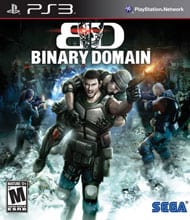
What Kind Of Leader Will You Be?
When an American audience is looking for the next shooter to cramp up their trigger fingers, they generally look to Western studios for their fix rather than to games developed in Japan. It’s not that the folks across the Pacific don’t have the smarts or the resource to produce shooters; there’s simply little demand for these types of games for consumers in the island nation. So when acclaimed Yakuza creator Toshihiro Nagoshi announced Binary Domain, a squad-based third-person shooter with a strong cover system and many influences from the Gears of War series, it definitely caught our attention. It should be interesting to see how it fares in a Western-dominated genre when it’s released this coming February, since it attempts to cater to all the big gaming nations. This may intrigue a wider audience, though, if not pulled off properly, it could simply alienate them.
There are certainly some original elements within the design of Binary Domain. The war herein is one of the more realistic of recent sci-fi offerings, taking place in Tokyo in the year 2080. Artificial intelligence has been conceived, albeit with built-in restrictions, but somewhere, somehow, these laws have been bypassed. Robots have taken control of their own destiny and individuality, seeing humans as a chaotic race that must be purged. As Sergeant Dan Marshall, you will lead your squad through the battle-worn lower sections of the city, under constant attack by robots of all sizes.

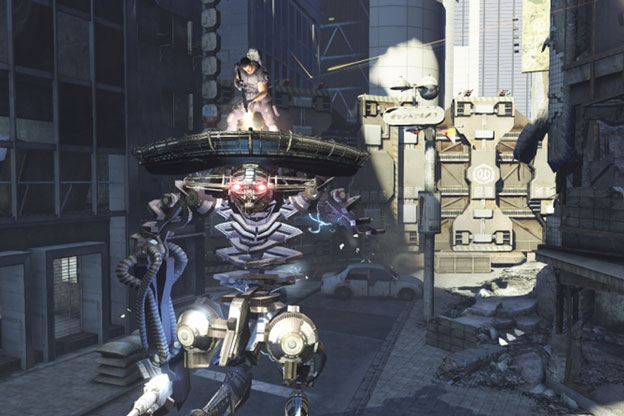
Since you’ll be battling against waves of robots, absent is the screen-splattering blood found in most shooters, but the endless shrapnel that fills the air while you’re unloading a barrage of firepower should make up for that. More interesting is how persistent the enemy is, as they will continuously encroach upon you, despite lacking a head or having lost mechanical limbs. Requiring a manic level of overkill to be certain they’ve all been dispatched shouldn’t bother fans of firepower. Taking on a battalion of man-sized machines or a three-story behemoth will require different tactics, and will yield many options for resourceful players. Understanding the strengths of your squad and exploiting them in the most effective way possible serve as the basis for two of the game’s central features.
The first of these, The Consequence System, shapes both the story and combat in a dramatic way. Inside and outside of combat, you will be making many decisions which will reflect what kind of leader you are. Do you always put the team’s safety above your own, or do you make them fodder so you can save yourself? Do you have an ear to lend and a kind shoulder when a group member is in dismay, or do you simply tell them to stop whining? Each interaction will have an effect on how your squad evolves and perceives you through the course of the campaign. They may fall back and disobey commands if you’ve given little care to their worries, or they may gladly dive into the fray if you’ve been a compassionate leader. The concept appears rather open-ended, a refreshing change of pace in the mostly linear alignment system of shooters. However, I have yet to see any tactical advantage in going down the renegade path.
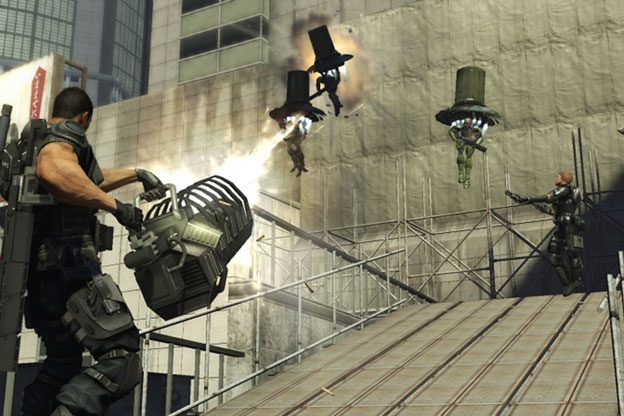
The second feature here is the voice command system, delivered to your A.I.-controlled squad via a headset. Calling the member’s name first and then issuing a simple order such as, “regroup,” “fire,” or “cover me” will have your squadmates comply in real time—that is, unless they choose to disobey you. When complete, the final version should be able to accommodate eight different languages for input, and developer Yakuza Studio is even testing the built-in microphone on the Kinect as another possibility. This is a bold move that would require absolute perfection in both the accuracy and timing of the vocal input. After all, it could be frustrating for players to issue the command for their soldiers to engage, only to have them retreat. Also, a lag of a few seconds between commands and responses could seriously break an otherwise innovative command system. Of course, as a failsafe, controller inputs are also available should you prefer a more traditional approach.
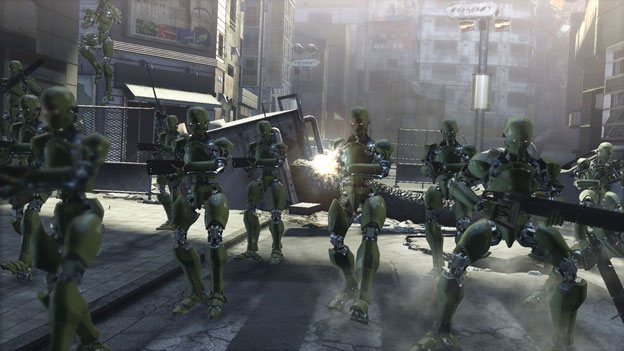
The overall aesthetic looks good in some points but outdated in others. The backdrops look well put together and certainly believable for the locale and time period, and the representation of the A.I. enemies are well formed (although very reminiscent of those in the film I, Robot ). The character models of you and your squad could use some touching up, or more accurately, some dirtying up. The textures are too smooth and the colors too clean, which makes them feel disconnected from the deteriorating city. We’ll see how they look in the final product, and whether it will be a major gripe come review time.
The shooter genre, whether it be first-person or third-person, is probably the toughest genre to stand out in. Binary Domain certainly has a tall and shear wall to scale, with its hopes to appeal to every gamer from East to West. Some features have the potential to absorb the player into the fantasy, and possibly cause other developers to rethink their future designs. However, the execution of these unique features must be absolutely flawless, on top of needing engaging combat, a gripping story, and online multiplayer that is at least on par with the current standards. If enough hype can be built before its release on February 14th, Binary Domain may be the new war everyone wants to get in on.
Game Features:
The Robot Apocalypse Has Come
The trailer for Binary Domain makes the game look a little like Blade Runner with guns. I got my hands on a playable demo at E3, and as it turns out, Binary Domain’s plot isn’t so much Blade Runner as it is “ZOMG Robots!” Still, it’s a pretty interesting third-person cover-based shooter with a few cool innovations up its sleeve.
So the robot apocalypse has come and Skynet is laughing itself silly. Essentially, mankind has built robots that have become more and more advanced until they’re eventually indistinguishable from human beings. After they develop emotions, feelings, hopes, dreams, and the other key aspects of sentience, they do what any sensible intelligent race would do: attempt to exterminate humanity. It’s up to the last few remaining humans on Earth to handle this in the most diplomatic way they can. Of course, this is an action game, so “diplomatic” means “kill them before they kill us.”
When you first start up the Binary Domain demo, it’s easy to mistake it for any other cover-based shooter. You’ll use the environment extensively throughout gameplay, ducking behind buildings, dumpsters, and sandbags in an attempt to stop the oncoming androids. However, it’s when your squad mates don’t exactly fight with your best interests in mind that you’ll start to notice the first of Binary Domains unique systems.
According to a SEGA booth rep, Binary Domain will use a “trust system” that will gauge how much your various allies trust your leadership skills. The main data this system will use will be your gameplay track record. Letting a teammate get shot will cause him to trust you less. If you protect him, he will trust you more. However, the game will also force you to make story decisions that threaten to tear your party apart. You will have no choice but to favor certain party members over others at different points in the game, making your party’s trust levels quite varied. If a comrade has high trust in you, he will listen to your commands more accurately. If he has low trust, he is more likely to go off on his own and screw up your plans. An ally with low trust might even go off and sabotage your entire survival mission. You know, just like your friends would in a real robot apocalypse.
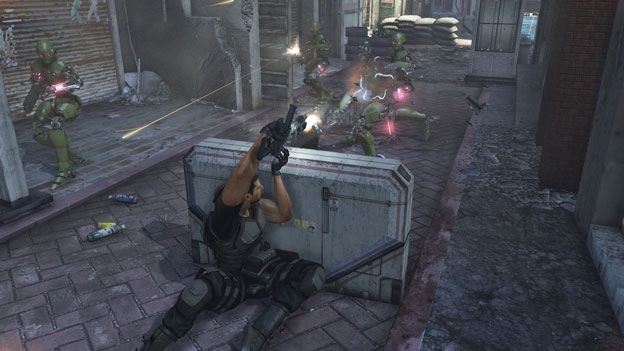
You can command your allies via the controller, or by plain spoken voice commands into a mic. Of course, none of this matters a whole lot if your allies won’t even listen to you. Even worse, this is another one of those games where allies have to help each other up when they fall in battle. If no one helps you out because you’ve been a jackass, you’ll die pretty quickly.
The next innovative system comes into play when you crouch behind a piece of cover and it suddenly crumbles around you. The game uses a “procedural damage” system both for its environments and its enemies. Nearly every piece of cover in the game, no matter how solid, is destroyable in some manner. A piece of wood will only take a few bullets before shots start getting through, for example, but a row of sandbags will take a rocket or grenade before it gets demolished. I was told that “no area in the game is truly safe” and that player will have to “constantly find new sources of cover to survive.”
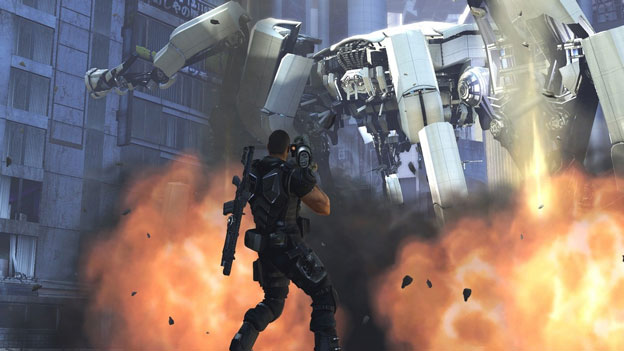
Your enemies are robots, so positional damage is going to matter quite a bit. Every robot model will have a different area where its power source is located. Unfortunately, shooting any other area doesn’t really stop a robot; it just weakens it. For example, some robots could have their head blown off and they would just keep on going. Sure, they can’t see you now because you took out their optical sensors, but they will fire randomly trying to hit anyone in the vicinity, and this might be even more dangerous. Blowing off an enemy’s leg will just make it crawl toward you with its hands, and even robots that are near fully dismembered will still attempt to get in your way in order to self-destruct.
Binary Domain is entertaining, but it’s going to have quite the battle ahead of itself since it feels a lot like the other third-person cover-based shooters out there. It’s somewhere between Vanquish and Gears of War in terms of feel, and while the real life locations (like the streets of futuristic Shibuya) work to set it apart from the pack, SEGA will really have to push the trust and procedural damage systems in order to make it look like anything other than just another third-person shooter. In short, it’s a game that could be great if done right but horrible if done wrong. We won’t know which is which until the game finally comes out.
Game Features: