Odd Man Out
In the venal world of film noir and its hard-boiled literary counterpart, few stories end happily. It’s not uncommon to see tales of hapless everymen and working schlubs that are pushed or duped into tawdry affairs, criminal scheming, and murder. Characters who aren’t willing to give up a little of their humanity for a chance at more material happiness are a rare occurrence. Even if the private eyes or cops get their man, there’s always a price. Sleuths go back to a life of loveless, alcoholic, world-weary cynicism, while police may turn a blind eye to dirty politics. This is just the way things work in a genre that deals almost exclusively with servicing the darker psychological desires inherent in humanity.
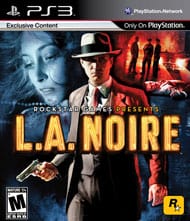
This makes Cole Phelps, L.A. Noire’s golden-boy protagonist, an unlikely hero for a noir exploration. Unlike most officers of the law, Phelps can’t be bought. He’s a hard-nosed, by-the-book cop who plays by the rules. He takes offense at his fellow LAPD officers when it is suggested (as it often is) that making a conviction stick is better than nabbing the right man. As the paragon that drives Noire’s narrative forward, Phelps is determined to make a difference in a city teeming with less-than-savory characters. He also makes this ambitious detective story a somewhat different take on noir in general. And make no mistake—Rockstar’s name may be on the cover, but what Team Bondi has created is far from GTA with more broads and snub-nosed revolvers.
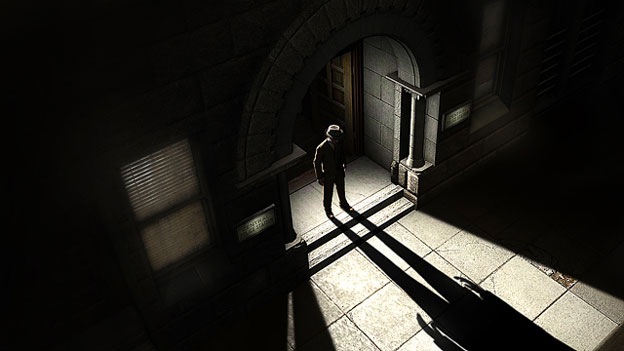
L.A. Noire isn’t an open world game either. Yes, you’re free, more or less, to explore the sprawling, golden-tinged streets of post-war Los Angeles, which Bondi has painstakingly recreated here (well, to 90 percent accuracy, anyway.) Yet the scope of the game is very linear. The narrative follows an episodic trajectory that tracks Phelps from up-and-coming beat cop to detective at various desks within the LAPD. There are, however, narrative meanders throughout the course of Noire’s (mostly) expertly-crafted script. That being said, don’t expect to get distracted by a swirling vortex of time-wasting activities to pursue when you don’t feel like investigating a case. In fact, Noire is actually much closer in design to classic point-and-click adventure games than it is a free-roaming choose-your-own-adventure. (Players looking to mug prostitutes and cause mayhem will probably want to look elsewhere.) Instead, the focus is on actual detective work, giving the game a feel not unlike that of a police procedural.
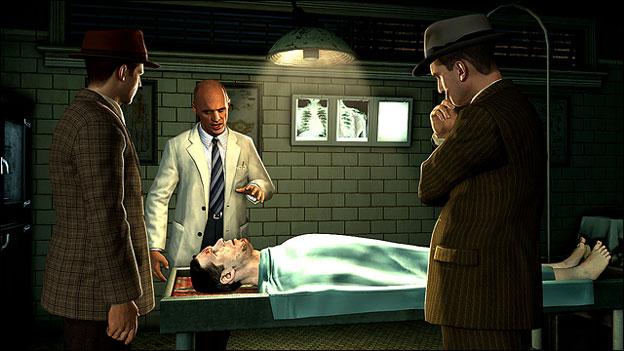
Here’s a typical gameplay scenario in L.A. Noire: Phelps and his partner are assigned a new case. This usually involves thoroughly picking a crime scene over for clues, which will either be marked as evidence or hidden around the premises. After giving an area a thorough search, the focus of the investigation turns to interviews. Are there any witnesses, suspects or people of interest? When there’s a corpse to be autopsied, does the coroner have anything to say about it? Are there neighbors to canvass? Getting a feel for any given crime scene will be crucial when it comes time to question anyone that might be able to give you leads for the case, or, as the case often is, when you need to start putting the screws to someone.
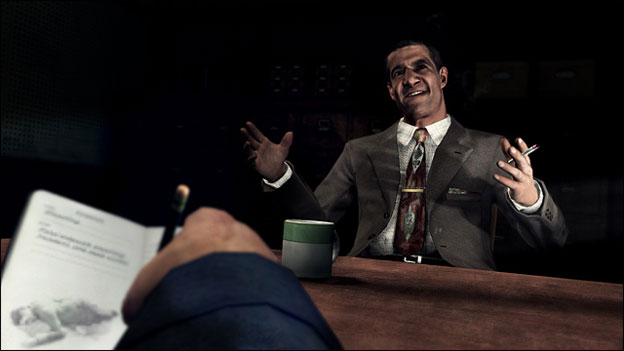
Call it a trait of the genre, but almost no one in L.A. Noire is going to be completely forthcoming with you. This is where the game’s conversational component comes in, and it’s where you’ll start to really notice how incredible Team Bondi’s design is. Using Avatar-like facial capture techniques, you’ll need to read the dart of a witness’ eye, an awkward swallow, or any nervous glance they might exhibit. Every question Phelps asks requires you to think carefully before choosing to believe someone’s words or accuse them of flat out lying. To put more pressure on you, there is a correct response to every inquiry you ask.
What’s particularly interesting about the questioning system is what happens when you screw up. Should you wrongly accuse someone of something by presenting the wrong evidence, the witness will generally become more hostile and clam up. This wouldn’t necessarily be a big deal, but, just as in real life, you only get one chance for any given questioning. When you don’t get the answers you need, it often keeps you from learning vital details about a case that you won’t find anywhere else.

A good example of this comes early on in the game, when two drugged women are put in a car with its accelerator pinned to the floor. Both women survive the attempted murder, and one of them, a Sunset Blvd-esque aging actress, clearly has some deal worked out with a movie producer involved in the case. I found it hard to read her flirtatious manner and wasn’t able to get much information out of her. When I eventually closed the file on the incident, that particular thread was never resolved—she was basically off the hook for whatever foul play she might have been involved in. Things don’t have to work this way, and to its credit, Bondi’s design forces you to start thinking like a detective. (You can also use “intuition” hints, handed out as prizes, essentially, for a good day’s work, but your allowance of these is limited.)
There are some other gameplay elements to L.A. Noire besides just the detective work. Suspects, whether guilty or not, almost always run, providing a bevy of on-foot and behind-the-wheel chases. And you’ll even get into shootouts with thugs and gangsters from time to time. Still, this isn’t an action game. Use of weaponry is entirely contextual, and you can’t pull your piece unless the story dictates it. The slow, methodical pacing here won’t appeal to everyone, though that doesn’t keep Noire from feeling fresh. Games that make you put all the puzzle pieces together yourself (I recommend you turn off the hint cues for crime scene investigation) aren’t exactly a dime a dozen these days. It’s a rewarding difference that keeps the game from being just another action game.
L.A. Noire is still not without its problems. It seems silly that just about every suspect you try to interrogate runs, even when there’s no clear link between them and whatever crime you’re investigating. If you ask questions out of order in Phelps’ notebook, continuity issues may crop up. (Sometimes things are discussed that would normally not have been brought up yet.) It can also be very difficult to know how to approach a suspect during questioning. With only the seemingly clear-cut choices of “Truth,” “Doubt,” and “Lie,” Phelps’ method isn’t always going to be easy to work with. Though you’ll get used to it over time, it would have been nicer to see a system with slightly more nuance. Noir purists may also argue that the game’s focus, which has much less of a psychological bent, may not feel as pulpy as it should.
In the game’s defense, Bondi’s depiction of the genre skews for realism and style, despite the requisite imagery, themes, and the great pulpy dialogue that’s peppered throughout the script. The tension bubbling below post-war America’s pristine and prosperous image is here in full force, though. If you’re looking for desperation, violence, unrest and depravity, it’s often etched right the faces of the witnesses you’ll be questioning throughout the game. Los Angeles is the perfect playground for all the freaks, creeps, thugs, and murderers you could want to see in a morally ambiguous game, and Noire doesn’t pull any punches with its blunt and often graphic depiction. L.A. Noire isn’t a perfect game, but it does represent a new benchmark both for realism in the medium as well as for the adventure genre. And at the very least, if it gets more people reading Raymond Chandler, I’m all for it.
RATING OUT OF 5 RATING DESCRIPTION 4.8 Graphics
Though there are minor imperfections, L.A. Noire is to be commended for its astounding facial motion capture and depiction of 1940s Los Angeles alone. This is a gorgeous game. 3.5 Control
The controls work well, although occasional contextual-in-scene actions can be a little finicky. 5.0 Music / Sound FX / Voice Acting
Hats off to the extremely talented actors and actresses who gave performances for this game. The jazz soundtrack and Chinatown-esque score are also fantastic. 4.5 Play Value
L.A. Noire caters to cerebrally-oriented players—it is a detective game, after all—but if you prefer a methodical pace, there’s a lot to love here. 4.7 Overall Rating – Must Buy
Not an average. See Rating legend below for a final score breakdown.
| Review Rating Legend | |||
|---|---|---|---|
| 0.1 – 1.9 = Avoid | 2.5 – 2.9 = Average | 3.5 – 3.9 = Good | 4.5 – 4.9 = Must Buy |
| 2.0 – 2.4 = Poor | 3.0 – 3.4 = Fair | 4.0 – 4.4 = Great | 5.0 = The Best |
Game Features: