Combat Ready?
Let’s not mince words: EA is in no uncertain terms going after Activision’s Call of Duty series with their reboot of Medal of Honor, the decade-plus strong series (historically set in WWII) that began life with the backing of Steven Spielberg.
Now that it’s 2010 and trending in the game industry has led to a preference of modern military-styled shooters over period games (Treyarch’s upcoming cold war-era CoD entry, Black Ops notwithstanding), the developers decided it was time to move on and do something new. But between the legacy of Infinity Ward’s Modern Warfare series and EA’s own Battlefield: Bad Company games, is there enough room for more post-9/11 inspired warfare? Well, that depends on how much you are interested in that setting.
Medal of Honor probably won’t be a game that holds many surprises for most players familiar with modern war-set FPSes. Much like other modern war shooters, MoH revolves around the ongoing ‘war on terror’ the U.S. and its allies have been doggedly pursuing for nearly a decade. However, unlike past titles dealing with the idea of contemporary warfare, Medal of Honor actually uses real locations and scenarios relating to post-9/11 military conflicts—in this case Afghanistan—rather than the vague, unnamed Middle Eastern locales typically seen in the past. Needless to say, this is something for which EA and Danger Close should be recognized. EA’s hardline stance about the game making you play as the Taliban (admittedly only during multiplayer) has also drawn some controversy, even leading the game to be banned on U.S. military bases. However, the commitment the developers have to MoH’s theoretically hot-button, topical subject matter is also a step in the right direction for the industry, particularly after Infinity Ward’s botched execution of Modern Warfare 2’s infamous airport scene. But after spending some time with both MoH’s single player campaign as well as multiplayer, I wonder if a real-life setting and some potentially ideologically-charged content is going to be enough.
That isn’t to say that I think MoH is shaping up to be a bad game, or even just an average one. It’s pretty clear that Danger Close have worked hard on the title, which is apparent from the quality of the gameplay. But the particulars of Iraq, Afghanistan, and the anonymous “Middle East” stand-in seen in most video games to date are probably going to be lost on most gamers, particularly CoD fanboys that just want to shoot each other in the face—which means that right out of the gate, MoH runs the risk of getting lost in the modern war-set shuffle. After all, you can only raid so many terrorist hideouts or run through so many sandy environments before you have to wonder if you’ve done this before elsewhere. Modern war shooters, at least those that loosely take notions based somewhat in our politically-charged reality, have to really do something different to stand out. Infinity Ward have proven their godlike prowess at weapons balancing and visceral gameplay; DICE, who created the game’s multiplayer, has its own Bad Company series with (sort-of) destructible environments and vehicles. MoH, following the Tier 1 operators and other military teams stationed in Afghanistan, may be much less Michael Bay than the alternate history bombast of Modern Warfare 2, but can it stand up to all the competition?
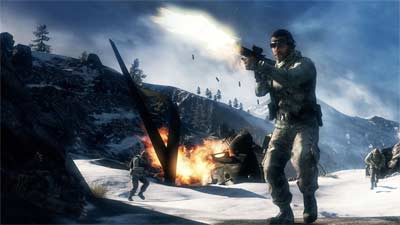
All generalizations aside, the game does have some tricks up its sleeve, though they somewhat bafflingly differ between single player and multiplayer. From a mechanics standpoint, the single-player campaign, running on the heavily modified version of the Unreal engine looks great and plays well, if a little slower than DICE’s frantic multiplayer. There are two major advantages MoH has over its rivals here: leaning kills and a slide maneuver that lets you dive for cover with ease. Peeking out to take a leaning shot from the relatively safety of cover in an FPS is nothing new, though surprisingly few console titles use it; being able to adjust your position both horizontally and vertically while, say, ducking behind a rock is a little hard to get used to at first (if you want to use iron sights while leaning, you have hold down both the left shoulder buttons) but once you do it becomes second nature to duck behind something, lean at a slant, and pop off a few well-placed shots. The mechanic may seem minor in the grand scheme of things, but its value quickly becomes apparent. The slide is just as important, particularly when sprinting between places to hide in the game’s firefights. Battles may not have the complete sense of panicked immediacy that Modern Warfare has become known for, but Danger Close has done a great job capturing the confusion and overwhelming feeling that being surrounded by a large group of armed targets that, say, hide among the sandy cliffs of the desert, making them tough to hit. Much like the vicious gun battles in Kane and Lynch 2, I often had a hard time figuring out what direction I was supposed to be running for cover, or where a hail of bullets was actually coming from—a nice dose of what I imagine would be realistic chaos that’s balanced well within the game’s linear track. Also adding to MoH’s sense of realism is the inclusion of dust, which can often obscure enemies to the point of near invisibility. It’s something so nuanced you might not even notice it, but it’s an environmental element that is largely absent from almost every other modern FPS with any kind of sandy environments.
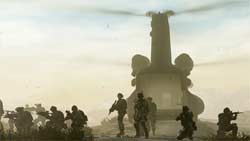
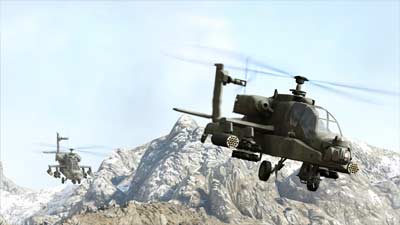
Taking another cue from Modern Warfare’s arcade elements, MoH also has sections that are relatively on-rails. During the ninety minutes or so I played of the single player campaign, two of the three levels utilized this type of design, including a long segment blowing targets up with a military chopper as well as some sniping using an extremely high-powered sniper rifle alongside Dusty, the heavily-bearded T1 operator featured on the game’s cover. Both missions played as well as the more traditional shooting segments, though how much switching off there is the full game remains to be seen.
Perhaps the oddest thing about MoH is the drastic differentiation between the single-player and multiplayer modes. Single-player looks to run at about 30 FPS and uses an engine Danger Close tweaked just for this game; multiplayer on the other hand uses DICE’s own Frostbite engine, which runs at a much faster clip and feels, well, like any other DICE multiplayer game. What puzzled me the most was that the mechanics you will likely come to rely on in single-player—the lean and slide—are both noticeably absent from MoH’s multiplayer. The faster speed compensates for this to some degree, but it’s still a kind of jarring difference that leaves the two game modes feeling like night and day. Regardless, the class-based Modern Warfare-style matches are a blast to play and have a variety of standard modes that should keep most players busy until their next FPS fix.
The jury’s still out on whether or not Medal of Honor can overcome its familiar trappings to do something truly unique, although the decision to seemingly not make a topical statement about current military dealings seems like taking a disappointingly safe approach to an ethically interesting issue. But with a more realistic storyline and pretty solid game mechanics, hopefully Danger Close and DICE can at least make an entertaining or dramatic experience, if one that probably isn’t as relevant as it could be. In any case, we’ll find out when the game launches October 12.
Game Features:
Top Tier
March 25, 2010 – Back in the days before Call of Duty: Modern Warfare rappelled it’s way to the top of the video game battle-sim pile (it’s so high up it had to find the way down to the top of the pile) there were several war games vying for the affection of virtual soldiers. The original PlayStation and the PS2 hosted some of the tightest gaming clashes as developers fought inch by inch to sink their bayonets into the consistently shifting “battle” games market. They were good times for gamers; plenty of still popular franchises like Call of Duty, Rainbow Six, and Ghost Recon made their mark with strategic and varied gameplay and tense realism. The first-person shooter genre was booming and fans had a lot of choices.
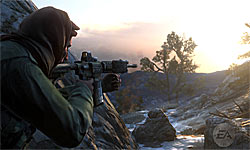
The original Medal of Honor debuted in 1999 on the PSone and gave gamers enough reason to stick with the franchise for a while despite a spotty array of games. Few games can claim the range of effective (and ineffective) games that the MoH series has and still walk away with a loyal following. Similar to the 2K games vs. EA Sports debates of the last decade of gaming (before EA gobbled up the NFL license), there was a time when Medal of Honor was comparable to Call of Duty and actually cost fans some serious gray matter when it came to picking a favorite. With the shift to the current generation there was a new class of war titles, and WWII titles lost their appeal with the advent of modern era shooters like Advanced Warfighter or Rainbow Six Vegas. The gaming public and developers took a lax attitude toward the ‘Nazi-killin’ bidness’ and franchises like Medal of Honor, which heavily or completely relied on WWII, faded into the history books.
With the success of FPS and third-person shooters set in the modern era-Army of Two, Modern Warfare, Battlefield: Bad Company-the big wigs at EA have decided to reenlist their old warhorse. It’s not hard to see where it takes some inspirations, but Medal of Honor may bring something new to fans and Modern Warfare junkies alike.
Medal of Honor is set for release this fall and early preview builds and media have been pretty sharp. Developer EA Los Angeles has shed the Axis powers and is focusing on the ‘Axis of Evil’. Curiously, though the main single-player campaign will be developed by EA Los Angeles, DICE (developers of the well-received sandbox action in Battlefield: Bad Company and Bad Company 2) will be working to develop the multiplayer. It will be interesting to see how the two developers balance their respective styles, but both have the track record to suggest some great gameplay. It’s definitely something to get excited about, but there are a lot of things to work out and there isn’t much information on either at this point.
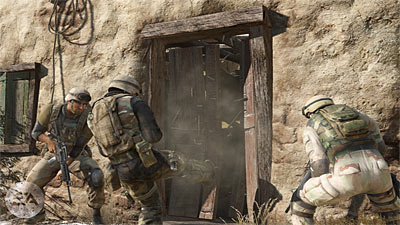
The story concerns a group of beyond-Black Ops agents who are called in to deal with situations to dangerous for even Special Forces to deal with. The members of this elite group are highly classified, respond directly to the National Command Authority, and number among the most dangerous and highly trained operatives in the world. They where no uniforms, follow their own rules, and get things done, and players will step into the GI boots of a Tier 1 operative on the ground in Afghanistan.
EA Los Angeles has worked alongside the US Armed Forces to ensure that things are as accurate as possible. Early demos and reports showcase the games heavy focus on stealth and strategic formations, but also demonstrate a big emphasis on squad effectiveness and action. Unlike games like Modern Warfare, which center themselves on dynamic (and very pretty) action set pieces, MoH might strike a balance between slow, methodical gameplay and more frenzied battles. In one type of stage, gamers may use the shadows to slink through the hills and take out enemy patrols, and in others your squad will gun down foes on the run as they chase objectives or launch fast, aggressive offensives. The design philosophy so far seems to be to keep gamers on their toes. Switching characters, communicating with commanding officers and supervisors at HQ, and varying objectives and opponents will all play some part, though it’s still unclear how they will affect the gameplay experience.
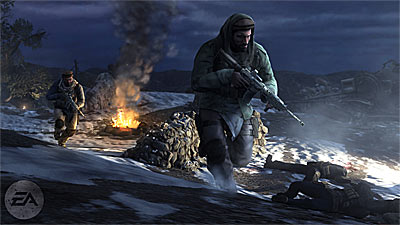
Visuals seem to take a big cue from some of the popular modern era shooters of the current-gen systems, appropriately enough, and sound design and enemy AI has impressed demo players in the past weeks. It’s been a while since Medal of Honor played in any war games, but they’re taking inspiration from all the right places. Keep an eye on this one.
Game Features: