
Dating Sim Meets Tactical Gameplay in Agarest
The dating sim role-playing hybrid is finally here! First we got Sakura Wars: So Long My Love, and now we have Record of Agarest War, a tactics game with a story shaped by interacting with your female companions, getting them to like you, and then “soul breeding” with them in order to produce the next generation’s main character.

Despite some pre-launch internet speculation, the soul breeding aspect of Agarest is not so controversial, nor is it the main course on the gameplay menu. The bulk of Agarest focuses on tactical gameplay, in which you maneuver your group of characters on the battlefield (while the enemy does the same), and then launch attacks which can be linked between characters.
On a battlefield that is otherwise streamlined (more on that later), linked attacks provide the greatest variety to gameplay. Units standing near one another’s “hot spot” can attack simultaneously, even if one character is technically outside of his or her normal range of attack. Attack Points dictate how much each character can do, and eventually, once you build up enough high-level characters, the linked attack system can turn every battle into a long free-styling session between teammates. Attacks are stacked up like ingredients, some attacks form their own powerful combos even within the overall linked framework, and it all leads up to a hot serving of DEATH.
But for all its depth, Agarest’s tactical gameplay is sorely lacking in a lot of the elements that make tactical games great in the first place. For instance, all battlefield maps are flat. Some of the greatest battles I’ve ever experienced (in games like Vandal Hearts, Final Fantasy Tactics, or Valkyria Chronicles) involved stealing the high ground from an entrenched enemy and then unleashing hell on those down below. Unfortunately, the news gets worse: battlefield maps get recycled. A lot. Rather than setting up the story in such a way that combat only commences when your team is trying to accomplish something epic, like take down a fort, or break through an ambush at a mountain pass, or kill an enemy general while waves of weaker units are harrying you, the battles of Agarest focus on random encounters that take place on flat, recycled maps. So one of RPG’s all-time most annoying features – random encounters – is employed instead of epic, story-framed tactical warfare, which is kind of the whole point of making a game tactical rather than just a traditional RPG.
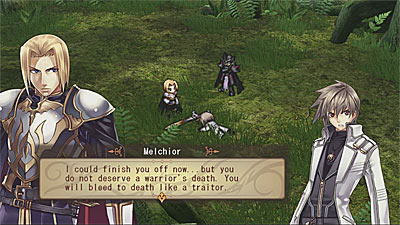
Agarest’s claim to fame, however, is the fact that it employs dating sim elements which are rarely, if ever, seen in mainstream Western games. You see, the game is divided into “generations,” each with its own protagonist and story arc. The game begins with one fairly plain protagonist; eventually some ladies join your team of heroes; through character interaction, some ladies will come to like you based on your responses; whichever lady likes you the most can undergo a process called “soul breeding,” which will then produce a new hero who carries some of the traits of both characters. (Why do I feel like I’m teaching a remedial sex education course here?)
And this is, by far, the most fun part of Agarest. All of the long, drawn-out random encounter grinds were (almost) worth it just for the opportunity to try to steer the protagonist towards one lady rather than another. This can be surprisingly tense, as you don’t actually choose which lady you want to soul breed with, per se, because you can mess up your interactions with the lady that you prefer and end up having to go with Plan B. Agarest is not unlike real life in that respect. But each generation has its own set of ladies, each with their own distinct personality, so you can’t strike out every time.
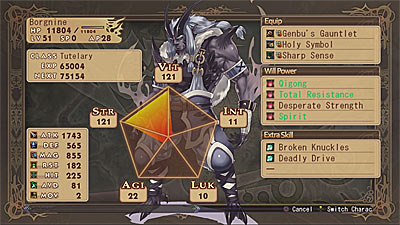
It would have been great if Agarest had been balanced with half of its focus devoted to tactical gameplay, and the other half devoted to character interaction in between large-scale battles. Unfortunately, it’s more like ninety percent random encounters, with ten percent left over for everything else. Plenty of Japanese RPGs are also balanced with the same formula, so this disappointment is nothing new. But on the other hand, are we not done level grinding yet? Is gaming culture still in love with the sacrificing of afternoons to level grinding through random encounters, rather than sticking with stories told through unique characters, and epic tactical battles that make sense because the story led up to that battle in a sensible way?
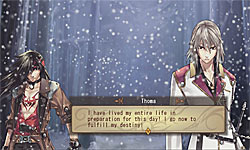
Character designs are very nice, though. Conversations play out with a large display of the speaking character (typical of dating sims, not-so-typical of standard RPGs), all of which look exceptionally cool. Even better, each subsequent generation of hero produced through “soul breeding” takes on some physical characteristics from his parent characters. So depending on which lady you end up “soul breeding” with in each generation, your new hero’s hair and armor could look completely different with each playthrough.
But when I say the character designs are exceptionally nice, I’m speaking strictly of the avatars used during conversations and within the menu system. Character design during combat is an entirely different matter. Even on my huge television set, which is practically the size of an IMAX screen, in-combat characters appeared squat and mushed, like some kind of Japanese “superdeformed” style of design often used in parodies. This sort of design choice would be fine for a PS2-era tactics game, where your characters were little more than visual markers for glorified chess pieces, but we’ve kind of gone beyond that. When battles occur on very small, simple maps, we need something nice to look at, something like characters who are taller than they are wide, or who at least look half as nice as their 2D counterparts used during dialogue sequences.
The voicework is presented exclusively in Japanese (with text in English of course), which is perfect for the purists or for those who find it distracting when English voice actors are reading off the same text that the player is also reading. Music is a mix of standard JRPG “mood setting” tracks and hair metal-meets-power metal to spice up combat. (Sorry, but the JRPG that incorporates death metal into its soundtrack is still nowhere in sight). The soundtrack sits in the background and does not make any glaring mistakes in terms of annoying the player, but it also does not particularly stand out, either. Gamers who own soundtracks by Nobuo Uematsu, or the Mass Effect soundtrack, or anything by the Minibosses, will probably not be hunting down the soundtrack to Agarest anytime soon.
RATING OUT OF 5 RATING DESCRIPTION 3.5 Graphics
Great looking 2D character designs seen during interaction. Squat and uninspired 3D characters seen during combat. Flat maps are recycled way too often. 3.5 Control
You can rotate the camera during battle. I’m still not sure how they managed to get trees to block the camera on a map that’s ninety-nine percent two-dimensional, but somehow they did. 3.3 Music / Sound FX / Voice Acting
Talented (but all-Japanese) voice work gives life to the characters. The soundtrack is appropriate, but not memorable. 3.0 Play Value
A game of insane length. Soul breeding gives infinite room for replay value, but just getting through the first time can actually take up the entire life span of a normal human. 3.3 Overall Rating – Fair
Not an average. See Rating legend above for a final score breakdown.
Game Features: