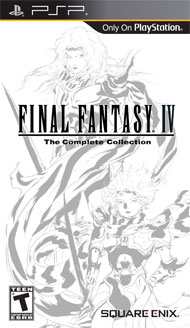
Two Generations of Final Fantasy IV
Square Enix knows that its early Final Fantasy games are very popular, and seems committed to porting the first four games to just about every platform imaginable. Originally found on the Super Nintendo, Final Fantasy IV has also appeared on the PlayStation, Game Boy Advance, Nintendo DS, and several other platforms. The After Years, a series of episodic adventures set after the end of the original game, was recently created and sold on the Wii Shop Channel as well. Now, Final Fantasy IV Complete Collection brings the GBA version to the PSP, with completely redone graphics, remixed sound, and with The After Years bundled in as well. It’s a much better deal than buying The After Years episodes individually on the Wii, but how does this FF IV version hold up?
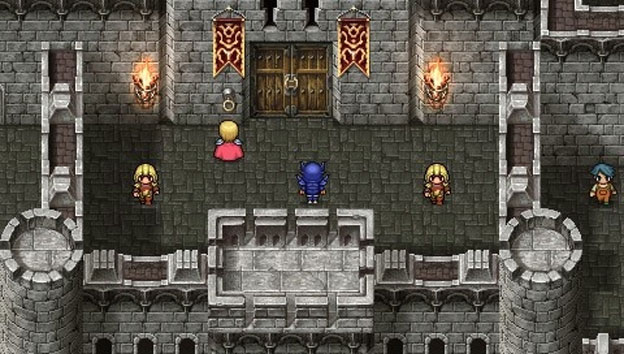
Final Fantasy IV is the story of Cecil, who begins the game as a dark knight under the service of a king who raised him like a son, but has lately become tyrannical and violent. Throughout the original adventure, Cecil, his girlfriend Rosa, and his best friend Kain must travel the world, fighting against both a mysterious enemy and the darkness within themselves. On the way, Cecil makes new friends and allies in a cast of characters that rotates in and out of the party throughout the game. It’s a story of friendship, sacrifice, and redemption, told in brief skits between spurts of exploration and dungeon crawling. Despite a distinct lack of the emotion-laden cut scenes found in modern Final Fantasy games, the story is compelling due to the varied and likeable cast of characters. The plot itself isn’t groundbreaking, but most players will find themselves wanting to see the adventure to its end for the sake of those characters. The main Final Fantasy IV story takes 15-20 hours to complete, but there is a large amount of optional content that can be used to power up the characters and extend the length of the game considerably.
The Complete Collection also contains the Final Fantasy IV Interlude, which sets the scene for the adventure to come, and The After Years, a series of adventures set seventeen years after the end of IV. It stars the cast of Final Fantasy IV, along with the children of the older cast members. The returning characters must face a familiar threat from the first game, while the next generation deals with breaking away from the protection of their parents and following their own dreams. After completing “Ceodore’s Tale,” the first After Years story, players will be able to select from a number of scenarios, playing them in any order they choose. Each scenario stars a particular character from the main Final Fantasy IV game, and once these scenarios have been completed, the final scenarios that complete The After Years storyline will be unlocked.
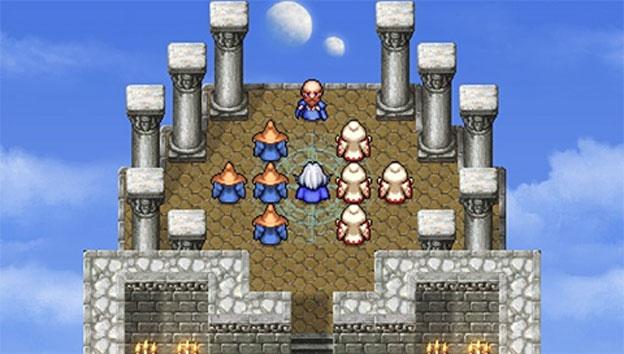
The After Years is a treat for fans of the original game, who have the chance to continue the story of the original characters and see how their lives have played out. The world has changed a bit, and while there aren’t a ton of completely new areas to explore, there are new dungeons, and many existing dungeons have been altered or added to. In later scenarios, players will start to see a better mix of new and old content. Mostly, however, The After Years is about giving players more Final Fantasy IV, from the characters to the world and the battle system.
The After Years is a treat for fans of the original game, who have the chance to continue the story of the original characters and see how their lives have played out. The world has changed a bit, and while there aren’t a ton of completely new areas to explore, there are new dungeons, and many existing dungeons have been altered or added to. In later scenarios, players will start to see a better mix of new and old content. Mostly, however, The After Years is about giving players more Final Fantasy IV, from the characters to the world and the battle system.
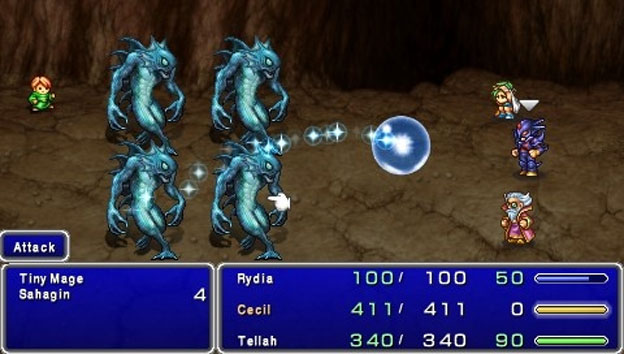
Beyond the shared basic battle system, FFIV DS made changes such as cranking up the difficulty level of the game a fair amount and adding an ability system that allowed for character customization, but was obtuse and almost required using a FAQ in order to avoid being too underpowered by the end of the game. In contrast, FFIV Complete Collection sticks with the older-style ability system from the Game Boy Advance version. Each character comes with a special ability, such as Cecil’s Cover ability that protects another party member, or Kain’s dragoon Jump attack. All special attacks and spells are learned naturally as characters level up, and there is no character customization. While it’s true that this simpler system makes melee attackers less interesting to use in battle than spellcasters, it also makes the game far less frustrating and more natural to play. There’s no need to pixel hunt or worry about missing a vital item that will be necessary for a powerful attack at the end of the game. FFIV Complete Collection has a gentler difficulty curve then the DS version as well. The game starts off almost too easy, but gradually ramps up the difficulty as it goes on, and players will still face some very nasty foes in the last few dungeons. The good news is that level grinding is rarely needed in Complete Collection, as any time there is a difficulty jump in the game, there is optional content available for leveling and gear-upgrading purposes.
As for The After Years, it adds two major gameplay elements to the system. The Band system allows two characters who share a special bond to execute a powerful combination attack. This is a neat way to expand the storyline into the gameplay itself, as characters who grow closer through their adventures are able to learn new Band attacks. The other major gameplay element is that there are four phases of the moon, which change every thirty minutes of gameplay and whenever a character rests. Every phase of the moon strengthens one aspect of combat and weakens another. For example, during the Full Moon, physical attacks (for both players and monsters) are weakened by fifty percent while black magic is strengthened by fifty percent. Unfortunately, the moon phases feel like a tacked-on annoyance rather than a tactical addition to gameplay, prompting little more than the purchase of a large number of tents so that the player can sleep past a phase that is detrimental to their party composition. Other than these additions, The After Years plays identically to Final Fantasy IV but with an extended cast of characters, as the player will be able to choose between twenty-two characters for their five-member party by the last couple scenarios.
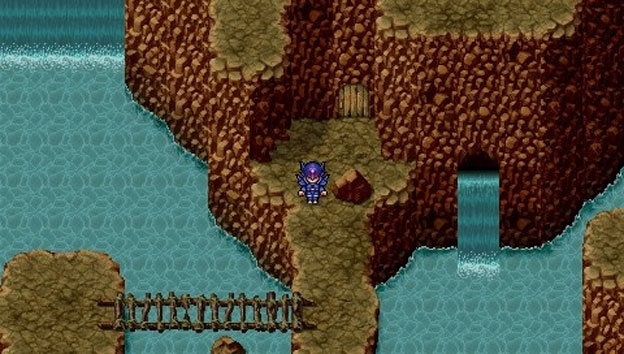
The game’s controls work fine, though movement feels better when using the D-Pad than it does with the analog stick, which can feel a bit slippery. Battle commands can be entered quickly and efficiently most of the time, though the spell lists get a bit long when the character reach a high level, and certain actions such as using a staff in battle could have used a shortcut. Running away from the game’s random battles is thankfully easy to do, because the random encounter level in the dungeons can be frustrating. Sometimes moving through a dungeon feels just right, while other times there appears to be a random encounter every other step, or even a chain of three encounters over three steps, always seeming to happen when the player is just trying to get back to a rest point. Yes, a rest point, for unfortunately the player can only save freely on the overworld map. There is no excuse these days for a portable game to lack a save-anywhere or suspend-save feature, even if it is a port of an older game.
Graphics and sound are the two areas where FFIV Complete Collection really shines. While the DS version rendered the game in blocky 3D, Complete Collection features new hi-res 2D graphics. While the game’s locations look nice enough for tileset graphics, the sprites and character artwork are the real stars of the show. The monster sprites look fabulous, and the character sprites are crisp and detailed. The character portraits that appear during dialogue also look very nice, though it would have been nice to see a few different versions of the portraits that showed the appropriate emotions on the characters’ faces. It’s especially fun to see the character portraits in The After Years, which show how the passage of time has affected the various characters. In the end, the hi-res 2D graphics are a superior way to experience the game, lending the world a great deal more authenticity, color, and character than the 3D graphics on the DS.
The sound in Final Fantasy IV is also superb, especially via headphones. The musical soundtrack features excellent, lush arrangements of traditional Final Fantasy tunes. The player can also choose to listen to the original Game Boy Advance soundtrack, but why would anybody do that when the new soundtrack sounds so good? The sound effects are also meaty, especially when the summoner Rydia brings forth one of her eidolons. The crackling of Ifrit’s flame and the earth being rent as Titan crashes through it sound real, and make the summoning sequences worthwhile. Sadly, there is no voice acting in the game at all, as some quality voiceovers could have added emotional impact to the story.
All things considered, Final Fantasy IV Complete Collection stands as the best-yet version of Final Fantasy IV. The original game’s charm and classic gameplay are preserved intact, without the addition of needless complications that were given to the game’s DS version. Even if a few of those classic gameplay elements such as the random encounter rate can be frustrating, the ATB system is genuinely fun and is flexible enough that almost any gamer can set it to a rate that’s comfortable for them. The graphics and sound are excellent, the character designs charming and effective, and The After Years provides many hours of additional story and gameplay. Anybody who enjoys classic Japanese RPGs and isn’t sick of Final Fantasy IV will be happy to play through this version, and it should absolutely be the first choice of any gamer who is looking to play Final Fantasy IV for the first time.
RATING OUT OF 5 RATING DESCRIPTION 4.0 Graphics
The graphics in FF IV Complete Collection are an example of how nice 2D games can look on today’s systems. Monster sprites and character portraits are particularly nice, giving a lot of color and personality to the game. 3.5 Control
The controls work fine, and the game’s options give the player good control over the speed of the battle system. Shortcuts for things such as using a staff to cast a spell in battle would have been appreciated. 4.0 Music / Sound FX / Voice Acting
Lovely arrangements of classic Final Fantasy tunes make up the soundtrack, which together with great sound effects (especially for the summon spells) make the game sound fabulous via headphones. There is, unfortunately, no voice acting whatsoever. 4.3 Play Value
The best-yet version of Final Fantasy IV, with The After Years providing a huge amount of additional content. A must-have for fans of classic Final Fantasy games, only weighed down by several legacy issues such as high random encounter rates and the lack of a save-anywhere or suspend feature. 4.0 Overall Rating – Great
Not an average. See Rating legend below for a final score breakdown.
| Review Rating Legend | |||
|---|---|---|---|
| 0.1 – 1.9 = Avoid | 2.5 – 2.9 = Average | 3.5 – 3.9 = Good | 4.5 – 4.9 = Must Buy |
| 2.0 – 2.4 = Poor | 3.0 – 3.4 = Fair | 4.0 – 4.4 = Great | 5.0 = The Best |
Game Features: