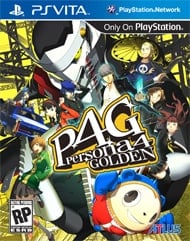
A Dose Of Personality
Originally released on the PlayStation 2 in the U.S. in December of 2008, just a year and a half after we received its predecessor, Persona 3, Shin Megami Tensei: Persona 4 seemed to strike a chord with fans and critics alike. It seems as though, while Persona 3 revived the long-dormant franchise, it was Persona 4 that really carried it into the limelight.
To date, the game has spawned an animated series and a spin-off fighter, the latter of which was also quite well-received . Now, as with all the previous entries in the Persona subseries, it has hit the Sony line of portable game consoles with Persona 4: Golden.
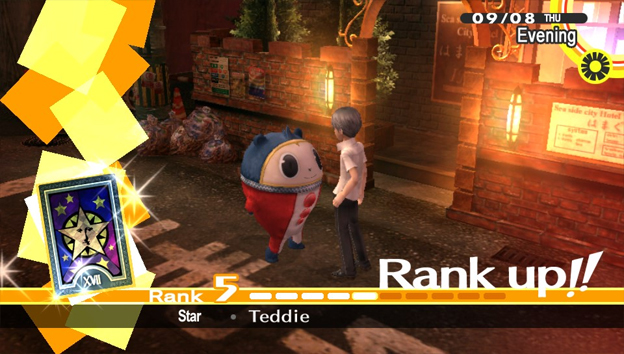
The disclaimer on this review goes that, for me, this was entirely new territory. Up until just now, I had never touched any version of Persona 4, and so any rebalancing or nuanced additions/subtractions regarding gameplay or story are going to be lost on me. There are still elements that were obviously not in the original version of the game, due to inherent limitations of the PlayStation 2’s hardware and operating system, but this seems to, by and large, be a very faithful adaptation of the console title.
It’s awesome, by the way. Just saying that flat-out. Persona 3 Portable had me worried, because I’d heard good things about that one, too, and the whole experience just seemed fairly flat and aimless to me. Persona 4, though, takes pains to get its hooks into you from the word “go,” immediately providing context that seeks to emotionally tie you to the game. Considering this is a series that, at this point, is all about your protagonist’s relationships, that structure is warmly welcomed.
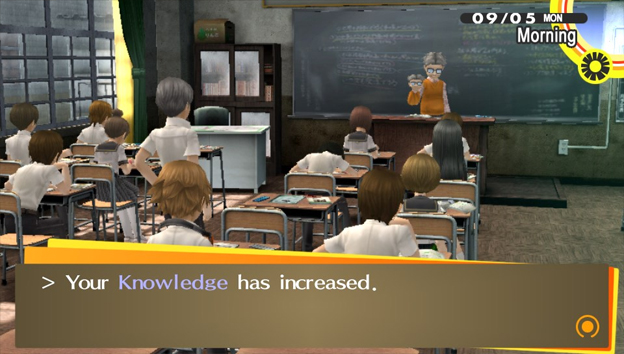
So you’re not all-alone-in-the-world this time out, having been provided with a de facto family, and while the game takes its time getting you to the actual action, the journey there feels more poignant and infuses your first combat experience with a real sense of emotion and just a hint of desperation. You get to play through a few days of school, interact with your peers (some of whom are future party members), and learn the lay of the land in rural little Yasoinaba.
In this introductory period, you’ll also glimpse the crux of the game’s plot: A series of murders that seems to be tied to the victims’ appearances on a strange, supernatural channel that appears at midnight on rainy nights, should one gaze into an unplugged TV. This mystery—and its impact on the characters at your high school—is what drives you forward and keeps the game moving. Contrast this with Persona 3, in which the protagonists begin the game effectively exploring a dungeon because it’s there—the Apathy syndrome that drove that game’s plot a less urgent device than a series of grisly murders—and Persona 4 comes out leaps and bounds more engaging. You’ll enter dungeons because there are people’s lives at stake, people to whom the game has introduced you and whom you want to save.
The dungeon-crawling is enjoyable, yes, but it’s truly telling how incredible this game is that the time spent between dungeons is perhaps its more compelling element. When the hero and his friends aren’t going toe-to-toe with enemies in epic battles, the game draws more from Japanese dating simulations. You go through every day in the life of your protagonist, each of which is separated into a morning, afternoon, and evening period. The morning is typically taken over by school, and the evening reserved for studying, work, or watching the Midnight Channel, which leaves the afternoon on most days for strengthening one’s “social links.”
Social links are representative of the meaningful relationships you have with characters or organizations, and they allow you to gain bonus experience when you create a Persona that falls under their Arcana (it all makes sense in context, I swear). They can also have other benefits, affecting how your party members perform in combat or providing a means to heal oneself in dungeons. One of the biggest changes in Persona 4: Golden is the addition of a pair of new social links; having not played the original, I can only confirm that they are well-integrated into this edition of the game and help flesh out the characters on whom they focus.
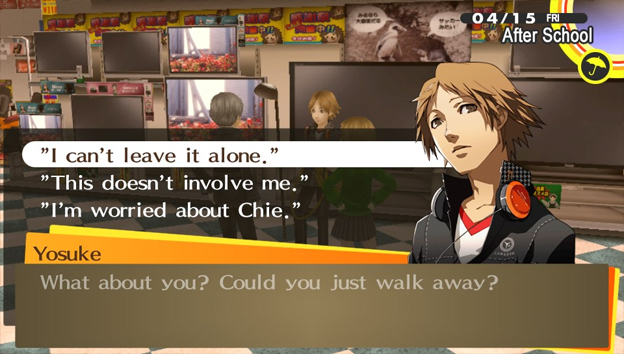
This is because social links are advanced by spending time and doing activities with the people and groups these links represent. Through this, you learn more and more about your character’s friends and loved ones, what they care about and what they fear. Who you spend time with and when is just one of many choices the game hits you with.
In fact, Persona 4 is the opposite of most JRPGs: It’s all about choice. While time does move irrevocably onward, and there are events that you’ll have to wait for to advance the plot (as well as deadlines by which certain plot-critical acts must be completed), how you spend your days and when you tackle the game’s dungeons are largely up to you. It’s not complete autonomy, but the game does an excellent job of making it feel as though you’re really in control. Dialogue options crop up during conversations, allowing you to flavor your relationships a bit and, sometimes, make more significant decisions (the game has multiple endings).
Besides that, housebound activities include studying, reading a book, or tending to the family’s garden (another addition to the Vita version of the game). There are part-time jobs one can take, which earn you precious money all while developing the traits that govern what jobs/quests are available to you and, sometimes, which dialogue options you can choose.
Choice extends to the combat system as well. Unlike his party members, the protagonist is not locked into a single Persona, but capable of holding a stock of them which he switches between on the fly (during combat, this is limited to a once-per-turn option). These Persona can be collected in a post-combat card shuffle or created by fusing multiple existing Personas together (the new Persona inherits some of the abilities from those used to create it and gains an experience boost at creation based on the level of its associated social link). Since combat is heavily based around targeting enemies’ elemental weaknesses, this is a tremendous boon. Further, one’s party members can either be issued direct commands or, as is the default, assigned a general tactic, which they tend to interpret in a surprisingly effective manner. I found that I enjoyed leaving them to their own devices more than micromanaging every turn.
More impressive than the sheer amount of choice in Persona 4: Golden, though, is how well it manages to defuse the tension of any one decision. This is largely due to the fact that Persona 4 rarely makes you feel as though you’ve in any manner wasted your time. As long as you choose to do something on a given day, the game generally offers some small reward or sense of progress. More to the point, it doesn’t overtly punish you for your choices, which goes a long way toward preserving the illusion of freedom. I found myself constantly crafting new Personas out of old ones, engaging with the characters who most interested me in the order I so desired, and taking breaks from dungeon-crawling to study or read in my character’s room.
Visually, too, variety is the name of the game. Each dungeon has a distinct appearance and, while Inaba and its surroundings are fairly static throughout the game, they have a rustic appeal that cannot be denied. The game is very good about gradually opening up the world in a way that allows you to acclimate to new locales rather than being overwhelmed by the variety. The Personas all have vibrant designs, as do most of the enemies; there are re-colors of existing foes in subsequent dungeons, but the designs are very good overall, particularly for the boss monsters. All of this is carried through with excellent visual fidelity; though it was originally a PlayStation 2 game, this stands up to anything else in the Vita’s library.
Further, while the game isn’t easy (I was playing on the Normal difficulty), its challenge level rarely feels unfair. Foes generally have an exploitable weakness, which makes combat more of a puzzle than anything else and, while bosses will usually push you, it’s possible to take down most on the first try with careful play and a well-rested party. Should you fall in battle, though, the game will offer to let you retry from the beginning of whatever floor of the dungeon you were just on. It can mean losing almost an entire floor’s worth of progress, but that’s still far preferable to trudging from your last save up through the hour you just played. Worth noting: Teleporting back to the entrance of a dungeon sets a return point back at where you just teleported from, which is another incredibly convenient touch.

Compelling characters (all of whom are terrifically voice-acted), a superb translation full of quirky humor, and a soundtrack to die for (the music in this game is incredibly catchy) round out the core game. The writing, in particular, stands out for how contemporary it feels, all while having that flavor of the unfamiliar provided by the game’s unabashedly Japanese setting. This is modern Japan, though, and so the cultural differences are in stark relief against the Western-style clothing most of the characters wear and the ubiquity within the game’s world of modern technology and at least the simulacrum of pop culture. This necessitates an incredibly idiosyncratic approach to both the base writing and the translation, which does an excellent job of feeling relatable and yet vaguely foreign.
Regarding Vita-specific features, the most interesting are by far those brought about by its Internet connectivity. It’s possible to, at most times, see what the most popular actions other players took were on a given day. If in a dungeon, you can shoot out an SOS signal or respond to someone else’s, which can provide a slight boost to players’ HP and SP reserves. The latter is nothing major, but the former is a very cool addition to the game, since it provides greater context for new players, and perhaps illuminates options of which they would otherwise remain unaware. Also, there are trophies, because PlayStation Network.
I know I’ve been gushing throughout this review, but I really have almost no criticism for Persona 4: Golden. It is an attractive, aural treat with a world and characters that ooze personality, a combat system that manages to be challenging in a rewarding manner, and a compelling storyline that ties everything together. Every time I put it down, I almost immediately wanted to pick it up again and play some more. Most telling, perhaps, is that I would spend the dungeons looking forward to furthering my social links and my time in Inaba craving the game’s combat. It’s very different from the JRPGs that have preceded it (and those that have come since), but it’s optimally what I think of when I consider a JRPG. I’m only sorry that I waited this long to play it.
RATING OUT OF 5 RATING DESCRIPTION 4.5 Graphics
The designs are exquisite and, while its roots as a PS2 game show, the experience holds up as a whole and definitely looks like something that belongs on the Vita. 4.5 Control
There are literally no complaints here; the interface make sense, providing both an intuitive and accessible means by which to manage one’s party whether in or out of combat. 5.0 Music / Sound FX / Voice Acting
The sound quality is as good as you could hope, which is important since the soundtrack is stellar and the voices are all well-cast. Kanji, in particular, has an incredible actor behind him. 5.0 Play Value
This is a massive game, even on the first playthrough, and it warrants multiples since there are so many different social links to explore, side-quests to do, and even multiple endings to see. 5.0 Overall Rating – The Best
Not an average. See Rating legend below for a final score breakdown.
| Review Rating Legend | |||
|---|---|---|---|
| 0.1 – 1.9 = Avoid | 2.5 – 2.9 = Average | 3.5 – 3.9 = Good | 4.5 – 4.9 = Must Buy |
| 2.0 – 2.4 = Poor | 3.0 – 3.4 = Fair | 4.0 – 4.4 = Great | 5.0 = The Best |
Game Features: