It’s may take a long time to simmer, but Grandia III is a tasty recipe once you sample its flavors. by Colin Thames
February 17, 2006 – It’s been a number of years since the last Grandia game, but the wait is over for fans now that Grandia III has been launched. The series was never particularly innovative, it was just a lot of fun, so you can expect more of the same. A lot of RPGs have been released during the interim which makes Grandia III seem even less original. Thankfully it still has its charming characters and manages to dish out the action.
The story is convoluted and can be distilled to the basic save-the-world premise that is standard RPG fare. Yuki is a young and adventurous sort that aspires to be like his hero, Sky Captain Schmidt. Yuki has designed and built many flying contraptions, all of which have been failures – until now. Determined to fly off his little island in search of big adventure on the mainland, he takes off into the wild blue yonder on his newly built plane, unaware that his mother is stowed away onboard. While in flight, Yuki spots a girl being assailed. Being the good guy that he is, he decides to stop and help her while at the same time his plane is forced into a crash landing due to the extra weight of his mother.
Alphina is the name of the rescued girl. She’s the one of the last of the lines of Communicator, which enables her to communicate with the Guardians. Alphina’s brother is also a Communicator but he’s turned greedy and evil as he is intent on killing the Guardians in an effort to take over the world. Yuki joins Alphina in a quest to stop her brother and his minions from realizing their evil conquest.
I told you the story was a little on the cliched side. Fortunately you get most of it over with at the beginning and the characters become more fleshed-out through dialog, cutscenes and in-game action. You will meet lots of new characters, some of which become members of your party but you won’t have to learn the back history to every NPC you run into. The voiceover work is good but some of the dialog is a bit on the cornball side. The characters discuss a variety of subjects, most of which have nothing to do with the storyline or gameplay. But these conversations give us insight into the characters’ personalities. Frankly this could have been accomplished with a 30-second cutscene on each of the main characters. There’s just so much superficial filler that you’ll begin to yell at the game to “Get on with it already.”
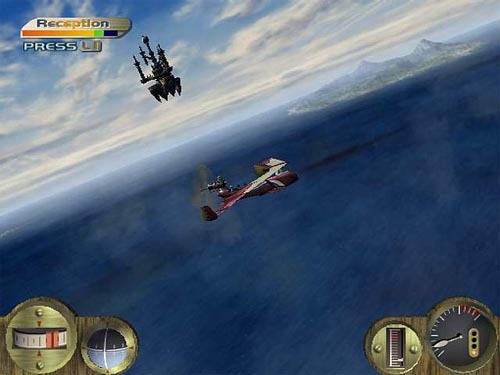
There are lots of interesting places to explore such as enchanted forests, castles, ruins and villages. The maps are huge and encourage exploring with an open-ended style of gameplay. You can explore a lot of places on foot but when it comes to extended travelling there’s nothing like taking to the skies in a plane. Flying the plane is an enjoyable and quick way to get around. It links you to four continents as you fly over fields, ocean, rivers, mountains and deserts.
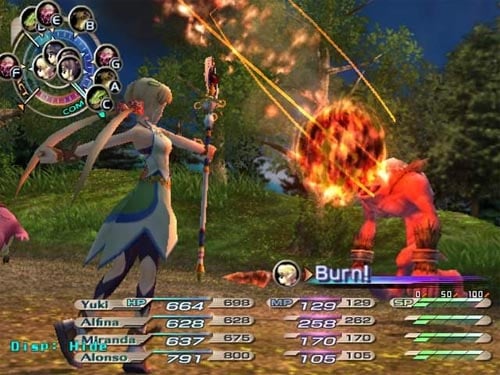
An IP gauge lets you see where enemies are and lets you avoid them if you don’t want to get into battles – but battles is what the Grandia series is famous for. Beginners may become a little perplexed at what seems to be a complicated battle system but these rules are just in place to make it more engaging. The system is dynamic which places it somewhere between a turn-based and real-time battle system.
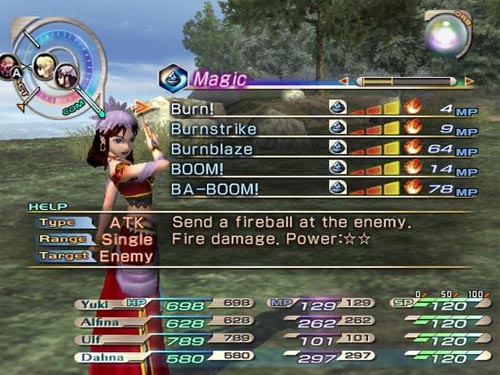
When nearing enemies the IP gauge will become active offering you three cyclical phases to help you stage and execute your battle. The IP gauge moves like a clock giving each character a certain amount of time for his or her turn. Their likeness is imposed on the wheel of the gauge as an icon, and they travel around the wheel as they enter into the three different phases. Interface commands are made fast and furiously since timing is of the essence. Issuing commands at the right time can help delay your opponent’s attacks and even cancel them altogether.
The command entry phase lets you determine and input your method of attack or defense. The execution phase takes place when your icon circles into that range. Here your commands are issued and the real fighting begins. The other zone is a waiting period where your character is in a holding pattern until you cycle back into the command entry phase again.
Choosing the right commands takes some forethought which brings some strategy into the game. You will be able to cast magical spells, issue special attacks and put your skills and weapons to the test. You will get bonuses for aerial maneuvers and also if you make it through the battle without taking any damage. You can continue to level-up your character so that each fight is different. Mana Eggs can be collected and used to beef up any of the four different magic classes. They can also be turned into rare and powerful spells. Spell books increase three main skill areas such as counter-attack speed and a reduced intake of MP. Armor and weapons are also upgradeable and the special moves that are unique to each character are preserved to maintain each character’s individuality. If these new traits are not enough to hold your interest you can have the CPU do your fighting for you. It works pretty well but it only does the bare minimum. If you want to get the bonuses you’ll have to take matters into your own hand.
As large as these maps are, the graphics never disappoint. Textures are realistic and the poly count is high, giving us incredibly detailed and diverse environments to explore. Even the homes that you pass by in the villages are incredibly detailed as you can see the wood grain on the beams. The character models, both the heroes and the monsters are brought to life with equal aplomb. They display appropriate facial expressions and animate with incredible smoothness. The music isn’t memorable but it also doesn’t irritate so I’m not complaining.
Come to think about it there isn’t much to complain about at all. Grandia III takes the basic RPG ingredients and cooks up a great, solid RPG that is guaranteed to satisfy millions of hungry RPG fans worldwide.

Features
- Romp through vibrant and colorful fantasy locales and natural environments
- Stunning cinematic sequences are animated by hand without the use of motion capture
- Scan surroundings to look for search points or treasure chests
- Ply the skies by plane to journey from one place to another
- Use your sword in the “random encounter free” field to destroy objects or stun enemies before attacking
- Seamless transition from field screen to battles with over-the-top animations
- Semi real-time battle system allows for fast paced action and strategizing with a Command Wheel that breaks the RPG mold of typical command text windows
- Perform and link up Aerial Combo attacks for massive damage
- Multiple auto-battle settings for each character dictate fighting strategy in addition, utilize the Strategy Advice System for tips during critical moments in battle
- Control conversation flow during special event scenes
By Colin Thames
CCC Freelance Writer