|
 With so many modes, option adjustments and improved graphics and animation, there’s not much more that you can ask of MVP Baseball 2005. With so many modes, option adjustments and improved graphics and animation, there’s not much more that you can ask of MVP Baseball 2005.
It’s sometimes easy to overlook the meat of the game as it can sometimes be overshadowed by the condiments. At the core of MVP 2005 is a solid baseball game with lots of control and depth. If this isn’t the best baseball videogame to date I will eat my baseball hat – and I say that without even including all of the extra modes and micromanagement.
Micromanagement has got to be my least favorite feature in any game. The Owners mode is where you’re going to take care of this business. It rivals an economic sim in its scope. You don’t even have to worry about playing games in this mode. You can have the results of a game in the push of a single button. You can even automate an entire season if you find yourself engrossed in the mode.
You’ll have some 30 years to turn your team into a multi-million dollar enterprise as you buy, sell and trade players to get the best team you can. This may sound a lot like a Franchise mode but you’re also responsible for hiring coaches, GMs, building a ballpark, positioning the bleachers, setting the ticket prices and selling team-related merchandise. During all of this you have to keep the players and the fans happy. As in last year’s game you will receive emails that will keep you informed of players’ stats, injuries and suspensions.
Playing ball was never so personal. With an incredible amount of slider options you can customize the gameplay to accommodate any style of player. You can go from arcade to sim and all points in between. Features that you can adjust include the batting power, the accuracy of throws, the speed of runners, the speed of infielders, the chemistry of the team and the frequency of injuries to name but a few.
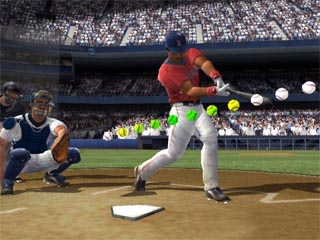
 Even with all this level of customizing, player will still earn points to upgrade their stats and ultimately their skills which will give them certain advantages. One of those advantages is a new feature called Hitter’s Eye. The ball will change to one of three colors when in flight. Each color represents a particular style of pitch allowing you to read the pitch and adjust your swing before it enters the strike zone. Better players will see the colors longer. Players with less stats will just get a glimpse. Red means that it’s a breaking ball, white means it’s a fast ball and green signifies a change up. Even with all this level of customizing, player will still earn points to upgrade their stats and ultimately their skills which will give them certain advantages. One of those advantages is a new feature called Hitter’s Eye. The ball will change to one of three colors when in flight. Each color represents a particular style of pitch allowing you to read the pitch and adjust your swing before it enters the strike zone. Better players will see the colors longer. Players with less stats will just get a glimpse. Red means that it’s a breaking ball, white means it’s a fast ball and green signifies a change up.
The sliding pitch scale is back but it’s improved to be more dynamic and realistic. This time the sweet spot doesn’t remain constant. It will decrease if the pitcher puts some muscle or spin into the pitch making the ball much more challenging to hit. Fatigue and moral will also affect players’ performances. Moral can be influenced by winning or losing a series of games. It can also be affected when the manager leaves the dugout to argue with the umpire. A meter gauges the intensity of the argument. If you put on a good show the team’s moral will be boosted but you run the risk of getting thrown off the field altogether and having the CPU manage your team which will send moral in a downward spiral.
Batting and pitching mini games can be used for training, gaining stats or just for the fun of it. In the batting games you will learn how to make the best of each pitch as the strike area will be highlighted and arrows will indicate the best places to hit the ball. The pitching game requires you to knock out squares on a grid by using any of four pitching styles. Not only will you get points to increase your players’ stats but you’ll learn how to throw more accurately as well as pick up a few tricks to fool the batters.
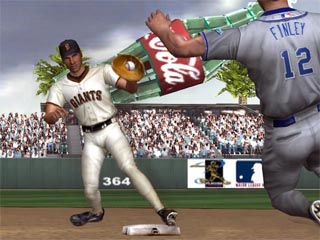
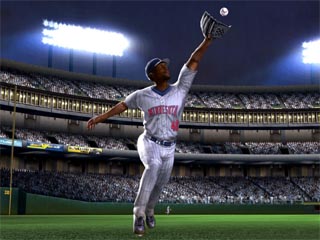
You may recall that the faces of the players left a lot to be desired in last year’s game. That’s all fixed now. Not only do the player look like who they are supposed to look like but the animations for batting, pitching, running, catching and tagging are much more fluid. These new animations make the game seem more connected rather than a series of triggered events. There’s a lot more close-ups of the players as they interact with the ball. The camera pulls away at just the right moment to give you an overview of the field when you have to make a decision as to where to run or where to throw. The crowd’s reaction is always appropriate but when you look at them individually it looks as though Wal-Mart had a sale on white T-shirts. Am I being picky? I suppose, but this game is so tightly developed I can’t seem to grab onto any loose seams.
 I could do without the generic-sounding tunes from bands that I’ve never heard of and will likely never hear from again. The announcers are great. They comment on the action like they’re really at the game complete with the occasional fact or players’ stat. They don’t repeat sayings because they eventually disappear. The fact is that you don’t even miss them after a while. It’s better than listening to them say the same things over and over again. Too bad the music doesn’t disappear altogether. I could do without the generic-sounding tunes from bands that I’ve never heard of and will likely never hear from again. The announcers are great. They comment on the action like they’re really at the game complete with the occasional fact or players’ stat. They don’t repeat sayings because they eventually disappear. The fact is that you don’t even miss them after a while. It’s better than listening to them say the same things over and over again. Too bad the music doesn’t disappear altogether.
This may be the last we see of the MVP series for a number of years at least. It’s only fitting that the series should end with a homerun.
|