Don’t Miss This The Second
Time Around
The Megami Tensei series (known as MegaTen by its fans) has been around for a long time. Megami Tensei (literally translated as “Reincarnation of the Goddess”) started in book form during the ’80s. Written by Aya Nishitani, the books focused on tapping into the world of demons through computers and held the subtitle “Digital Devil Story.” Starting on the MSX, a series of games were created, and by the turn of the 16-bit era the word “Shin” was added to the front of the familiar phrase, changing the full title to mean “Reincarnation of the True Goddess.”
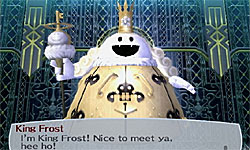
The series evolved over time, experimenting with different gaming mechanics and aesthetics. For the Megami Tensei series, the continuity thread has had less to do with specific characters and more to do with the play between two worlds – one, a shadow world inhabited by demons, and the other a depiction of modern Japan. The Persona offshoot of the series has its own ingredient list: take one part demons, another part high school simulator, and mix them together.
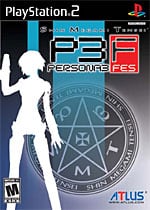
Persona 3 FES is made up of two parts: “The Journey” and “The Answer.” The former is a retelling of last year’s Persona 3 (with a few tweaks), and the latter is an entirely new chapter focusing on later events. In The Journey you are put in the role of a transfer student at Gekkoukan High. You quickly discover that at midnight the “Dark Hour” occurs – citizens become coffins and shadows flood out of Tartarus (a transformed version of the school) to cause trouble. A select group of students seem to be immune to the effects of this magical hour, and you just happen to be one of them. Quick to recruit, this group inducts you into the Specialized Extracurricular Execution Squad (SEES). Your job? Help them exterminate shadows during the Dark Hour.
In order to fight the shadows, personas are needed. The game describes them as “manifestations of psyche,” and they resemble mythical creatures. The more sensational aspect is how you summon them. Using a tool called an evoker (a magical gun), characters shoot themselves in the head to release these allies. Sure, it’s a little over-the-top, but not nearly as graphic as it sounds. Once summoned, personas can perform special abilities and help turn the tide of battle.
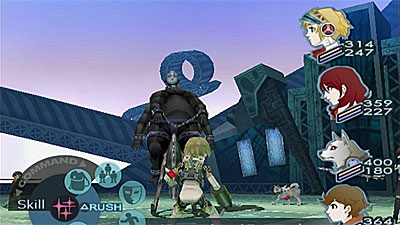
When the Dark Hour occurs, you have the option of venturing to Tartarus with your SEES partners. With your party assembled, you explore the randomly generated dungeon one floor at a time from an isometric perspective. No need to worry about random battles. Shadows appear on the screen, and you can attack them to gain an advantage at the start of a battle or try to hoof it past them. Since the dungeon is randomly generated each time, enemies, staircases, and loot locations are always different. To help with the massive scale of the dungeon, random checkpoints are placed around that allow you to return to the start; there are also warp points every couple of levels that allow you ascend or descend Tartarus quickly.
Battles are a unique affair. Instead of placing you in control of the entire party, the game only offers you complete control over the main character. All the other SEES members are A.I. controlled, and the most you can do is change their battle tactics. This lack of complete control might turn off some players, but since it is paired with decent A.I. it doesn’t end up being a deal breaker. Sure, you can dish out normal melee-based attacks, but the game is about the personas and using them effectively against your enemies. This mechanic plays out in an exploitation system – fire works well against ice-based foes, ice against fire, etc. The only problem with it is the naming conventions and your huge stockpile of personas. For example, a fire-based attack is not called “fire” or “flame” but rather “agi.” Pair that with the fact that spells are tied to specific personas and you can only summon one persona per turn, and it quickly becomes apparent you might need to keep a pencil and paper handy.
After certain battles, you’re presented with a reward in the form of a tarot card shuffle. The reward always correlates to the type of card you select: some reward you with money, others increase experience, some heal party members; you can even earn new weapons. But the biggest draw of the shuffle is the chance to net new personas. Once the persona card is selected, the particular creature is added to your database and you can access their default skills right away. You also have the option of taking personas to the Velvet Room and merging them together in two combinations: normal and triangle. Normal represents merging two personas together; triangle means a combo of three. Merging is essential as it creates new personas to add to your arsenal.
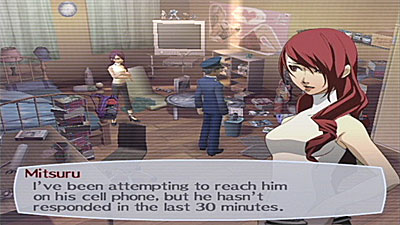
Aside from the dungeon crawling during the Dark Hour, there’s the other half of the game: a Japanese high school simulator. At first this seems like a not-so-enticing offer, but it helps break up the level grinding and there are plenty of incentives to interact with other characters. Since the time in each day is limited, your social choices matter. Will you attend Student Council or track practice? How about going to the mall to eat ramen with your friend as he talks about his taste in older women? Each of these affects your Social Link, which in turn levels up aspects of your various personas. One complaint can be leveled against these activities: they’re all merely a series of text boxes and nothing more. Going to track practice doesn’t start a fun mini-game, but rather you just talk to a friend for a few minutes and your social link increases.
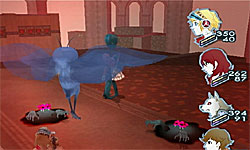
Set immediately after events in the first game, The Answer finds members of SEES in a peculiar situation: the date is stuck on March 31, and they can’t escape their dorm. They quickly discover a desert of doors beneath their dwelling that connect to particular dungeons. This quest is on a harder default difficulty, and to help, Atlus starts new players on a default level of 25. If you have a save file from Persona 3 you can transfer stats over. Aside from the difficulty (it’s pretty rough – you will die during random battles), there are two complaints.
One is the omission of the high school aspect. The Answer is purely a dungeon crawler, and while it will satisfy those who like the Pokemon-style collecting of Personas, it may strike others as too much grinding and not enough socializing. Also, the new main character uses a gun to target shadows before battle, and this can be flaky, resulting in lots of missed opportunities to get the jump on enemies. But amidst these problems there is the bonus of an enhanced tarot card shuffle system. You’ll occasionally be given the opportunity to double up, which means you can select two cards instead of one. You may come away from a battle with two new personas or one persona and a new weapon.
As a whole, the game is more about style and slick presentation in the audiovisual department. While the in-game character models and environments aren’t highly detailed, they are extremely clean and well-done. Where Atlus shines is where it always does: in the 2D art department. The anime-inspired cutscenes are top notch, and the character artwork has a great manga flare. Audio, on the other hand, is a more difficult case. The voice acting is actually quite well done, but the soundtrack is a bit of a dilemma. Vocal numbers are mainly pop oriented and can get repetitive rather quickly. However, the instrumental work has been given more thought, and its delicate nature matches the tone of the game much better.
So, here’s the big question: if you haven’t played Persona 3, should you pick up FES? The original game carries a higher price tag, but comes with an art book and soundtrack. However, Atlus tends to release games in very limited numbers, so chances are you’d have to pick up a used copy. Persona 3 FES lacks the memorabilia, but packs more in-game content at a cheaper price. The newer version offers a chance for Atlus to recruit new MegaTen fans and should be enticing enough even for those that picked up Persona 3 last year.
RATING OUT OF 5 RATING DESCRIPTION 3.5 Graphics
While it’s easy to harp on the lack of detail in the 3D models, the game sports a compelling (if a little bit emo) aesthetic in the 2D department. 4.5 Control
Aside from occasional issues with targeting enemies before battles, the control set is simplified and dependable. 3.7 Music / Sound FX / Voice Acting
Here’s a rare one: a JRPG with decent voice acting. The music suffers from a split – vocal numbers are repetitive and made up of traditional j-pop and hip-hop fare; the instrumental numbers – arrangements of mostly piano and strings – are eerily beautiful. 4.8 Play Value
As if the original incarnation of Persona 3 didn’t offer enough content, Atlus has added hours more of dungeon crawling and new features. Rarely will your gaming dollar go this far. 4.1 Overall Rating – Great
Not an average. See Rating legend above for a final score breakdown.
Game Features:
The image featured at the top of this post is ©Atlus