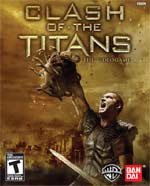
Titanic Time Waster
When going into a game based on a movie license, one generally knows what to expect. Despite the often-hurried developer’s best intentions, the end product is typically a sloppy, repetitive, and second rate (or lower) experience. Only when a licensed game is true to its source material, looks good, and plays well is anyone actually surprised. Unfortunately, there is nothing surprising about Clash of the Titans.
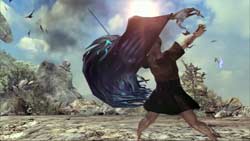
The game puts you into the role of Perseus, the human son of Zeus. Tensions are high between the gods and humanity, with many folks trying to break away from the gods-worshiping days of the past. Despite their devotion to the old ways, Perseus’ adopted family and village are destroyed by Hades. With a newfound hatred of the gods, Perseus is tasked with helping humanity survive their attempt at breaking away from the gods who seemingly care so little about them.
In many ways, Clash of the Titans is essentially a poor man’s God of War. The two clearly share a similar backdrop full of gods and mythology and are both hack-and-slash action games. They also both involve playing as a man seeking vengeance for the wrongdoing of the selfish gods. However, while describing Clash of the Titans as a poor man’s God of War may be somewhat accurate, I believe it to be insulting to both God of War and poor men everywhere. In fact, a far more accurate way to describe almost every inch of this game is awkward and poorly done.
When a game has as many problems as this one, it can be difficult to know where to start. I suppose the overly complicated and unsatisfying combat is as good a place as any. Perseus has the ability to perform light, heavy, and sub weapon attacks. Light and heavy attack buttons can be mashed and alternated to create combos, although you will only find a few variations. Sub weapon attacks, on the other hand, require souls to use, which limits their effectiveness. In order to gain the souls you need to perform sub weapon attacks, you will need to drain the soul power from enemies.
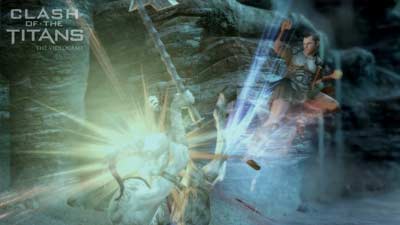
You’ll typically find yourself in fights against multiple enemies; however, you are able to lock onto a single enemy to make things easier. When this works correctly, which isn’t always the case, you are able to see an aura around the foe you are focused on. This aura will let you know what state your enemy is in and whether you can perform a soul seize or sub weapon seize on it.
When an enemy turns light or dark blue, you will be able to drain its soul energy and add it to your meter. However, if a foe is flashing orange, you can perform a sub weapon seize. This attack will thrust the player into a quick-time event (QTE) where they’ll simply have to time a few button presses (which buttons you choose to press doesn’t matter). If completed successfully, you’ll often gain your enemy’s weapon as well as a random gift. As a result of these attacks, most battles involve focusing on one enemy, slashing them until they glow, using a seize attack, and then moving on to the next foe. Considering each type of enemy also only has one type of QTE for these seizes, this gets tedious and boring almost instantly.
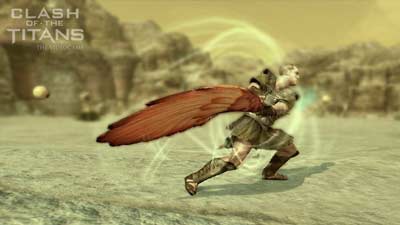
There are actually a good number of weapons to be had in this game but most are rather similar. These weapons can be upgraded using the gifts you receive from seizes and defeating enemies. Unfortunately, rooting through the menus of this game is a painful experience in itself. Just trying to find out what you are upgrading and what is needed to do so takes much longer than it should.
Things get even clumsier when the game requires you to switch between sub weapons in order to destroy certain obstacles. Throughout the course of the game, you’ll find impediments such as boulders and floating enemy spawning machines that need to be taken out by a specific type of sub weapon in order for you to proceed. There are tens of different types of sub weapons and you can only have four mapped to your D-pad at a time, so trying to find the right one through trial and error is a painful endeavor.
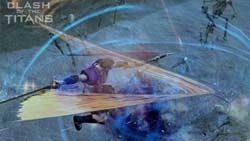
The missions in the game also do nothing to add variety. Every mission in the game seems to boil down to just hacking your way through a certain number of enemies. The game will even try to trick you at times, giving you an objective such as catching a fish or finding a certain number of seeds. However, upon taking these missions, you quickly find out that catching a fish means hacking your way through tens of enemies and finding a glowing spot that has a dead fish on it, and finding seeds consists of slashing your way through foes and attacking plants until they die, giving you a seed. The quests in this game are completely mindless, boring, and irritating at best.
Clash of the Titans even attempts to throw a multiplayer component into the game, but as you might expect, it is incredibly awkward. Two players can’t play through the game side by side. Instead, there are some missions throughout the game that will have an A.I. teammate tagging along with Perseus. If you have a friend with a second controller, he or she can hit the start button after the mission has started to join in. After this, the two of you will be able to play, sharing the same screen until the mission is over, at which time the second player is done playing until another two-person mission presents itself. While co-op makes almost every game better, this game found a way to become one of the exceptions to this rule.
As if things couldn’t get any worse, Clash of the Titan’s presentation is just plain awful. The visuals of the game seem more akin to that of a PS2 title than a current gen game. In-game conversation animations look stiff and awkward, with characters moving their limbs clumsily while their mouths continually open and close randomly as though someone put peanut butter on their lips so their attempts to get it off made it look like they were speaking. Unfortunately, the audio doesn’t fair much better, with more awkward pauses between lines of dialogue than you’d find in a Final Fantasy title. Even during a supposedly heated exchange, expect there to be a few seconds pause between every spoken line.
If you want a good hack and slash experience full of angry gods and mythology, you’re better off with the God of War series. Even if you’re playing through the PS2 ones, they will look and play immeasurably better than Clash of the Titans. At least with those titles, you won’t have to combat terrible visuals, soulless voice acting, clumsy combat, tedious missions, and an overall sense of frustration as well as your enemies. I can’t imagine a circumstance in which I would recommend this game to anyone.
RATING OUT OF 5 RATING DESCRIPTION 2.0 Graphics
For a PS2 game this looks, wait, this isn’t a PS2 game, oh. 2.2 Control
While pressing a button will make you attack, fighting with the game’s camera and lock on system will make you angry. 1.5 Music / Sound FX / Voice Acting
The only thing worse than the soulless voice acting in this game is the awkward pause between every line of it. 1.9 Play Value
While this game will take you twenty or more hours to complete, it is so repetitious and clunky you’ll swear it was closer to eighty. 2.0 Overall Rating – Poor
Not an average. See Rating legend above for a final score breakdown.
Game Features: