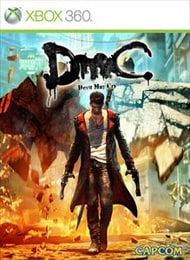
Demon Hunting Action On The E3 Show Floor
A lot of fans are worried that Dante’s new punk/emo look means that the new Devil May Cry game is going to be a totally different game. Well, these fears are half valid. DmC is certainly a whole different beast than Devil May Cry 1, 2, 3, and especially 4. However, “different” doesn’t necessarily mean “bad,” and DmC is far from bad. It’s potentially reigniting the love I once had for the series and introducing some awesome new gameplay elements that could make me love it even more. If you are a big fan of hyperactive, high-flying action games, then read on.
Dante can pull off most of the moves that he had in other Devil May Cry games. One button does basic melee attacks with his sword Rebellion, another fires bullets with his guns Ebony and Ivory, another launches, and another jumps. I’m sure another button on the controller must have blocked or dodged, but this is Devil May Cry! Blocking and dodging are for wimps who don’t know how to rock a red trench coat.
Most of Dante’s movement abilities have returned intact. He can jump, double-jump, glide, and perform all sorts of other acrobatic feats. When attacking an enemy in the air, Dante gains the familiar power of cinematic anti-gravity, allowing him to combo his enemies to death before they fall to the ground. He also still has his familiar Devil Trigger power, although oddly enough this no longer turns him into a demon. Rather, using Devil Trigger now slows down time, causes Dante’s health to regenerate, greatly increases his strength, and turns him into his old silver-haired incarnation. You can also de-activate Devil Trigger mode as well should you slaughter the enemies quicker than you needed to.
However, Dante’s newest skills come in the form of his new weapons, the demon axe Arbiter and the angel scythe Osiris. By holding either trigger you can pull out one of these weapons, effectively changing up all of your skills.
The Arbiter is extremely slow and powerful. It wreaks havoc on groups of enemies and shatters shields and defenses with relative ease. Dante can make the ground shake with the Arbiter and can kill the most powerful enemies with only a few attacks. In addition, Ebony and Ivory are changed into a grappling hook when the Arbiter is out. Dante can use this grappling hook to pull enemies and platforms toward him. At one point in the demo, Dante needed to rip down demonic cameras from the walls using this ability while the living city streets he was walking on tried to kill him.
Osiris is the complete opposite of the Arbiter. Instead of being slow and powerful, Osiris is quick, light, and deadly. While enemies take far more strikes to kill with Osiris, its speed easily interrupts Dante’s quicker foes, especially the annoying flying ones. When Osiris is equipped, Ebony and Ivory change into a grappling hook that serves an entire different purpose as that of Arbiter. Instead of pulling enemies and platforms toward Dante, Osiris’ grappling hook pulls Dante toward his target. You can switch between both of these weapons mid-combo, and I quickly learned to grapple onto annoying light-ranged enemies with Osiris before slamming them to the ground with the Arbiter.
DmC takes a page out of the book of Ikaruga and Outlands by combining these two weapons into an ever present two-color style of gameplay. Certain enemies can only be hurt by demon weapons (signified by the color red) and certain ones can only be harmed by angel weapons (signified by the color blue). Similarly, certain environmental objects can only be interacted with by one weapon or the other, and entire stages and boss fighters are designed so that you have to be switching between both rather frequently. In fact, the only bad element of this new focus on color-switching gameplay is that you rarely find yourself using Dante’s basic sword and guns, which still have quite a bit of style to them. There is a possibility that even more weapons will show up over the course of the game, according to a Capcom booth rep, but the two-color gameplay stays throughout the whole thing.
Then there’s the plot. Fans everywhere have been wondering what Dante’s new look actually means for the storyline. Well, after extensive Q and A sessions and several playthroughs of the demo, I can honestly say that I still don’t know. Capcom didn’t really explain the story much. What they did say was that the world of DMC actually overlaps with our own real world. Demons, however, only exist in the demon world, a bizzare living Silent Hill-type world that overlaps with our own. The demon world, called Limbo, can only be visited by people with Demon blood, which makes Dante a prime candidate. Unfortunately, Dante can be pulled into the demon world against his will, and demons don’t seem to like him much. Fortunately, this does gives him an excuse to kill more baddies.
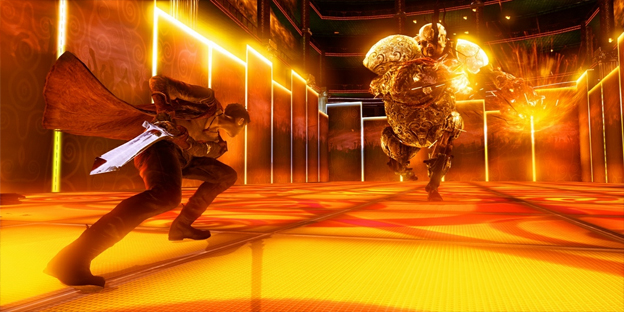
There is one thing I can say about the plot though: it’s become far more mature. Dante swears a whole lot more than he used to, and his demonic enemies do the same. Yeah, this one’s rated M for Mature, guys.
Overall, DmC is a blast. The two-color gameplay, awesome environment, and action-packed fights make this one of the best action games we saw on the E3 show floor. DmC: Devil May Cry releases on January 15th, 2013.
Game Features: