War, Games
War, or its simpler, constituent form, violence, is prevalent in damn near every video game out there. Historical reenactments or fictionalized adventures set against the backdrop of wartime events are just as common. So making a unique game of any kind of historical period, as you might expect, isn’t easy.
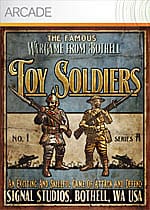
Toy Soldiers has two things going for it in this regard: first, it’s set in the muddy, barbed wire-mired no-man’s land of WWI, a topic that’s seldom explored in most video games. Secondly, it has a unique aesthetic that makes it stand out against most other war-related games-it’s pieces are all plastic.
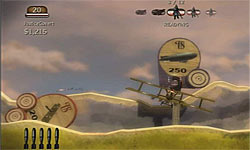
The ‘Army Man’ angle has been explored in games before (mostly in 3DO’s sub-par Army Men series), but the difference here is that Signal Studios has even taken the look of their toy models into effect. They’ve made them look, more or less, like military toys that children would’ve played with in early the 20th century, had they been playing with plastic replicas of the Kaiser’s infantry and their assorted European opponents. There’s also a real feeling of kids playing war out of an old-timey toy chest, rather than just creating a world where these toys are alive. The battlefields of Toy Soliders are elaborate dioramas (not a living, breathing world) right down to the encroachment of the ‘real’ surroundings (a child’s room) that can be seen when, say, flying high above the battle below in a replica Sopwith Camel.
In terms of design, Toy Soldiers is set up more or less like a tower defense game, but thankfully, it plays more like a cross between an action game and an RTS. Essentially, at the rear of each map is your toy chest, which you have to protect from marauding German invaders. They’ll send wave after wave of enemies at you: infantry, cavalry, specialized assault groups, tanks and other artillery, even bi-planes and bombers. But, instead of simply building of your defenses from an eagle’s eye perspective, Toy Soldiers lets you get in the thick of things, taking control of whatever unit types you desire. There’s a decent arsenal at your disposal (even if you don’t see many of your own infantry in single-player mode), although there are only so many designated areas per map map-larger squares for anti-aircraft emplacements or heavy shell gunnery (Howitzers), and smaller circles for anti-infantry machine guns, chemical weapons, and mortars-that you can place units.
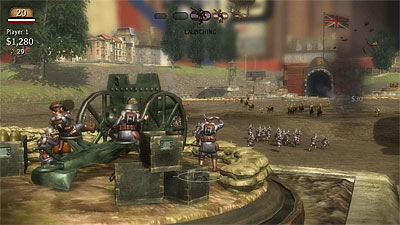
For example, if you place a machine gunner down just before the enemy lets loose on a company of soldiers, you can select the machine gun, swinging the camera down from a quasi-isometric perspective, and open fire, third-person shooter-style. This seamless transition is simple and gives it a pick-up-and-play accessibility that most strategy-style titles don’t have. It’s also a vital part of your battle strategy, since manually controlled units receive an increase in rate of fire and reloading speed. Jumping in that AA gun or manning a Howitzer when overrun by planes or tanks could be the difference between life and death.
Toy Soldiers’ resource-gathering mechanic is also streamlined-the more kills you earn, the more cash you have to build and upgrade units. Unfortunately, as the game goes on, this upgrading system essentially makes your old ones obsolete, meaning you’ll only have a small selection of what they could’ve been (albeit with variations in the German campaign). These upgrades are certainly important, however, especially during the latter half of the campaign when the heavy tanks start rolling out. It becomes essential to beef up mortars and heavy artillery as much as possible if you want to best these steel beasts.
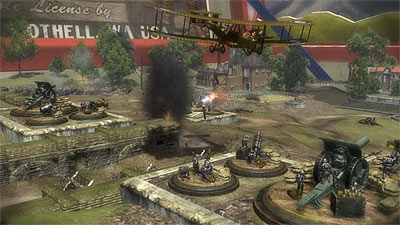
Signal also took some historical liberties that make the game more interesting, pitting you and your troops against giant mechanical monstrosities (at least some of which are based on actual German design plans for impossible fighting machines that were never made) that serve as the game’s boss encounters. Luckily, you get Whippet and Big Willie tanks (French and English armored cavalry, respectively) that help to even the odds.
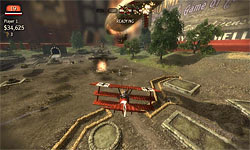
The inclusion of the tanks (as well as the relative authenticity of the game’s maps to actual WWI battles) makes for sometimes-uneven difficulty. There are times when you will be pinned down against opposing, entrenched forces with only a few unit spaces available (at which point you’ll have to switch back and forth between tanks and building or maintaining what little arsenal you have), while other times you’ll be stacked against an enemy force that, if you play your cards right, won’t even touch you.
Toy Soldiers never gets truly difficult-even when the Germans start sending out simultaneous infantry and ground or heavy weapons squads-but most of the time it keeps you on your toes. Then again, there are plenty of times when you’re mopping up the battlefield in a Whippet or a Big Willie, blasting incoming infantry, and gassing or using flamethrowers out its sides on any stragglers. Still, it’s interesting that it doesn’t always necessarily increase the difficulty in a standard slope.
Maybe the most fascinating thing about Toy Soldiers, however, is its underlying message. People have made a game of war arguably since time immemorial, but by placing such acts of horrific, sadistic violence (again, gas and fire come out of the sides of your tanks)-by making it fun to watch as enemy units explode in little chunks of plastic-the game seems to exemplify in a particularly salient way the complicity we subconsciously have to a broader cultural obsession with violence. I always appreciate it when a game that touches on some cultural commentary, whether it’s obvious or not. And given how entertaining it is to “play war” in the setting provided here (and believe me, it is) is proof that sometimes violence isn’t as much about what is shown-in a game as much as anything else-but what isn’t.
RATING OUT OF 5 RATING DESCRIPTION 4.7 Graphics
Toy Soldiers looks damn good for an XBLA title, with top-notch aesthetics. 4.5 Control
Navigating between units is a cinch, but the camera can be a little wonky on occasion. 4.5 Music / Sound FX / Voice Acting
The roar of the battlefield sounds authentic, and the selection of battle fanfare-style period tunes adds to the game’s unique feel. 4.5 Play Value
Toy Soldiers is great fun, although a bit simple at times. 4.7 Overall Rating – Must Buy
Not an average. See Rating legend above for a final score breakdown.
Game Features: