With the inclusion of Age of Empires: The Age of Kings, Nintendo’s DS is not just for juvenile gaming delinquents, it’s also for nerds. by StewXX
February 17, 2006 – Age of Empires is a strategy series that is hugely popular among the PC crowd. The games are deep, fun and highly addictive. All of the moves take place in your brain before you touch a controller. A great deal of thinking is involved but you don’t have to be a genius to play the game. A lot of the fun comes from learning and experimenting as you play against the computer with the different difficulty settings or other humans of various skill levels. With a few basic lessons you can be up and running in a few minutes. There is an in-game tutorial that will give you the lowdown on just about everything. The interface will also assist you by prompting you with decisions during actual play. The gameplay can be as light as checkers or as deep as chess. It’s really up to you to take it as far as you can go.
This DS version has been overhauled specifically to work within the parameters of the CPU. To this end the game is turn-based and not in real-time as the PC games are. This may be a bit of a disappointment to the PC fans but there are good reasons for the turn-based style. The main obstacle is processing. The DS can’t compete with the average home computer. The DS’s screens are too small to display larger sections of the map in addition to the interface. It takes some time to scroll through the map to see all of your units. Ultimately the processor is too slow to facilitate real-team control. Keep in mind this is a pretty serious game.
 |
Taking place in Medieval times you can play as five different factions including the Mongols, Japanese, Franks, Saracens and Britons. There are five huge campaigns, one for each faction. You can choose any campaign at any time. Each campaign includes about a half-dozen battles. With popular historic characters such as Joan of Arc, Richard the Lionhearted and Genghis Khan, players are bound to get a history lesson whether they like it or not. I find it fascinating that a game like this brings history to life so painlessly. We get to examine these great leaders and learn how they employed their troops and planned their strategy on the battlefield. Many of these battles changed the course of history – but the outcome can be different every time because you’re in control of the situation. It’s a great way to be introduced to these people, places and events and I’m sure it will inspire many gamers to mine more information from history books. This is how nerds are created.
The object of the game is to rule the world – or as much of it as you believe exists. Keep in mind that the New World is yet to be discovered. So Asia and Europe will have to suffice. Each civilization has unique weapons and units that they employ. Units that are similar to other civilizations’ units are evenly matched for the most part but they all have a unique gimmick that determines the outcome of a particular section of battle in a rock/paper/scissors format. For instance, pikemen can penetrate the armor of knights who are protected against ranged attacks from archers. Pikemen on the other hand can’t defend themselves from the archers ranged arrows. Siege weapons such as trebuchets will, in turn, decimate the archers. You can even hire mercenaries and other siege weapons from other civilizations such as the elephant brigade which can do a lot of damage when up against a weaker unit.
Waging wars costs money. Before you can even think about going into battle you have to take care of some things at home first. There is some micromanagement of resources to undertake but nothing that’s too detailed or ultimately boring. You have to make sure your population has enough food to keep them healthy, there has to be enough material to construct buildings, and you need a lot of gold to train, outfit and maintain an army as well as purchase new technologies to advance your civilization.
Conquering new territories will earn you more money and help you to “Age-up” your civilization to the next level. This will make you stronger and allow you to develop new technologies in a variety of disciplines such as chemistry, ballistics, siege machines and spying techniques, all of which can be applied to your war efforts. You will also earn points which can be used to unlock new units and new maps.
The turn-based system allows you time to plan out your strategy since there’s nothing to immediately react to. You can position your units, create structures, harvest resources and research new technologies. Then your opponent takes his or her turn.
There is a multi-player mode in which up to four players can take part in using the wireless system, or you can choose to play against the AI which does a good job of keeping up with you and trying to trap you into changing your strategy. The good thing about the turn-based strategy system is that you can play against other players by passing the DS around when it’s their turn to play. This only requires one copy of the game and allows you to play with friends that can’t afford their own DS. I call these unfortunate kids, moochers.
 |
 |
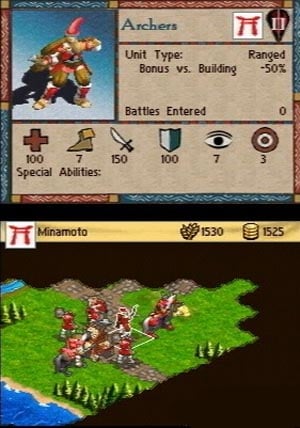
The bottom screen shows the map while the top displays the various units, buildings and terrain. Things can get a little crowded on these small screens so you’ll probably have to consult the interface more than you normally would on the PC just to keep track of things. Fortunately the menus are heavy on the icons and short on the text which makes things easier and faster to locate. The top-down view is perfect for seeing most of the battlefield but you’ll have to do some scrolling on the larger maps.
The armies animate smoothly as they take to the battlefield. You can hear the clashing of swords, the battle cries of the victorious and the screams of the defeated. Each faction is accompanied by their appropriate music but it does get repetitive and that can be a bit of a pain since the replay value is incredible.
Age of Kings is one of the smartest games on the DS. It’s highly recommended for gamers of all ages and intelligence.
Features:
- Command one of five different civilizations: the Britons, Franks, Mongols, Saracens or Japanese
Control special ‘hero’ units such as Richard the Lionheart, Minamoto Yoshitsune, Joan of Arc and Genghis Khan whose special Hero Powers affect the battlefield - Lead over 60 different types of units into battle–from archers and monks to hand cannoneers, battering rams and samurai
- Construct and upgrade buildings to create resources for your civilizations and provide access to new units and technologies
By StewXX
CCC Staff Writer