Lend A Hand
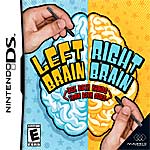
Let’s start with a simple exercise. Take out a pen and a piece of paper. Now write your name down using your normal writing hand. Looks good right? Ok, switch the pen to your other hand and try to write your name again. If the second result looks like it was scrawled by a kindergartener then you may be – like the majority of people roaming the earth – afflicted with an extreme lack of ambidexterity. For those of you who simply can’t bear the thought of having inequality amongst various limbs, Majesco’s new brain and hand training game Left Brain, Right Brain may help you overcome this disheartening revelation.

Ever since the success of Nintendo’s Brain Age, the gaming market has seen a recent flood of casual titles aimed at making players smarter in one way or another. The DS in particular seems well suited for this emerging genre, and it’s clearly becoming the prime platform choice for developers of these kinds of games. So far, we’ve seen games to improve your vocabulary, math skills, vision, overall intelligence, and more. It’s hard to tell whether or not any of these video game concepts actually make a significant impact in the areas of your mind and body they purport to expand, but in many cases it is rather intriguing to sit down and play a game with self-improvement in mind. Left Brain, Right Brain my not be the most expansive of such offerings, but it does bring a slightly fresh angle to the table.
Instead of testing a players’ mental capacity, the 15 different mini-games in this package are geared towards improving and developing fine motor skills and hand-eye coordination in your weak hand. The goal is to gradually bring your weaker hand’s abilities up on par with those of your good hand by regular training. All of the games are played with the DS held on its side like an open book; you’ll flip the touch screen around to the corresponding hand you’re working with. To start out, players can take a simple test to see how their two hands weigh-in. In the ambidexterity check, you’ll play a series of three games first with your good hand and then with your weak hand. The first test throws a bunch of empty squares on the screen, and players must tap a continually shifting green square as quickly and accurately as possible before time runs out. The next game will have you snatching meteors out of the sky and throwing them back into space to save the planet. The last portion of the test has you moving a small blue circle with the stylus to collect blue stars while simultaneously avoiding red stars. Your results will be tallied once you’ve played each game with both hands individually, and a chart will show you the individual score statistics of each hand.

After the ambidexterity check, it’s time to begin training exercises to work your weak hand. Players can select from five different difficult levels which contain three unique mini-games each. You’ll first be asked to complete each trio of games with your good hand to record baseline data. Then it’s time to try them with your weaker hand. The goal is to strive to reach or exceed the baseline score with your weak hand in each game. It’s easier said than done with some of the games, but even if you don’t have mad skills with both hands it won’t take long to plow through the set with decent scores. There is a reasonably good level of variety found among the 15 mini-games. You’ll be tracing letters, moving a dot through increasingly complex mazes, whacking moles and alien ships, cracking safes, and crumbling rocks to reveal animals inside to name a few. As you get better with both hands, you can continually update baseline data to try to increase your weak hand abilities. Each game is timed, and in most cases it seems more emphasis is placed on getting through as many levels of each mini-game as possible in the allotted time. The objectives in the mini-games are simple, yet it’s not always 100 percent clear what you’re meant to do each time until you’ve played them once or twice.

In addition to the exercise mode, there are a few meager offerings which attempt to round out the title. Balance check lets you check your ambidexterity as you go while L vs. R places your hands in a maze race. First you’ll play with your good hand and record ghost data; then you’ll play with your off hand and race against the ghost data. L vs. R only contains the maze game which hardly warrants being given its own separate mode.

A visual graph for recorded data is available, but it only tracks your overall score in each difficulty level. The inability to record and chart your progress from day-to-day or over a longer period of time – a popular feature found in other similar training games – seems like a substantial design flaw. This takes away much of the incentive to come back and keep playing the same batch of basic games over and over again. A DS download feature lets you give friends an opportunity to test their ambidexterity or compete against you for higher scores in one of three multi-player games.
Much like the mini-games themselves, the visuals are nothing to write home about. The point of the package is clearly not about wowing players with top-notch graphics, but it doesn’t hurt to have a little flair here and there. The only character in the game is your host: a hastily scribbled hand with legs, eyes, and a mouth. He’s actually pretty cute. When he’s not providing simplistic play instruction, the little guy alternates between cheering you on with little dances if you do well and freaking out and balling into a grumpy clenched fist if you mess up.
Left Brain, Right Brain is an interesting training game idea that unfortunately suffers from a lack of depth and an occasional feeling of pointlessness. Initially, it’s fun to try testing out your hands’ abilities, but within an hour or so most players will have already completed the bulk of the 15 mini-games and exhausted any other features. The gameplay gets stale quickly without the ability to track data over time or unlock additional content. If you count yourself a lover of training games, there is some benefit to be gained by putting up the $20 for a little hand training. Whether or not you’ll actually come out the other end with a substantially greater level of ambidexterity is anybody’s guess, but you’re likely to have some fleeting entertainment in the process.
Features:
RATING OUT OF 5 RATING DESCRIPTION 2.2 Graphics
One of the most basic presentations on the DS you’ll find. Usually this works fine for a training game, but in this case it’s visually below par even when compared to other titles in the genre. 3.5 Control
The stylus controls are tight. Working with your weak hand takes some getting used-to. 3.3 Music / Sound FX / Voice Acting
The audio doesn’t do much to enhance the experience, but it doesn’t particularly detract either. 3.0
Play Value
It’s interesting to begin with, but falls flat a bit prematurely.
3.3 Overall Rating – Fair
Not an average. See Rating legend above for a final score breakdown.