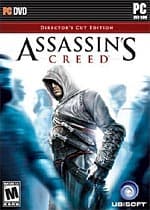
Ubi’s PC port is late to the party, but could just be worth the wait
After a year and a half long blitz of hype, promises, and lofty ambitions, Assassin’s Creed was destined to be one of the year’s biggest sellers, despite mixed reactions from a polarized press. The virtual Holy Land the assassins protect bleeds production value from every stone, and Altair’s nimble moves would humble even Strider Hiryu – more than enough to capture the attention of any gamer. A few months later, some of the excitement has cooled down, and Ubisoft’s PC port has finally materialized, but it’s still not clear if this is a new classic or a lot of untapped potential.
If you’ve played Ubi’s usual PC conversions, we’d expect you to be cautious. They generally range from buggy and unfinished, as with Splinter Cell: Double Agent, to sharply downgraded, like Ghost Recon: Advanced Warfighter, and almost always show a fundamental lack of understanding for the format, as evidenced by the missing controller support in Beyond Good and Evil. After so many consistently botched efforts, PC gamers probably feel like Charlie Brown winding up to kick that football one more time.
But the “Director’s Cut” moniker inspires a bit of hope that this time might be different. Ubisoft has the confidence to imply that this is the definitive version, and they’ve actually delivered. Despite the generously high system requirements (which seem to be a bit more than it really needs), Assassin’s Creed runs smoothly, looks even better than its console cousins, and has faster load times to boot. We experienced no noteworthy glitches, the menus work with the mouse or controller, and there’s even a bit of new content. There are still a few oversights – the analog triggers aren’t properly supported on Xbox 360 pads (the “recommended” controller, no less) and there’s still not a proper save management system – but these hardly drag down an otherwise very solid port.
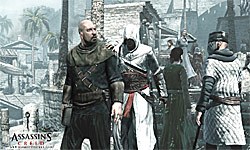
None of the “wow” factor has faded in the few months since the game premiered. It’s still immediately apparent why we were all fascinated by every trailer. Set against the backdrop of the third crusade, Assassin’s Creed recreated four cities of the medieval Holy Land with unparalleled authenticity. From atop cathedral spires and towers, you can see these walled cities extend for miles in every direction, every bit as large as they were in real life. It’s a time and a place that has gone underrepresented in gaming for too long, and being able to run through the crowded marketplaces of Damascus or scale the Dome of the Rock in Jerusalem is novel in and of itself.
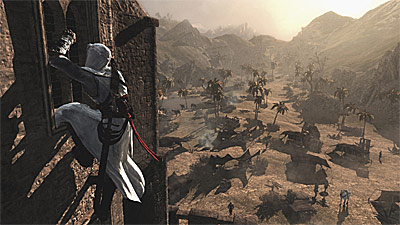
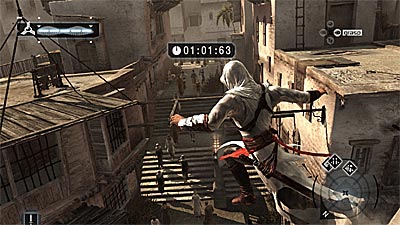
Controlling your hooded hitman is equally novel. Ubisoft Montreal has taken the concept of context-sensitive controls to a new level. Altair can perform a wide array of acrobatic maneuvers to make even the Prince of Persia jealous. This is inspired by parkour/free-running, allowing you to leap across rooftops and scale sheer walls. While the controls are very intuitive, they may have been streamlined too much. At times it feels like all you have to do is point in the right direction and watch Altair run, leap, grab ledges, and swing from posts, negating any depth this could have had. Still, it’s almost hypnotic to watch this beautifully animated character perform such a dynamic display every time you run around.
We start to run into real problems with the mission structure itself. Billed as an open-ended “sandbox” game, Assassin’s Creed promises you free reign to explore the cities’ streets while you hustle for information to find and eliminate your target. Unfortunately, these missions generally boil down to the same four or five tasks over and over again, and most of them are uninteresting at that. You might have to sit on a bench and eavesdrop a conversation or walk slowly behind someone to pick their pocket. After the first time, these really feel like filler to get to the more interesting assassination missions that let you flex your infiltration skills.
This issue is actually not as bad as it was in the console version. There are a few new kinds of missions in Director’s Cut that help to mix things up. There is a rooftop variant of the stealth assassination quest, where you to take out archers atop various buildings. You might also be asked to escort a contact and play defender. These new missions are actually a bit more interesting than the originals, and it’s good to see that Ubi recognized this issue, but there’s still a lot of untapped potential, and it doesn’t eliminate the feeling that this is just repetitive busywork to kill time between bosses.
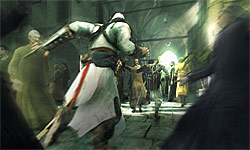
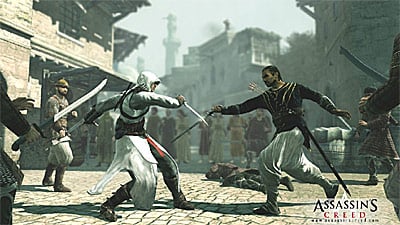
As you’d expect from the premise, there’s a major stealth element to the gameplay, and there are some very fresh ideas about just what “stealth” means. Traditionally, stealth has been a simple matter of avoiding being seen, but in Assassin’s Creed, it’s about avoiding being noticed . It’s your behavior that determines how likely you are to be spotted. If you’re strolling around with a bunch of scholars in white robes, no one will notice you, but if you’re barreling over people, scaling walls, or waving a sword around, guards will be a lot more likely to take pay attention. You can use the anonymity crowd to hide in plain sight – a refreshing break from the usual skulking around behind backs.
Once you do get spotted, however, the system turns peculiar. We’ve come to expect that guards will give up after their target has left their sight for enough time, but Altair isn’t so lucky. He still needs to escape his pursuers’ line of vision, but no matter how long he does so, they won’t give up until he “hides” in one of a few pre-determined spots, like diving into a bale of hay or sitting on a bench. Even though they don’t witness the hiding itself, Altair’s decision to sit on a bench somehow magically ends the chase, like reaching “home” in a game of tag. It’s really quite annoying, as you likely don’t have every safe spot nearby committed to memory, and they can be far apart.
Ultimately, Ubi might not fully understand just what makes sandbox gameplay work. It isn’t just about the freedom to run around a large environment or tackle tasks out of order. It’s about the ability to play creatively and make your own choices. There are simply not enough ways to express yourself in Assassin’s Creed. If there were more complex consequences for your actions, and more ways to influence characters beyond simply killing or not killing them, it would be a richer, deeper experience. Instead, we are met with seemingly endless tutorials and rigid hand-holding that impose an unwelcome tedium.
There is a lot to like here. It’s difficult to ignore why this was one of the hottest titles of 2007. The concept, setting, and production values combine to create something downright captivating, and a few months later the slightly upgraded Director’s Cut is certainly no worse for the wear. Alas, beautiful and fascinating though it may be, it is not substantial. There’s a severe lack of depth for a game so enamored with its aspirations of an “open world.” The gates may be open, but the possibilities couldn’t be more limited. Assasin’s Creed is a game you’ll want to love, but the wasted potential begs for a mercy that no cold-blooded killer should have.
RATING OUT OF 5 RATING DESCRIPTION 4.5 Graphics
Beautiful design, incredible detail, and unbelievable animation make this every bit the looker it was on the consoles. It’s a very pretty game. 3.5 Control
The controls are very simple and approachable, maybe to a fault. At times it feels too easy to do the wrong thing because all you have to do is point Altair in the right direction. 3.5 Music / Sound FX / Voice Acting
The realism of the ambient sounds are the best part. Repetitive voice clips and forgettable music hurt it somewhat. 4.0 Play Value
A solid length for an action-adventure with a lot of optional objectives for completionists to explore. 3.8 Overall Rating – Good
Not an average. See Rating legend above for a final score breakdown.
Game Features: