
Heavy Metal Discord
It feels weird reviewing a game that is blatantly in open beta, but, given that Hawken’s cash shop is open and has been since the “open beta” launched on December 12, it certainly feels like a legitimate release. And they want your money. They want it as badly as any other developer out there, but Hawken is a free-to-play title, and so it must be a bit less transparent in how it proposes to part you from your money.
The first step appears to be making a game that doesn’t carry the most common markers of a free-to-play title. Hawken has gorgeous graphics (but runs smoothly) both on a technical and aesthetic level. The post-nanovirus industrial arenas of Hawken are that carefully engineered sort of haphazard that befit the original Death Star, thousands of intricate metal parts that seem both random and purposeful at once, or rocky deserts with mechanical husks providing shade, cover, and texture.
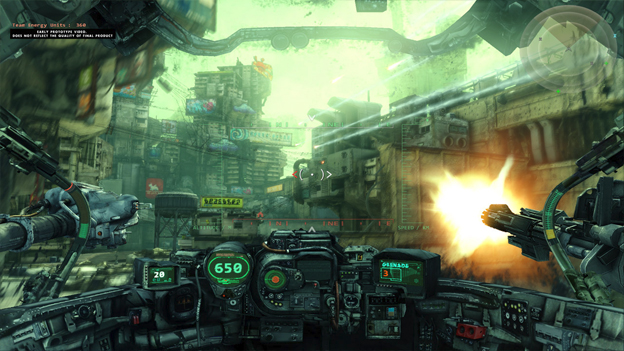
On a more functional level, the cockpit has been cleaned up a bit since the E3 demo. Though it still prefers rendered gauges over a completely free-floating HUD (better befitting the theme of the game), there are now more colors than gray and green, making it easier to assess one’s status on the fly. This is further aided by graphical indications of damage, such as a cracking windshield and glaring red lights that inform you of your imminent destruction. There are other little touches, too, such as your mech’s visible arms (à la Steel Battalion) and the superb animations.
Sound, too, is impressive, with the mechs making meaty crunches as they stomp through the game’s arenas, missiles exploding in the air about them, gunfire ricocheting off the walls or your enemy’s hull. There’s this terrific impact to the sound effects that ensures you know what’s going on, even if it’s hard to visually determine what’s happening around you (and, given how fast-paced a game it is, it can be). Hawken’s production values are certainly above reproach, and will do their part to draw you in, but the fast-paced, often hectic combat will be what keeps you there. That and the customization element.
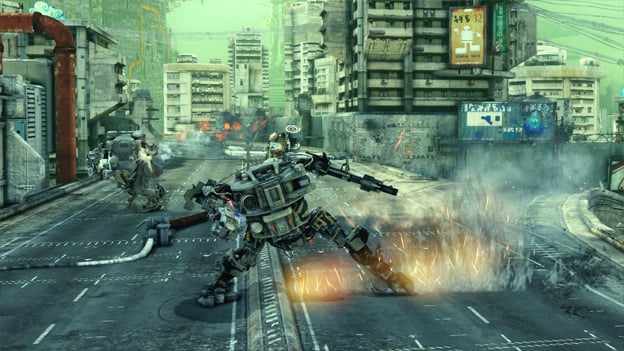
The game’s style of play lands halfway between that of a mech sim from the olden days of PC gaming and a first-person shooter. Best controlled with either a dual-analog setup or a mouse and keyboard, Hawken’s mechs move fairly quickly when just milling around, but also possess an extended, boosted jump, the fuel for which can also be used to dash along the terrain so as to quickly cover ground. In combat, lateral dashes are more akin to quick boosts, mech hopping dramatically aside and potentially out of the way of a deadly volley of missiles. This action has a bit of a cooldown that is independent from the fuel gauge, so repeated zig-zag dashing is not a viable strategy.
There are four game modes, encompassing the basic deathmatch and team deathmatch, as well as Missile Assault and Siege. Missile Assault is Domination, with three missile silos that, when controlled, launch their payloads at the enemy’s base, gradually bringing its health total down until it crumbles to the ground. Siege, meanwhile, involves first gathering energy resources from hotly contested wells, then returning that energy to base to launch a battleship. Once one (or both) of the battleships have been launched, the focus switches to the anti-air missile launchers around the map. Control them so that they fire on the enemy’s battleship, taking it down and allowing your own to do damage to the enemy’s base. Rinse and repeat until one team’s base is destroyed.
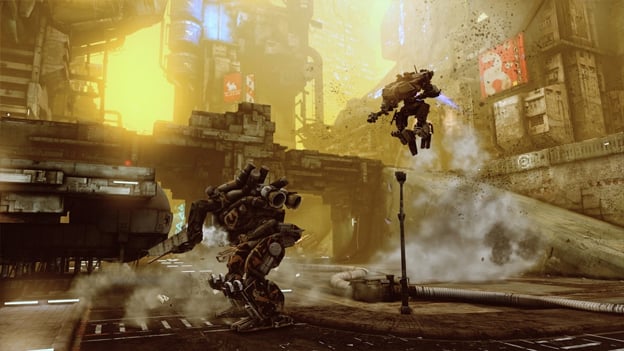
None of these are especially complex, which is okay. They’re a lot of fun, the actual matches forcing you to constantly be on the move, aware of what’s going on around you, shifting fluidly between offense and defense as you seek a hidden corner in which to repair. In capture-based modes, objectives are generally close enough together that moving from one to the next is quick, but you can’t just stay at one and defend the lot of them (a testament to the game’s map design).
Where it all starts to break down is in the “free-to-play” nature of the game. Mech games have always been predicated on variety. The only distinguishing characteristics between them and other shooters are their typically plodding pace (comparatively) and the malleability of the combatants themselves. Hawken largely does away with the plodding pace of other mech games, but it still has the customization elements in reserve. They’ve certainly been dumbed down, though.
Customization in Hawken takes the following forms: You have your choice of a base mech. You can then outfit it with a primary weapon, from a selection limited by the frame, a secondary with the same restrictions, and a few internal modifications that alter your stats in small but significant ways. It’s more comparable to Call of Duty and its old weapons/perks system than anything from Mechwarrior, Earthsiege, or any of the other mech greats. You won’t be balancing weaponry with heat mitigation while staying within a tonnage limit, that’s for sure.
There’s also the optimization tree, which has paths for offense, defense, and movement (though they overlap in some ways, which helps them complement each other). Optimization points (along with permanent boosts to one’s abilities) are gained for leveling. They can be spent in the optimization trees for permanent stat increases that affect things such as heat buildup, healing startup time, and weapon damage. Aesthetic variations are also available for each mech, including new torsos, limbs, thrusters, and paint patterns, but they do not seem to have any sort of explicit, functional effect on gameplay.
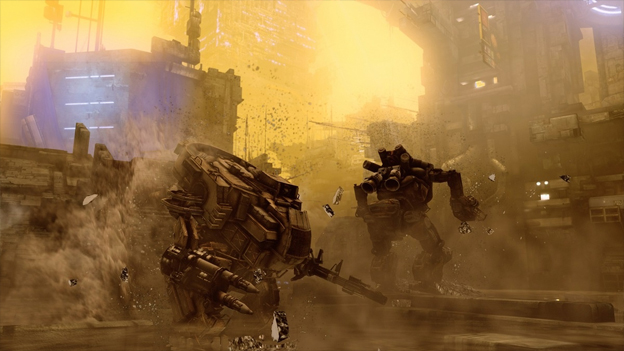
That said, customization is kneecapped by the game’s financial structure. Most parts for a mech run 3,000 or so Hawken Points, while mechs cost over 6,000. As a frame of reference, even after dominating a match and gaining enough XP to level my mech up five times in one go, I still gained only about 200. You can circumvent the grind by paying real money for Meteor Points (and aesthetic parts are only available for real money), and the costs in those terms are fairly low, but all this really cuts into the playability of the game.
The game provides you with only the starter mech, which is an all-around functional piece of equipment, but to find out how any of the others play, beyond simply reading about them, you must actually buy them. For their winter event, Meteor gave me 5,000 Hawken Points, which I combined with what I’d already earned to buy a mech that sounded appealing. I soon discovered that it did not fit my playstyle and, as such, was entirely useless to me. In a game where I’d simply been able to try it out and then move on, I’d have shrugged it off as a discrepancy in taste and tried something else. In Hawken, though, I’d spent the fruits of my investment on this hulking scrap heap and, dammit, I was going to play through a whole match with it no matter how much I cursed the game’s balance, its oddly clunky lock-on mechanics (specific to Hellfire missiles), and the papier-mâché that passed for its armor. By the end, I was livid, shouting obscenities of which I am definitely not proud.
This was all completely avoidable, too, even with the game’s existing financial model. The developers do let players test out mechs for a period without actually purchasing them, but it’s limited to the specific mechs the developers have selected at any given time. Considering you can’t modify them or really level them up without purchasing them anyway, it seems strange that they limit which ones you can try. It would certainly save a lot of undue frustration.
There are other issues, of course. There are only a handful of maps to play and the friend system offers no readily apparent means by which to party up and play with said friends (you have to hope there’s an empty slot in the game you join, then invite them in), but the biggest ones are all related to the ways in which Hawken tries to squeeze you for your pennies. It’s a fun diversion, to be sure, but with its less-than-extensive customization options, absurd reliance on grinding to incentivize microtransactions, and limited variation in actual gameplay, it probably isn’t worth a monetary investment.
RATING OUT OF 5 RATING DESCRIPTION 4.5 Graphics
Perfectly evoke the industrial atmosphere on which the game depends. The world feels desolate and decimated in the best possible way. 3.5 Control
They’re intuitive FPS controls, extremely responsive, but with some odd design decisions such as the 180 degree turn and mapping the “map” key right next to the one used for repairs. 3.5 Music / Sound FX / Voice Acting
It sounds like a mech war, with a lot of metal on metal, solid thuds and crunches. This is a game heavy on the bass. 2.0 Play Value
The lack of variety and its extremely grind-heavy progression, for those who don’t immediately feel like shelling out cash, is a real replay killer. 3.2 Overall Rating – Fair
Not an average. See Rating legend below for a final score breakdown.
| Review Rating Legend | |||
|---|---|---|---|
| 0.1 – 1.9 = Avoid | 2.5 – 2.9 = Average | 3.5 – 3.9 = Good | 4.5 – 4.9 = Must Buy |
| 2.0 – 2.4 = Poor | 3.0 – 3.4 = Fair | 4.0 – 4.4 = Great | 5.0 = The Best |
Game Features: