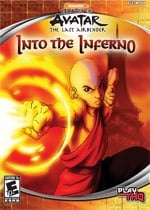
A Poor Finale
The Avatar series of games started off with a lot of potential. They were all mainly focused on pleasing younger fans of the series and, as such, were never really that difficult or memorable, but for what they were, they were pretty nice. However, it seems that Avatar-The Last Airbender: Into the Inferno, which is based upon the final season of the hit cartoon, has taken several hits in the quality department since the game’s previous iteration last year. It is especially disappointing for longtime fans of the series who were especially excited for a game based upon the events surrounding the conclusion of the series.
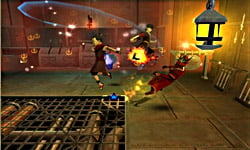
Into the Inferno follows the last book of the series pretty linearly. It begins with Aang waking up from his coma following the incidents that occurred at the close of the last season. The gang has resolved to face down the Fire Lord (who now refers to himself as the Phoenix King) during Sozin’s Comet, when his powers will be weakest. Although the game does recall several of the major events of the series, fans may be disappointed to learn that many of the events have been altered or toned-down for this title.
One particularly painful instance of this occurred in the penultimate battle against Azula, Zuko’s sister. Those who have watched the TV show will remember that there were quite a few interesting circumstances that permeated the battle and made it one of the most memorable Avatar battles ever. Unfortunately, in the game, this battle is portrayed as just a straight-up fight between Zuko, Katara, and Azula, with no special circumstances or cutscenes. Regrettably, there are many more examples of the game losing the energy of the TV show, even when it comes to the final battle.
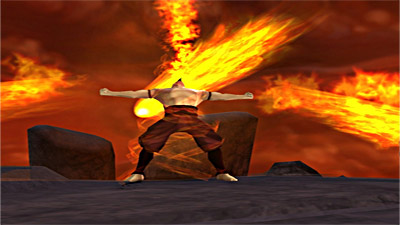
In addition to lost story elements, Into the Inferno also loses the open world feel of the past two Avatar games. Although it takes the generic puzzle platform approach to the gameplay, the world feels much more restricted this time around when compared with past iterations, which at least included a semi-open world where you could look around and explore. Instead, it seems that this title is content to keep things in the box, and the linear levels are very frustrating to deal with. The level design also suffers from the game’s fixed camera system, which makes it hard to look around when trying to make complicated jumps or solve room-based puzzles. Both of these characteristics make the game feel very claustrophobic.
Even though the story cuts and linear game design are fairly disappointing, they are not the worst facet of this title. Unfortunately, the controls for the PlayStation 2 version of the game are absolutely terrible, and make this game close to unplayable. The controls are ported over directly from the Wii version, but instead of pointing and clicking with your remote, you will have to use an on-screen cursor that is controlled with the right stick. And since you have to move with the left stick, it becomes very difficult to interact with different elements while you are moving around. This makes battling enemies very difficult, especially boss battles where you will have to run around and control elements at the same time for success.
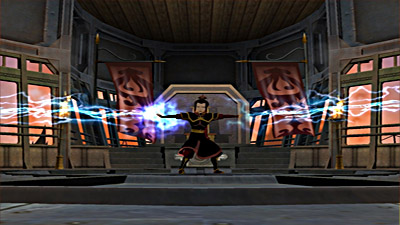
The combat system itself is also below par, even when compared to previous Avatar games. Although the combat has never been all that varied, Into the inferno gets rid of the combo system that was used by the last two games and just gives you a single combat button to spam in order to defeat enemies. You can also use elements to defeat enemies, but because of the aforementioned control issues, this is rarely practical and generally ends up in character death.

The graphics here aren’t too shabby, but they aren’t that good either. The look of the game has a cel-shaded quality to it, although not as fully realized as in games like last year’s Naruto: Ultimate Ninja 2. There are a few areas where there are some seaming and framerate issues, but thankfully, there are much fewer glitches than in past Avatar games.
However, what the game lost in graphical glitches, it has made up for in audio glitches. During several cut-scenes, the sound will not engage at all, and you will have to sit in silence until the actual gameplay begins. This happens randomly, and if you really want to hear the audio in a cutscene, you will have to exit your current game and restart. These glitches are definitely annoying, and it is a real shame because the level music and voiceovers are actually fairly good. But not knowing whether the audio will play or not really negates this positive element.
Overall, I was extremely disappointed with this title. The animated television series was one of my favorites of the past few years, and I was really hoping that the game based on the final season of the show would go all out and deliver a memorable experience. However, the only thing that proved to be memorable about this game was how terrible it was. From the broken controls to the mysteriously disappearing audio, this game should definitely be avoided, even for die-hard fans. Although it might be tempting to play a game based on such an awesome series, the game channels none of the amazing spirit of the show. The best way I can describe it is weak—like a Firebender stuck in the ocean during Sozin’s comet.
RATING OUT OF 5 RATING DESCRIPTION 3.0 Graphics
Graphics have a pseudo cel-shaded look and are about average. 2.2 Control
The ported Wii controls just don’t work on the PlayStation 2 and make bending and moving at the same time almost impossible. 2.5 Music / Sound FX / Voice Acting
The voiceovers and music are not bad, but the sound will randomly disengage, and you can miss entire cutscenes as a result. 2.0 Play Value
Although you can replay different levels and gather collectible artwork, there really isn’t much incentive to do so, especially considering all the poor aspects of the game. 2.1 Overall Rating – Poor
Not an average. See Rating legend above for a final score breakdown.
Game Features: