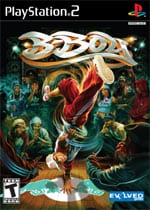
You Deserve a Breaker Today
For all the B-boys and B-girls out there in North America, B-Boy is bringing it home, literally. After circulating around the world for the last couple of years, B-Boy is now available in North America, the land that created breakdancing. B-Boy is breakdancing without the mess; no blood, bruises, or broken bones. It’s all about getting the right moves down at the right time with your controller, not your physical body. Part Guitar Hero, part Tony Hawk with a little bit of Street Fighter thrown in and you’ve got the essential ingredients to B-Boy.
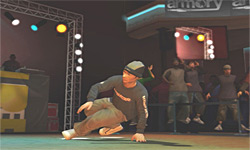
B-Boy is put together as a cohesive package. Despite all of its influences, it is fresh and original. It doesn’t feel like a Frankenstein, it’s a sophisticated game with complex, but not complicated, gameplay mechanics. Some technical issues hamper the overall presentation and enjoyment, as they can actually interfere with your progress. There’s no getting around some of these flaws, so you’ll just have to live with them. Eventually you will compensate for them, but it does take a lot of practice to work your way around them. I must admit that during the first few hours of play it seemed unmanageable. I was incredibly frustrated and was just about to deem the game unplayable and give it a terrible score. But when I took a break for a day and realized that all I was trying to do was get through the game as fast as possible to write this review before the weekend, I decided to change my perspective, and consequently my attitude. It’s not about the destination, it’s about the journey.
Like anything in life, you’ve got to practice if you want to learn a new skill. Breakdancers aren’t born with these moves, they acquire them through years of practice. Physically these dancers can differ drastically as well. Some may be incredibly strong but lack flexibility, while some may be lithe but unable to support their own weight with their neck muscles. So, I learned to make do, as you will too. So, don’t throw in the towel if you find yourself frustrated at the technical flaws that I will discuss later. Just give it some time and patience.
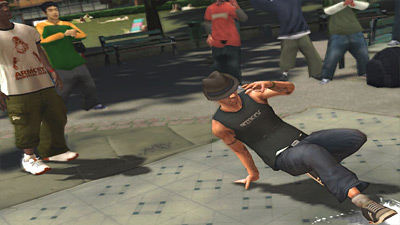
A series of moves, activated at the right time with strings of combos is the basic premise of B-Boy. You are dancing-off against opponents in the quest for medals, awarded for your timing ability and your skills at linking combos together. You will begin with a character that you can customize with body type, facial features, hair, and outfit. Starting at the bottom, you will earn street cred, money, and eventually acquire a posse. You will also earn and learn new moves that you can add to your repertoire. Competitions will begin in the ‘hood and take you around the world to places in Asia and Europe.
Main moves are executed with the face button. The triangle is for the top rock, the X is for the six step, the circle activates the windmill, and the square is the freeze. Used in conjunction with the face buttons, the D-pad and dual triggers act as modifiers as well as letting you access a new set of moves. For instance, when you use the freeze move, a micro mini-game appears in which you have to keep a gauge balanced in the center by making adjustments to the right and left trigger. If you press either trigger for too long, you will lose the balance in the gauge and the freeze move will be over.
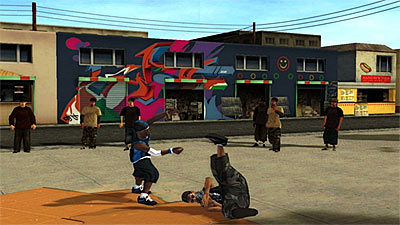
Before each competition, you will select, program, and store a handful of new moves to be used in conjunction with the moves mapped to the face button. These moves are then accessed by pressing the D-pad and the appropriate face buttons. Your character will receive moves, instructions, suggestions, and other tidbits of information on a laptop from Kool Rock. A practice arena lets you try out and perfect the moves before you enter into competition. When you have them down, you can add them to your movebook. It’s kind of like entering a battle in an RPG. Although you will acquire a large inventory of moves, you will only be able to bring a handful of them with you. This concept works because it keeps you from having to memorize a seemingly infinite amount of button combos. As it is, you add only the moves that you feel comfortable with.
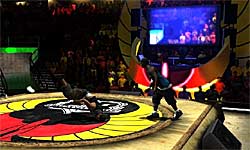
Variety is the key to winning each competition. If you play it safe, you won’t generate enough interest in your performance and your opponent could steal the medals away from you. The medals make their appearance during the competition and are the possession of the dancer deemed to be doing the best at that time. The medals will alternate as each competitor steps up his or her game. It’s a great visual aid, almost like the pitch meter in a karaoke game, as it gives you real-time indication as to your progress, or lack thereof.
Under your dancer is a turning circle. It has slots on it that line up with a marker as it turns. Pressing the buttons when the slots line up will give you points for your rhythm. At the end of the cycle is a blue slot. Trigger your transition moves when the blue slot is lined up with the marker. This is the key to success, but it’s also where the technical flaws are revealed. The camera angles, in an effort to emulate MTV videos with lots of fast edits, will change so drastically that it’s difficult to keep a visual on the turning slots. The other problem is that commands don’t register until the next bar of music, which doesn’t give you instant feedback. The confusing camera angles and control delay require that you keep the beat in your head and not rely too heavily on the visuals.
B-Boy is an average looking game despite the hundreds of motion-captured moves. The characters are bland looking and the environments look blocky and dated. Thankfully, the soundtrack is not dominated by lame hip hop and rap tunes. The addition of Kool and the Gang and the Godfather of Soul, James Brown, add some class and depth to the presentation. An online mode is definitely the next step for this game if it’s going to continue as a series. The two-player versus mode is not a deal breaker. It would be nice to be able to test our skills against the other players around the world that have had this game for the last couple of years.
RATING OUT OF 5 RATING DESCRIPTION 2.7 Graphics
Average looking environments and characters. Smooth motion-captured moves. 2.7 Control
Transitions don’t register instantly. Good movebook system. 3.3 Music / Sound FX / Voice Acting
Good variety of old and new-school tunes. 3.6 Play Value
Challenging and sophisticated gameplay. Not just for the hip hop crowd. 3.1 Overall Rating – Fair
Not an average. See Rating legend above for a final score breakdown.
Game Features: