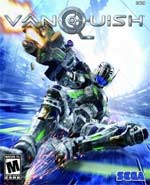
Under Heavy Fire
When Mega Man and Dead Rising creator Keiji Inafune said that Japanese games in development today were “awful,” and that the game industry was “five years behind” at this year’s Tokyo Game Show, he was referring to the seeming lack of innovative ideas coming out of Japan today.
Inafune has a point; these days it’s no easy task to ignore the near-endless waves of cookie-cutter action titles, blasé anime-inspired niche strategy games, and JRPGs that saturate the shelves of game shops both domestically as well as overseas. Of course, as a counter-argument I would posit that Western games are often just as set in their ways. As of late, the would-be solution that most Japanese developers try is to either appeal to a very specific Japanese niche market or simply take a Western approach to series both old and new. The common result of such thinking—outsourcing well-known Japanese series to western development teams—is generally a noble attempt to breathe new life into stagnant properties, not to mention create a diversified market from which Japanese gaming giants can theoretically cull new financial lifeblood. But it’s often largely a business decision over a creative one, and the quality of these partnerships seems to be pretty hit-or-miss. It should come as no surprise then few games that make an honest attempt at breaching the cultural divide between East and West game design, making hybrids that draw from the best of both styles rare, to say the least. Instead we see creatively bankrupt imitations of Western design, without so much as a single original thought put forth as to how this Eastern knockoff could possibly differentiate itself culturally or innovatively from its decidedly western template (Quantum Theory, I’m looking at you).
Vanquish, on the other hand, is the polar opposite of this kind of game. In an industry where Japanese developers seem desperate to try to tap into Western design sensibilities, Vanquish’s one-of-a-kind take on cover shooting—quite possibly one of the most static (and often bland) iterations of Western action game design to come out of the past half-decade or so—isn’t just a Japanese game masquerading in Western clothes. It’s Western game made by a Japanese developer. From its style to its breakneck pace, its hybrid philosophy is as much Robotech as it is Gears, borrowing some basic western shooter tenets and sprucing them up in a way that arguably only a Japanese developer could. Vanquish is the result of Resident Evil creator Shinji Mikami’s desire to make a pure action game, and it really is a product of two worlds.
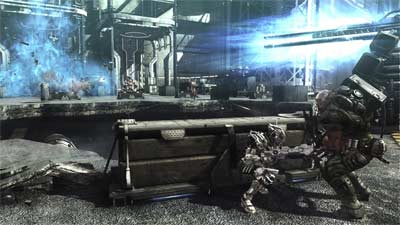
On the surface, Vanquish probably most closely resembles a cross between Gears of War and an anime-influenced Halo, given the sleek, cybernetic suit worn throughout the game by Sam Gideon, a highly-trained DARPA operative. But it’s not really a cover shooter, or even a standard one. You’ll have to make use of cover from time to time, but the frenetic pacing here means you’re going to be zipping around aboard a massive, war-torn space station using a slide maneuver that’s something like a cross between in-line grinding in an extreme sports game and continuous dashing as seen in mech titles like Virtual-On. Sam can slide across a battlefield in a matter of seconds, making wide swaths around enemies while targeting them or flying into cover practically on a dime. While the slide will make your suit overheat, you won’t be running around like a normal soldier very much—at least not if you want to stay alive. In terms of pure control, Sam’s suit feels closest to the orbital frames in Zone of The Enders, specializing in fluid maneuvers that give Vanquish a high-octane feel. All the anime influence is still layered on top of pretty standard run, duck, and gun mechanics, but the fast pace of the battles here barely resemble the comparative plodding pacing of most cover shooters.
Speed is only half of the equation, though. Sam’s Augmented Reactive Suit (ARS) also lets him distort the battlefield environment around him, essentially slowing down time. This so-called AR mode is basically Vanquish’s version of bullet-time, but Mikami and company designed Vanquish so that you’ll need to use it in conjunction with your speed-based evasive and tactical capabilities, giving the mechanic a distinct feel. You can activate AR mode after performing a dodge roll, leaping over cover, or sliding in any direction. Being able to slow time to a crawl while jetting across an open path in battle (while gunning down a host of enemies in your wake) is as effective as it is a blast to perform (or even just to watch). When it comes to action, Vanquish will spoil you: you’re just going to want to slide around with the speed and agility you have here in every other action game after you play this one.
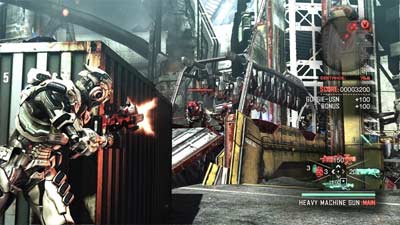
You’ll also need to master these skills, because this one’s often relentless. If there’s one thing Vanquish avoids, it’s subtlety—enemies descend from drop ships in hordes and fire in volleys at you from heavily entrenched positions. Unit types don’t differentiate too much, but your foes quickly move from small groups of mechanical grunts to specialized classes like snipers and melee to hulking 15-20 foot tall tanks, transport vessels and massive, screen-filling mechanical monsters.
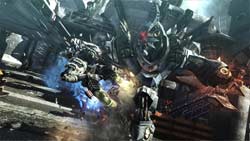
Vanquish’s campaign follows the minute-by-minute events of a wide-scale military counter-measure offensive, and though it isn’t that long a game—you should be able to blow through it in between four and six hours—the sheer intensity and number of enemies make the game’s escalation of conflict particularly grueling. With so much adrenaline and testosterone running on all cylinders, it can be downright exhausting to play this for more than, say, an hour at a time.
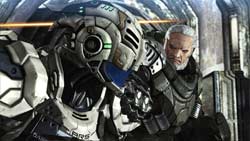
And despite Vanquish’s Japanese influence and aesthetic, it’s clearly aware of its identity as a western shooter. The game’s conceit, which involves a war in the near-future against the United States and Russia, is nearly all we get as real narrative; Vanquish would rather focus its attentions on delivering spades of over-the-top, goofy military dialogue and following each and every objective that Sam and the marines must tackle. But Mikami seems to be poking fun at the meatheaded stereotypes these kinds of games are known for. The marines’ CO, a tough-as-nails, muscle-bound caricature named Burns, routinely growls lines like, “Oh, you robo-f—k!” and makes fun of Sam’s use of tactical jargon in battle. Similarly, when Sam rescues a group of marines from electrically-charged prisons early on in the game, they complain that he shouldn’t have rescued them because the electricity, say, cured their back problems, or otherwise felt good. Sam also smokes every chance he gets when not in battle, which just adds a layer of anime-style ridiculousness over everything else—he even pulls one out at one point when dangling by one hand over a yawning abyss. While the game is supposed to be a serious undertaking in some ways, it’s pretty obvious that some elements of Vanquish are intentionally tongue-in-cheek.
Shinji Mikami has had a pretty successful career getting his hands dirty with interesting ideas. And if even if they don’t always work (read: P.N. 03), Vanquish has the potential to be a promising new IP with a lot of room to grow. If the game is a success, I’d love to see a sequel with a full-on upgrade system for Sam’s suit (rather than just the strangely understated weapons-based one seen here), as well as different applications for it. A few more setpieces wouldn’t hurt either, although the bombastic ones here are still pretty thrilling. Vanquish may be a fully modern game and western-style game, yet its non-stop, over-the-top style and pumping soundtrack is also reminiscent of Contra or Square’s underrated horizontal shooter Einhander—titles that are Japanese through and through. It would be easy enough to recommend Vanquish for its gameplay merits alone, but if you consider yourself a fan of both Western and Japanese games, missing out on one that bridges the design gap as well as Vanquish does would be downright foolish.
RATING OUT OF 5 RATING DESCRIPTION 4.5 Graphics
I don’t know what kind of proprietary engine Platinum used here, but this game gorgeous is gorgeous. 4.0 Control
Sam’s AR suit is exceedingly easy to navigate, though the speed can throw off precision stops behind cover. This is a great modification of your standard cover shooter control scheme, and you’ll never want to stop powersliding. 3.7 Music / Sound FX / Voice Acting
The exchanges between Sam and Burns are pretty entertaining, and sometimes may even make you laugh out loud over the sheer ridiculousness. The sound of war rips all around you at all times, while Vanquish’s soundtrack will make you feel like you’re at a European trance rave. 4.2 Play Value
Vanquish is great fun while it lasts, though it only lasts about six hours (if only there was more to do!). Still, absolutely worth playing. 4.1 Overall Rating – Great
Not an average. See Rating legend above for a final score breakdown.
Game Features: