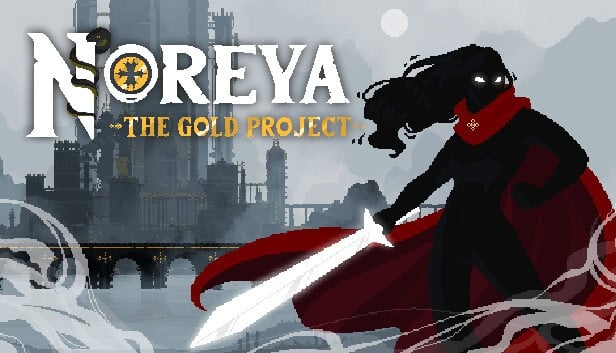
Let’s face it — the deluge of Metroidvania titles arriving in the wake of Hollow Knight‘s success is starting to become a bit much. Sure, there are plenty of titles that stand out as exceptions, coming close to achieving the same greatness as Team Cherry’s now-legendary Metroidvania/Soulslike hybrid. But, for the most part, many of the games coming as part of the current Metroidvania renaissance are, well, hollow. By attempting to recapture what made Hollow Knight so special, many newer Metroidvania titles are forsaking their own identity in the process. This is why Dreamirl’s Noreya: The Gold Project is so refreshing.
Rather than mixing Soulslike elements in the framework of a Metroidvania, Noreya is a game that adheres to the original genre template. Make no mistake, Noreya is a pure Metroidvania through and through, with twin emphases on combat and platforming. But where the title ultimately succeeds is in its understanding of the Metroidvania genre’s balance between these two disparate halves, and its purity and simplicity end up being the title’s greatest asset. While it occasionally stumbles along the way and suffers from some slight pacing issues, Noreya offers up an experience that sticks closely to the tenets of the games that inspired the genre in the first place.
Emphasizing Fundamentals
©Noreya: The Gold Project gameplay screenshot – Original
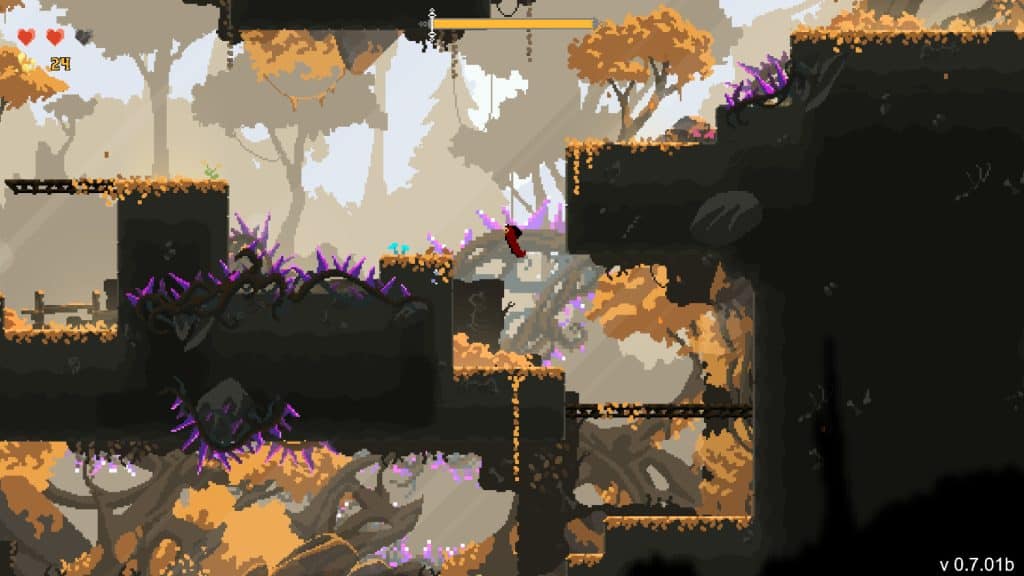
The opening to Noreya introduces us to the game’s protagonist, Kali, as they rise from the grave following a terrible tragedy. While the story in Noreya is serviceable, it’s mostly just set dressing for the real star of the show — the Metroidvania gameplay. Noreya is a game that clearly pays homage to the twin halves of the Metroidvania portmanteau, with an especially clear reverence for the “Vania” half. While combat mostly boils down to a simple three-hit combo, the game’s skill tree affords some freedom of player expression in terms of how you can approach encounters. Enemies are fairly mobile and each behaves differently. And while each enemy type is some variation of a shadow creature, the excellent pixel art and animation give each foe a unique presence in combat and require players to react accordingly to their move set.
Truthfully, combat in Noreya is not much more than what one would expect from a traditional NES-era action platformer, but the title’s platforming is where the full picture begins to come into focus. Platforming in Noreya is what could best be described as sublime. Initially, Kali begins with just a jump. Not that far into the adventure, we gain the ability to cling and rebound off of walls. This opens things up significantly, but a later upgrade — being able to shift between the physical and ethereal realms — is where Noreya’s platforming reaches new heights. Many of the game’s upgrade materials (extending a life meter, increasing attack power, etc.) hide behind cleverly designed platforming challenges, and attempting these ends up being one of the best parts of the gameplay experience. It’s not quite as platforming-heavy as a game like Aeterna Noctis, but Noreya puts its environments to good use.
World of Gold vs World of Light
©Noreya: The Gold Project gameplay screenshot – Original
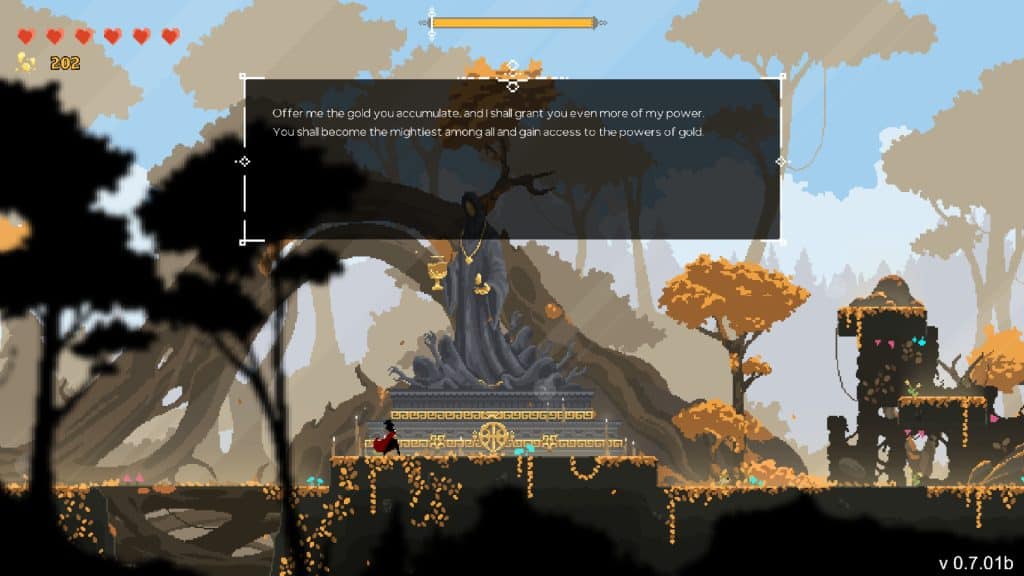
The world of Noreya is one of contrasts, in which two competing gods battle for influence over both the hero and the world they inhabit. These deities, the god of gold and the god of light, factor into Noreya‘s gameplay as much as they do its story. Dotting the map are large statues that act as checkpoints. While in the vicinity of the statues, Kali can choose to pray to either god, as well as pledge offerings to them in exchange for skill points. It’s also worth mentioning that, depending on which god Kali chooses to pledge to, the map of Noreya fills in differently. On the pause screen, you can switch between the World of Gold and the World of Light to see how much map area is complete for either, and there are even achievements for fully exploring the map for either god or both.
What’s less clear is how the worlds differ other than a meter at the top of the screen indicating how aligned Kali is with either god or the fact that we can choose to spend more or fewer skill points in the game’s large skill tree depending on whether we want god of gold or god of light abilities. For the most part, the large skill tree in Noreya offers some freedom in terms of how players build out Kali. Some abilities are unique to either god’s half of the skill tree, with neutral, general upgrades occupying the middle portion. That said, whether you choose to spread out your skill points or strictly allocate them to one god’s progression path seems to have little bearing on the game’s somewhat simplistic combat. Ultimately, it’s the health upgrades and the weapon power upgrades that offer the most bang for your buck.
Pitch Perfect Atmosphere & Visuals
©Noreya: The Gold Project gameplay screenshot – Original
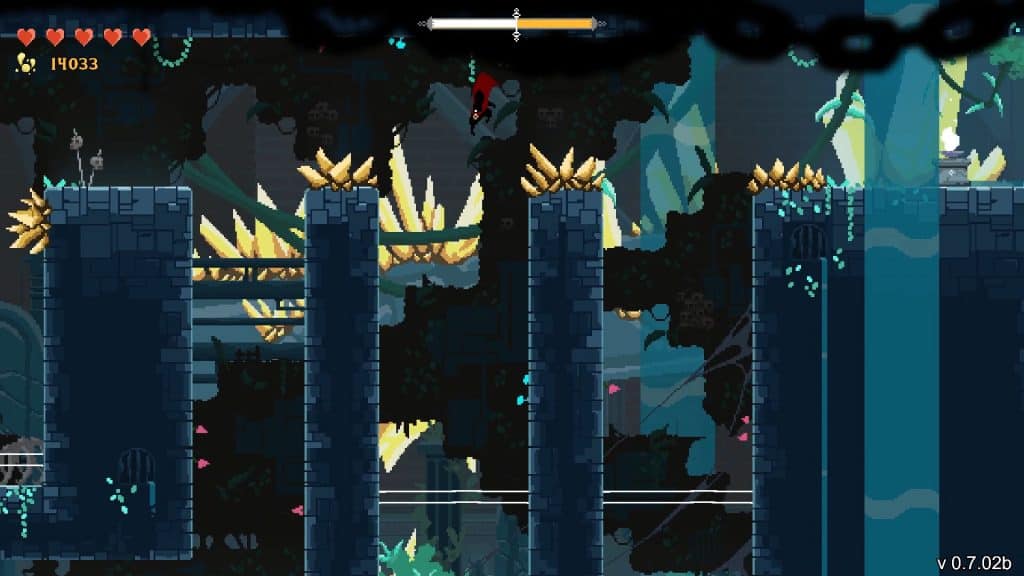
What will likely draw most people to Noreya are its impeccable visuals and animation. In terms of perspective, Noreya cleverly adopts a dynamic camera that regularly zooms in and out on the environments to give the player a better vantage point. This results in Noreya‘s environments having a sense of scale that escapes most other Metrodivania titles. Further, the environments themselves (as well as the background details) are bursting with color and detail. This serves as a nice juxtaposition to the character and enemy models, which all employ a gold and black motif keeping with the game’s story of gold and greed versus light and shadow.
But even though the character models all abide by a similar color scheme, the animations for both Kali and their enemies are nothing short of impressive. These highly detailed pixel-art sprites move in ways that seem far more natural than the medium would allow for. While I was playing the game for review, I kept thinking to myself that there was something about Noreya‘s animations that seemed familiar. Then it dawned on me — the fluid movement of the characters is strikingly similar to 90s classics like Another World or Flashback in terms of its understanding of how things in the natural world actually behave while in motion. Combined with some great, understated music and a Metroid-like atmosphere of a once prosperous world fallen to ruin, Noreya‘s presentation is punching far above its weight.
Pacing & Balance
©Noreya: The Gold Project gameplay screenshot – Original
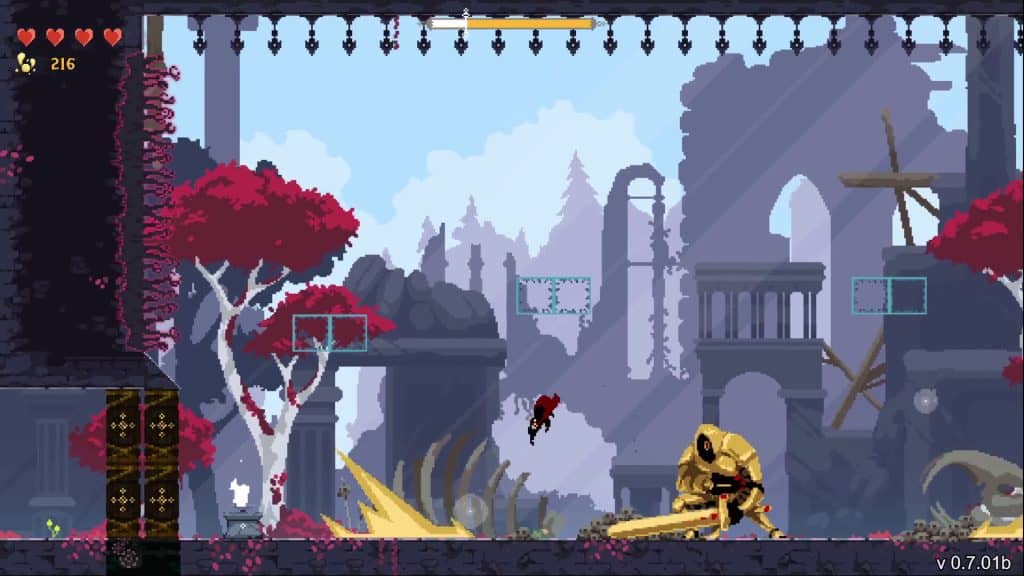
If there’s one area where Noreya stumbles, it’s in its pacing. I was surprised to see that, after clearing the first boss, my progression counter was showing 30% complete. Surprising, then, that it took me roughly 5 hours of playtime (in comparison to the initial 2) to get up past the 50% mark. This kind of inconsistency is fairly common in Noreya in both its pacing and difficulty, and the title’s rough edges are fairly obvious in comparison to other modern Metroidvania titles. Where Noreya earns a pass, though, is the fact that it is largely the work of a solo developer who has been active and responsive to player feedback in the days and weeks following the game’s release. Rough edges are to be expected, and it’s commendable to see that they’re getting ironed out so quickly.
That said, the issues with Noreya‘s pacing can occasionally lead to confusion over where to go or what to do next. Maybe it’s growing accustomed to the conveniences of modern Metroidvanias and their tendency to hold the player’s hand, but there were plenty of times when I was outright directionless when playing Noreya. And with the lack of any fast-travel or warping option, getting stuck in an area can begin to feel hopeless. While some of the negative user reviews on Steam highlight that the game’s combat is too stiff to deal with enemies and bosses effectively, I would argue that the game’s difficulty is well-balanced and that boss fights simply require observing move sets and recognizing patterns and windows for attack.
Bottom Line
In terms of modern Metroidvania titles, Noreya: The Gold Project is a game that doesn’t stray far from the core elements of the genre. But that is in no way a knock against the title, as its emphasis on the genre’s fundamentals (and understanding of how they should work in practice) sets it apart from many of its contemporaries. Noreya‘s pacing and combat tend to struggle a bit in comparison to the game’s excellent platforming and visual style, but its manageable length and responsive controls act as a salve to any of the minor weak points the game may have. Noreya is a “meat and potatoes” experience that sets reasonable expectations and nails every one of them, and its technical performance on the Steam Deck is rock solid following a rapid slew of updates in the wake of the game’s initial release.
Rating: 8.25 out of 10
The image featured at the top of this post is ©Noreya: The Gold Project key art / Original