Hyrule Becomes Pandora
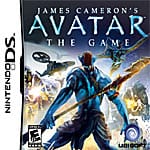
James Cameron’s Avatar, the superstar director’s first movie since Titanic, promises a jaw-dropping visual spectacle, a gripping story, and a frenetic pace. Some early reviewers have accused Cameron of being too preachy with his tale of environmentalism and war, but even they have agreed that in most ways, Avatar is a true revolution in filmmaking.

Unfortunately, the DS game that shares the movie’s name is something less than a revolution. It’s merely a knockoff of top-down Zelda games; it’s well-made, but it was released only six days before the latest DS outing of the franchise it steals from. Gamers who finish Zelda: Spirit Tracks and still hunger for that classic puzzle-solving, boss-battling gameplay might want to give Avatar a shot, but it’s nowhere near as much a must-play as the movie is a must-see.
This handheld title makes no attempt to ape the gameplay of its big-console brethren. Players will find no third-person shooting, no intense melee combat, and no 3D capabilities, and they won’t have the option to play as a human.
Instead, they’ll play solely as Nok, a young, Link-like member of the Na’vi tribe on the planet Pandora. The “sky people” – humans who belong to the military group RDA – are invading Pandora for the purpose of mining the metal unobtainium. The sky people are disguising themselves as Na’vi through the use of human-Na’vi genetic hybrid “avatars,” and gradually it becomes clear that Nok is destined to fight them off.

We haven’t seen the movie yet, but from the information available online, it appears the developers took a good deal of license with the story. As presented here, the lengthy tale is full of twists and turns but is far from interesting or compelling, which is probably not the case with the plot of the film. Nonetheless, we suggest seeing the movie first so the game doesn’t spoil anything.
As Nok, you have to explore Pandora’s various continents, acquiring information to pass on to the Na’vi deity, Eywa, who in turn helps Nok in his quest. As you’d expect, you acquire useful items along the way that help you explore previously out-of-reach places, and you fight bosses with unique weaknesses.
The control setup will be familiar to anyone who’s played a DS Zelda game. Virtually everything is done with the stylus, and there’s no option to use traditional controls. Fortunately, the Zelda franchise more or less perfected this setup, and it’s rarely frustrating here. You move by touching your character’s destination, attack with your (sword-like) staff by touching an enemy or moving the stylus in a swing pattern, and use items you collect by navigating a menu. Our one complaint is that after selecting an item from the menu, you have to select it again to use it; we can’t tell you how many times we picked an item, tapped the location on the screen where we wanted to aim it, and promptly walked off a cliff instead.

The gameplay here is surprisingly compelling, especially for a licensed game. Many of the puzzles are extremely simple time-wasters (push this block, flip this switch, find that key card), as is to be expected from the Zelda style, but there are some real doozies here, especially later in the game. They get complicated in part because of the items you have to use, which include various projectiles and even a monkey-like creature that can fit into small openings. Even the easy sections are arranged in ingenious ways that keep you moving back and forth across the game’s territories without feeling bored, and there is almost no needless backtracking, at least until one later mission that sends you scouring the areas you’ve already explored for glow worms.
The platforming challenges also get more and more involved, incorporating platforms that move or even electrocute you. The earlier boss battles get repetitive (wait for him to throw an explosive at you, throw it back), but some of the later foes have very clever weak spots, and beating them requires some strategic item use.

This trajectory of easy tasks building into a tougher challenge is perfect for casual gamers, and for children who can handle somewhat-complex puzzles. However, even the game’s most demanding moments probably won’t hold the attention of a hardcore gamer. The map is a little too helpful, not only telling you where to head for your next objective but also pointing out some of the collectibles you missed. Because you can save any time you enter a new area, there are almost no consequences for dying. If a boss kills you, the only punishment is that you have to re-watch the opening dialogue before trying again, which admittedly is a little obnoxious. Also, of course, you lose any damage you dealt before dying.
Much of your character’s development happens automatically as you progress, but you also collect pieces of lore, as well as currency. The lore unlocks various upgrades, which you can purchase at a “lore-sharing shrine” with the currency. You can do everything from making your staff more powerful to giving yourself more life to carrying items more easily. There are 70 pieces of lore in total, and you can’t grab them all on the first play-through, so they provide a reason to keep going past the end credits. Avatar doesn’t quite achieve Zelda levels of bonus material (in our years with that franchise, we’ve spent almost as much time on side quests as on core missions), but it does make a good-faith effort to provide gamers value.
In terms of presentation, the game succeeds for the most part. The graphics don’t exactly push the DS to its limit, but they’re pleasing to look at and do a reasonable job of depicting a foreign, exotic planet and the creatures that live there. The sound effects are fine, though the music is a little stereotype-heavy in how it evokes a tribal society (it sounds Native American). The dialogue scenes are the low point here, and can make the game drag in places. They’re just cartoonish images of heads with speech bubbles attached, the writing is terrible, and they don’t fit the game’s overall dark feel.
Over the coming weeks, almost all movie-lovers will flock to Avatar. DS owners will have a less frenzied response to this licensed game. Anyone who likes Zelda-style gameplay will find something to like here, but it’s hard to justify a Zelda knockoff when a real-deal Zelda just hit shelves. We can’t say Avatar is a bad buy, given how much fun we had solving its many puzzles and smiting its tougher bosses. Still, we’d rather spend our time and money on Spirit Tracks, which is listed at only $5 more.
RATING OUT OF 5 RATING DESCRIPTION 3.7 Graphics
They look good, but they’re not exactly jaw-dropping. 4.5 Control
They’re basically aped from the Zelda franchise, but they work great. 3.2 Music / Sound FX / Voice Acting
The sound effects are fine, but the music relies on stereotypes instead of innovation. 3.0
Play Value
The story is lengthy and there are plenty of extras to find after finishing, but the gameplay is derivative and can drag at points.
3.2 Overall Rating – Fair
Not an average. See Rating legend above for a final score breakdown.
Game Features: