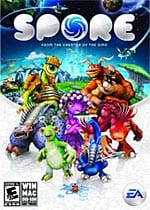
April 27, 2007 – As with any technology-driven medium, the video gaming world evolves through competition and innovation. Just like in nature, big changes can occur rapidly and randomly and then are refined through smaller changes and adjustments over time. It’s the big changes that matter though, and they are the reason we eat burritos while surfing the web instead of sipping plankton in the sludge. The latest spawn of the gaming gene pool is all about Evolution. It’s called Spore, and it’s the brainchild of developer and industry luminary Will Wright. Spore is devilishly simple and one might say, without exaggeration, brilliant.
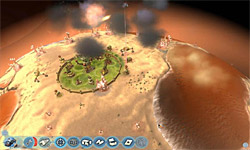
The game starts out in soup. We’re not talking bisque here, more primordial soup teeming with DNA combining into the very earliest forms of life. The player explores the soup, encountering other similarly simple organisms and competing to eat or be eaten. As your organism flits and eats its way through its environment, it can begin to evolve. This is the key to the entire game, and the very first step in the evolutionary process. The organism can now lay an “egg” which opens up an editing interface where the player can trade in points to adjust the organism. In this two-dimensional mode, the player can add vertebrae, pincers, appendages, or any number of basic adjustments to their organism. As the organism continues to gain points through eating and competing, the player trades them in to make more and more adjustments. Eventually, the organism has evolved into a higher form of life and may even take to the land.
Some organisms never leave the water and continue to evolve, but the ones that do engage in some of the most interesting content of the game. Just like in the “Cell” phase of the game, the player must pit their creature against others in the search for food and, you guessed it, more chances to evolve. From a purely technological standpoint, the evolution of movement and ambulation in these creatures is amazing. As the player uses the editor to adjust their creatures, the game dynamically creates solutions for how the creature will move and walk based on the player’s adjustments. For example, a top-heavy creature with an odd number of legs will waddle from side-to-side, transferring its weight to each appendage one at a time. The game performs this feat instantly, and can keep up with even the strangest flights of the player’s fancy. 12 beaks and 30 legs? No problem. The game will find a way to make it live. Did I mention reproduction is no longer asexual? Yep, the creatures totally do it. What’s more, the game figures out how they mate in the same way it figured out how they would walk. There’s a musical accompaniment and everything. Once the player has advanced the creature through this phase they can begin to max out its brain. What happens then? I’ll answer with another question: did you ever see Deep Blue Sea?
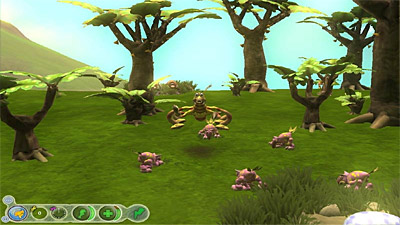
That’s right – the things get smarter. They get smarter and start to form tribes. In this phase of the game the focus shifts from the purely biological to the socio-cultural. The player can trade in their points to give their creatures fire, musical instruments, or even weapons. The end result is that these little guys will start to dance, play, and generally socialize. This forms a rudimentary creature society, complete with dwellings and day-to-day interactions. It’s all beginning to feel like the Sims, no? Wait for it…
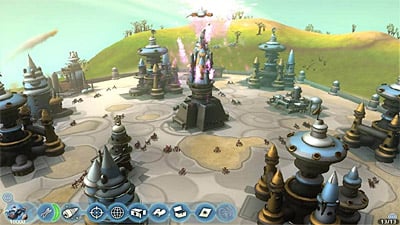
The next phase of the game takes on a bit of a SimCity tinge as the player can now create and manipulate the creatures’ cities. Buildings and the environment can range wildly from highly industrial-looking cities of the future to more organic, Dr. Seuss-like abstractions. However, you’re not alone in this brave new world. Those octopus-things you ate a few levels back? Well, they’ve evolved, too – and they have tanks. Vehicles are the primary way in which various civilizations interact at this level. The player can create and adjust vehicles for their civilization with as much free rein as with the creatures themselves. At this point, the player must begin to use military force, diplomacy, and economic means to interact or even conquer their neighbors. Just when the player has firmly established their civilization on the planet, the game takes a step into the final frontier.
Space is your new sandbox in the last phase of the game. The player travels in a flying saucer from planet to planet in their solar system, encountering other civilizations and interacting with them in a variety of ways. Whether you bring them love or the sword, it will affect your reputation and the manner in which civilizations react to you. The player can even plant colonies on planets and eventually terraform them to be habitable for your creatures. The mechanism for this is very similar to the Genesis device seen in the Star Trek films. As with your first encounters with other civilizations, you can bring the sword to entire planets. If they just won’t listen to reason, or otherwise displease you, you can blow them into space dust. Eventually, the player can travel between solar systems by listening in on communication signals and following them to their point of origin. At this final stage of the game, the player’s power and perspective is truly cosmic.
The game itself is more of a toy than a game. That is, the purpose is more to exist and enjoy the world, playing with the various functions and achieving small goals along the way. The various editors allow the player to adjust creatures, buildings, and vehicles down to the very finest details of shape, size, and texture. No matter what choices the player makes, the game finds a way to make it work in the game. The end result is a nearly endless series of possibilities for creating worlds. Creator Will Wright claims about 40 percent of the game is tinkering with the various adjustments to the creatures, buildings, vehicles, and planets. It’s a very simple basis for what could become a tremendously diverse gaming experience.