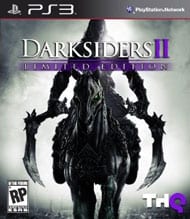
Take A Ride On The Darkside
In January, THQ walked us through a short demonstration of Darksiders II , introducing us to its new protagonist, Death. In the time since, details have come forth on the title’s release date, its pre-order incentives, and its Limited and Collector’s editions. Then came Monday, when the developers finally felt comfortable putting the controller in our hands and letting us have our first taste of the upcoming action-adventure-with-light-RPG-elements mash-up.
The demo was set near the end of the first act, we were told (the game takes place over four major areas, each of them purported to be as large as the entire map for the first game), and the basics of control were explained to us. Then we were off. It turned out that our journey would begin just after where the previous demonstration had ended, with Death striding past a massive hammer on his way deeper into a dungeon. Exploring the temple led to its center, where the massive, guardian construct we were tasked with awakening stood dormant, demanding three “heartstones” before it would come to life and help rid the Makers’ Realm of the Corruption.
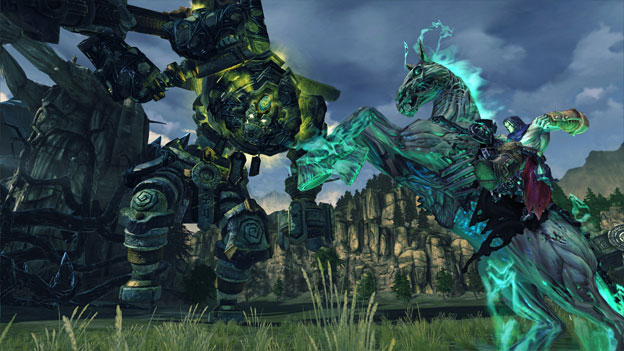
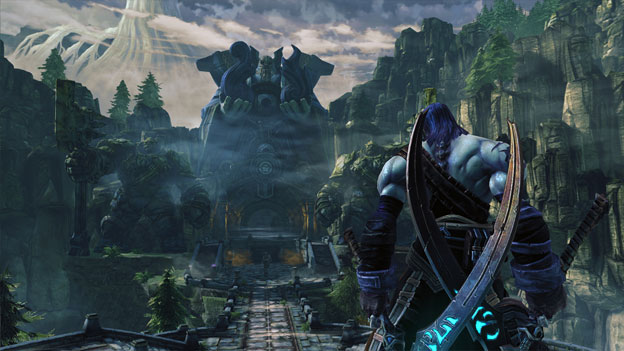
Pursuing these stones took us through varied environs, from old hallways of brick and metal to verdant clearings and chambers coursing with lava. There were lakes as well, in which Death could swim. The scale of these areas was incredible, elements often stretching into the distance so far and so high that I assumed they were only background, until the game demanded that I proceed to them. The graphics, in general, are consistent with those of the first game, though most objects seem somewhat smoother, their textures more intricate.
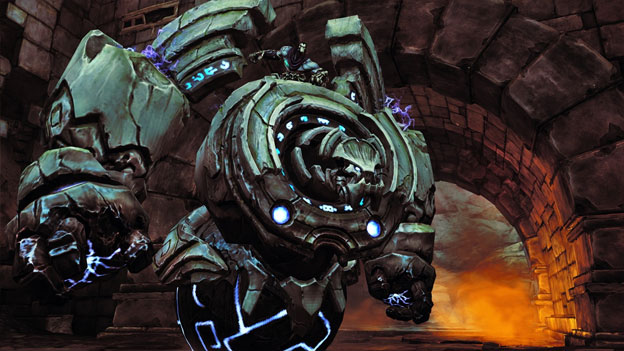
Eventually, after finding all three stones, the guardian shuddered to life, but one of the power sources had been corrupted, and soon I was riding atop Despair, combating a hulking behemoth that would easily have been at home in Shadow of the Colossus. Once defeated, the demo came to a somewhat abrupt end, the entire experience leaving me, on the whole, tentative regarding the game. Before I go into my thoughts, though, a few housekeeping things: First, I asked whether the game had been sent in for certification prior to the event, which it had not as they were still in the process of polishing it; second, the demo was based on month-old code, and was thus not entirely representative of the game as a whole.
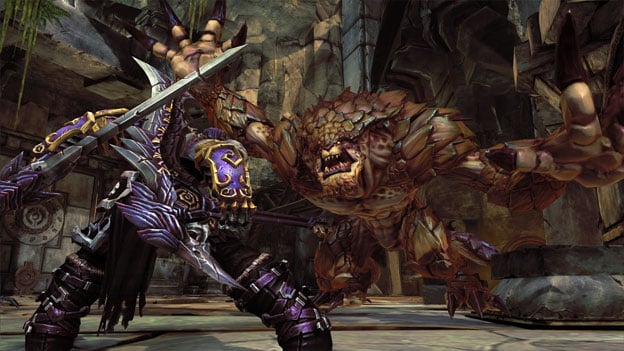
That said, there’s definite promise. The environments are creative and interesting to explore, the graphics are recognizably Darksiders, but are both cleaner and more complex than the first entry, and weapon variety has been improved. In the demo alone, Death had tonfas, axes, hammers, and claws available as secondary weapons. This was in addition to his dual skill trees, each of which features multiple abilities to buy and a series of skills that in some way modifies or powers up the attached ability. Each of these skills could be upgraded multiple times.
Further, as mentioned before, the boss for the demo was tremendous, as was the open field in which we fought him. In general, environments were bigger and more open to exploration than in the first game, which only occasionally left me feeling overwhelmed and, far more often, provided a sense of wonder at the scale of the game.
There were a few things that irked me, but they may be fixed by release. The frame rate was inconsistent, constantly dipping if things were starting to get a little hectic. There was also prevalent screen tearing, though turning on V-Sync in the options menu reduced this at the cost of more frame rate. Platforming occasionally felt a little wonky, with Death inconsistent about when he would grab a ledge and when he would just bump into the same and plummet to his demise. The camera was unwieldy, resistant to being controlled and often too close in or at the wrong angle to give a proper sense of distance and orientation for the target of Death’s next jump.
Then, there are the elements of the game that just seem like poor design decisions: Combat is even more button-mashy than in the first game, since Death is a faster character. I caught myself hitting the attack buttons in a regular, dull rhythm, only occasionally having to think about defense. Abilities are still somewhat awkward to use, demanding that one hold down a button that temporarily disables one’s capacity for normal attacks. As such, abilities are still unable to be worked naturally into combat, demanding a very specific intent to use them; often I just forgot I had them.
Most worrisome, though, are the platforming controls and the loot system. While Death’s expanded wall-running capabilities and more acrobatic climbing are welcome, it seems somewhat unnecessary to—if one has already used one button to specifically target and launch toward a peg on the wall for the express purpose of boosting oneself into the air—demand that a player press the jump button at some ill-defined time as Death approaches the peg to actually use it correctly. This “press jump to use the peg” concept shows up when wall-running, too, if one wants to use one of them to continue their wall-run longer without dropping too low. It’s reminiscent of 2008’s Prince of Persia reboot, which required a ballet of button presses for various platforming feats. As in that game, there’s no feedback here to tell you whether or not you’ve succeeded, until Death either uses the object correctly or doesn’t. It’s a strange enough choice that I constantly caught myself forgetting to actually hit the button as I was launching myself toward my target.
Even this, though, is relatively minor compared to the loot system. Equipment drops fairly often from downed enemies and springs out of opened chests en masse. There are half a dozen different slots to equip, from weapons and armor to accessories. It’s great that there’s so much variety in what Death can wear, and that it models so well on him, but there are seemingly innumerable characteristics that a given piece of equipment can possess, from the basic “attack” or “defense” stats to various elemental resistances and bonuses to specific types of damage. Percents and scores flit around onscreen, and it’s all a bit overwhelming. Further, the number of stats any given weapon has all but ensures that there will be a lot of red in the comparison screen, and picking an item that suits your play-style becomes overly time-consuming. This utterly broke the flow of the demo, which was at its best when I was either exploring or solving puzzles.
Again, all of these impressions are based on a non-final build of the game, which has yet to be submitted for certification. What I played, though, has left me a little apprehensive about Darksiders II. The first was a hodge-podge of various genres and gameplay elements from prevalent series, but it managed to use those elements well and, as a whole, it just worked . The sequel has certainly expanded its range of inspirations, but seems to have a little trouble distinguishing what works for it from what’s best left on the cutting room floor.
Game Features:
Death Gets A Life
Darksiders was one of the most depressing narrative experiences I’ve ever had. Take Zelda, but excise its charm, and set it in a world in which humanity has been eradicated. Honestly, what’s left for one to empathize with? War? He’s an anthropomorphized expression of a concept, not a compelling and multi-faceted character. The one pervading theme throughout the title was the character’s rigidity (all characters, actually), as situations were dictated not by individuals’ emotions and agency, but by arbitrary rules and codes to which they would cleave, holding them to their chests like metaphysical life preservers.
That said, the gameplay itself was fun. Combat was entertaining, if somewhat one-dimensional, and the environmental puzzles were good fun. Plus, the artistic design was compelling. War was a visibly powerful protagonist. He’s also not in the sequel. Though, in truth, to call Darksiders II a sequel to the original is a misleading statement. It’s more of a parallel tale, focusing on Death’s journey as he traverses fantastic realms in an effort to clear his brother’s name.
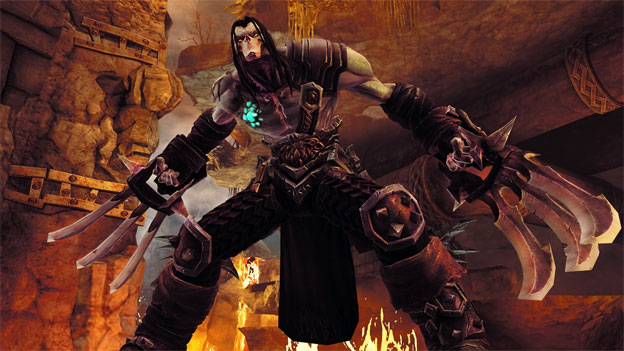
According to information provided by THQ, Death is the de facto leader of the horsemen. He’s certainly the oldest, and is written to be something of a philosopher, perhaps. At the very least, aestheticism and precision mean something to him, informing both his choices as an individual and his combat style in game.
See, War was a tank. He hit stuff with a big sword and weathered the storm of weaker blows from his opponents. He could move, but it was somewhat laborious, and this came across in the gameplay. Combat was a somewhat soggy affair. Darksiders II aims to spice things up by taking away your block button. Rather, Death will have to evade his opponents in melee, lashing out with his base weapon of dual scythes in fast and furious combinations (note that the scythes can recombine into a single one for certain attacks) or one of the subweapons. In fact, two of such subweapons were demonstrated for us: a massive hammer that swung slowly but did tremendous damage, and a pair of claws that attacked in weak, rapid combos, shredding enemies.
The thing is, as many changes as have been made to combat and the underlying game system, many of the same concerns stick out to me. Though Death attacks faster, it feels like his attacks are having even less of an effect on sturdier enemies, who don’t respond to his attacks in an aurally or visually exciting manner. This is exacerbated by the new damage numbers and enemy health bars (I asked, and it was confirmed that one can turn these off), which do provide exact knowledge of how one’s fight is proceeding, but also made it apparent just how much damage these foes can soak up. There’s also the Ghost Hand, which is used in combat as well as traversal, and is more or less Nero’s Devil Arm from Devil May Cry 4.
Traversal, on the contrary, has seen almost unilateral improvement. Death’s agility and Ghost Hand enable acrobatics on a Prince of Persia scale, including wall-running and beam/rope balancing. It looks to be very intuitive, as long as the camera can be reined in a bit and it’s careful to introduce new traversal options, such as the aforementioned Ghost Hand, in controlled environments.
The biggest alteration to the overall Darksiders formula, however, is the introduction of more blatant RPG elements. Death, unlike War, can collect equipment from downed enemies. There are three main sets of armor—Slayer, Necromancer, and Wanderer—which enhance different aspects of Death’s performance. There are numbered stats, taking the game a bit further from its action-adventure roots and firmly into the territory of the action-RPG. Along those lines, it also features a pair of skill trees in which one slots points over time. These two trees, Harbinger and Necromancer, open up spells and afford you greater control over how you play Death.
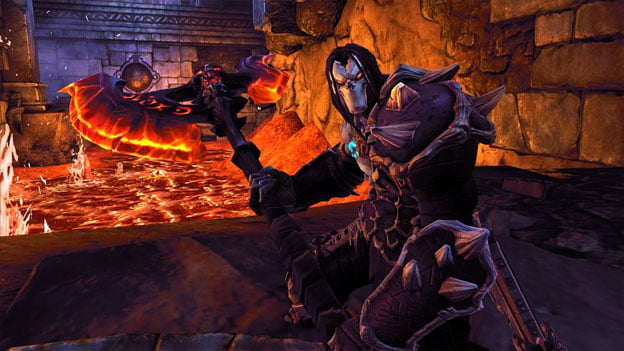
In the all-too-brief gameplay demonstration, THQ walked us through parts of an early side-dungeon (we have been assured that there is a tremendous variety of secondary content) and showed off a sub-boss fight. They were very proud of the size of their bosses, asserting that the mid-boss we were seeing—three or four times the size of our protagonist—was built on a much smaller scale than the game’s real bosses. To punctuate this point, we were shown a snippet of a later dungeon, with Death observing a tremendous, stationary hammer ostensibly gripped in the obscured hand of that dungeon’s monolithic boss.
Visually, Darksiders’ pleasingly bright color palette has not been dimmed for the Pale Rider’s outing. It’s as vibrant as ever, with Death displaying elements of white, purple, and green in addition to the black, brown, and grey one would expect. Despite the apocalyptic subject matter, this is not a game that believes in muted tones.
Understand that this was not a finished build of the game, and everything we saw is subject to change. What was already there, though, was the framework for a title that should entertain players who enjoyed the original Darksiders, and provide them with a longer and more involved experience. We’ll know for sure when it hits later this year.
Game Features:
A Shot At Redemption
When last I left Darksiders 2 , I was less than enthused with what I had seen. The game was a choppy, slow-paced, unresponsive shell of what had made the first game so much fun to play. Leave it to Vigil to turn that around in a matter of months. In the THQ conference room (in lieu of a booth this year), after seeing Metro: Last Light and Company of Heroes 2, the company allowed me to sit down with a new build of Darksiders 2, this time ripped from the beginning of the game and showing far more polish than its predecessor.
Things kicked off with an introductory sequence, explaining the history of the Horsemen, how they had turned their backs on their own kind in service to a higher ideal. War’s “betrayal” is recounted, and Death heads off in an effort to end his punishment by uncovering a means by which he hopes to bring back humanity. It lends some context to the Darksiders mythos that, in the first game, was notably absent, and allowed me to better sympathize with Death and his journey. The fact that there’s a sense of filial responsibility, that Death’s excursion is for his brother, provides the emotional impact that Darksiders’ tale of vengeance was lacking.
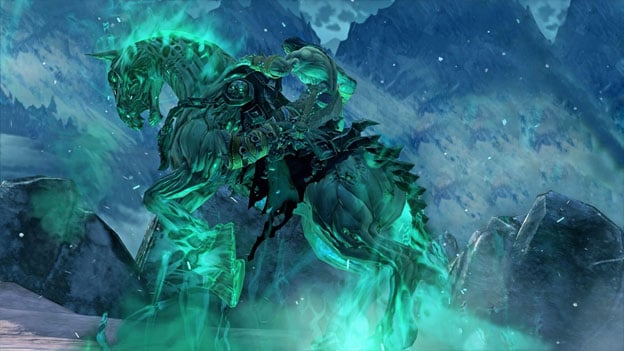
Upon gaining control, the first thing I noticed was the frame rate, which seemed surprisingly stable. As Death trudged up the snowy slope atop his steed, approaching the icy fortress at its end, the frame rate never dropped. This held even once inside, combating crystalline enemies and golems with Death’s twin scythes and a massive hammer he found a few rooms in. Smoother, in fact, would describe the entire experience, which was better for having its platforming simplified down. Death now automatically propels himself along when he comes across the little stubs in the wall that had previously demanded a second input. Further, he seems to more naturally grip the edges of climbing surfaces than before, making for fewer frustrating and unintentional falls.
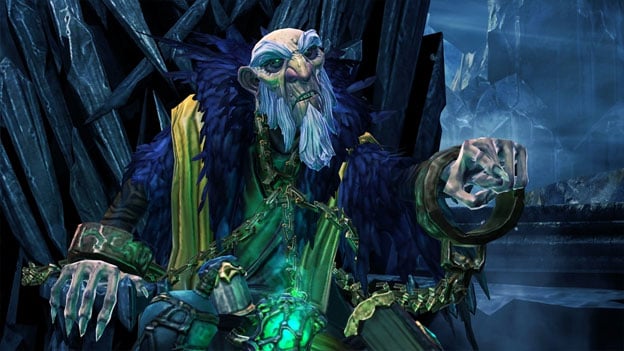
Partway through the demo, I left for another appointment, but came across the same demo of the PC version of the game at the Alienware booth later in the day. This ran extremely well, the more powerful hardware removing even the last elements of hitching that had been present in the Xbox 360 demo. As it proceeded, Death worked his way through the small dungeon and to what appears to be the game’s first boss, an old crow of a man with a lantern that bore the trapped spirits of the Horsemen’s kindred. He is appropriately titled the Crowfather and serves as a keeper of secrets, burdened with them and the manse of souls via an apparent deal between him and Death. The Horseman demands knowledge of how to restore humanity, at which the Crowfather balks, demanding to be freed of his burden in turn.
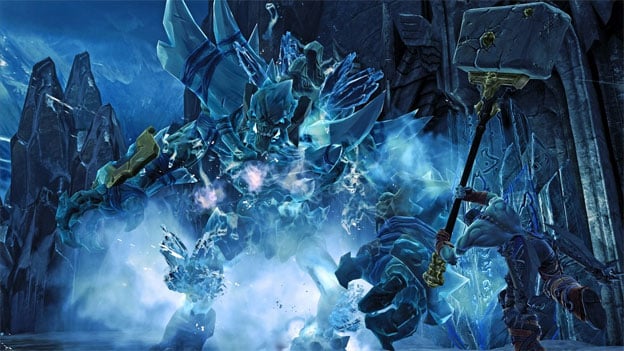
The disagreement results in the Crowfather attacking Death, assuming the form of his brother, War, and begetting the first truly challenging fight in the demo. The minions faced up until this point had gone down easily, with obvious patterns and sizable blind spots that could be readily exploited by a player with even a smidgen of awareness. The War simulacrum, on the other hand, is an altogether different beast, his attacks coming quickly, breaking through Death’s combos and hitting with wide areas of effect. His hand forced, Death slays the Crowfather in the form of his brother and the manse breaks, impaling Death’s chest with a crystalline projectile, which leaves a pulsating, glowing patch on his skin, knocking him to the ground apparently unconscious.