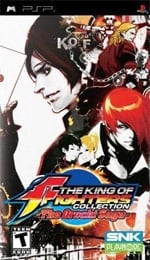
A Sizable, But Flawed Fighting Offering
Capcom may have been the fighting game heavyweight with arcade classics like Street Fighter II and comic book-based franchises such as X-Men, but that didn’t stop SNK from producing a string of 2D one-on-one fighters.
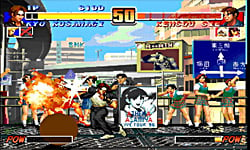
SNK, known for their Neo-Geo arcade and home systems, kept a solid pace with Capcom throughout the ’90s, with series like The Art of Fighting and Fatal Fury. Even while SNK was cranking out new entries to these staple series, it also produced The King of Fighters every year – beginning in ’94 and ending in ’98. This series took fighters from The Art of Fighting, Fatal Fury, Ikari Warriors, and Psycho Soldiers and threw them into one big tournament, moving from one-on-one battles to group brawls, pitting three fighters at-a-time against one another.
In the past, gamers had to buy an entry at-a-time when it came to The King of Fighters series. Now, SNK has packaged all five games – ’94, ’95, ’96, ’97, and ’98 – on one UMD. It all seems like a matter of simple economics – five for the price of one should always be a better deal – but technical issues as well as redundant gameplay keep this fighting compilation from rising above the rest of the fighting pack.
Before dissecting Orochi Saga’s technical problems, it’s important to remember its point of specialized origin. All these games were meant for an arcade cabinet with a 4:3 SDTV screen with a nimble eight-way joystick. Once you realize those two facts, you can already begin to imagine the problems of chucking that experience onto the PSP. Since the PSP has a default aspect ratio of 16:9 (that is, it’s widescreen) that means that SNK had two options: it could either rework its code to properly reflect this or run the titles through an emulator and experiment with aspect ratios. SNK chose the latter route, which is unfortunate. There are several screen resizing options – for instance, you can crop the screen to 4:3 or stretch the image across all of the PSP’s display – but neither of these options is stellar. If you want to get the game’s original aspect ratio, you have to crop the image so much that you’re left with a box in the middle of your PSP that roughly takes up only half the screen. And if you stretch the image, then you miss out on a good amount of pixels.
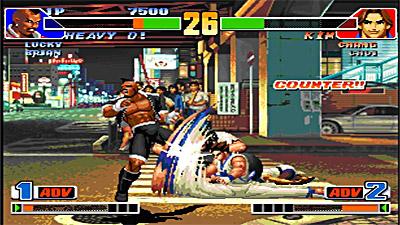
Then there’s the joystick side of the equation. There’s two replacement options for that: the PSP’s D-pad or analog nub. The nub might as well not be an option as it doesn’t register input very well. The D-pad – while much better than one would assume – is still insufficient compared to a proper joystick; it does its job, but in more of a serviceable manner than an excellent one. The PSP also doesn’t help matters with the slow nature of its UMD drive. It leads to delays in sound effects – sometimes taking several seconds to register – and load times that reach the half minute marker.
Playing through these five fighters serves as a form of narrative flashback. Fighting games have never been strong on story, but this was even more so in the heyday of 2D, one-on-one fighters, and each entry in The King of Fighters Collection is a reminder of that fact. If you try to follow the two main story lines – one revolving around the rich drug trafficker Rugal Bernstein and the other, which dances around a mystical power called Orochi – you’ll either find yourself not caring or completely lost in nonsensical ramblings. This all carries over to the lines delivered by the characters that seem to always straddle between sloppy English and full-blown Engrish. Of course, games like Street Fighter had these same silly bouts of dialogue, but when you read a character saying, “You need to find the real meaning of battle. Pain!” or “The only enemy I have is me…And my old girlfriend, and…” all those 2D fighting memories come back, for better or worse.
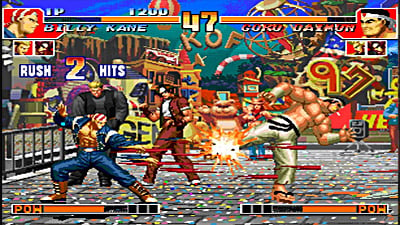
Covering a time span of five years, the assumption would be to see a steady progression in gameplay mechanics or at least some sense of refinement as one moves up the historical SNK chain. Even though you’re getting five games in one, there is a sense of diminishing returns present. Sure, each entry in the series has more characters, a slightly higher amount of sprite detail, and some new moves, but the basic gameplay is one that centers primarily around special attacks.
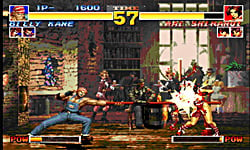
While fighting games now have advanced counter systems and sophisticated multi-hit combos, all the games in Orochi Saga are of a “wait to perform the special move” nature. You can’t really build up big combos and the counter system present is minimal. It never feels like you’re being strategic in any real sense – rather, you’re blocking and setting up for that moment where you do a stereotypical quarter-circle punch move. Since all the games essentially play like this, it begs the question: do we need five versions of this? SNK fans will undoubtedly say yes; however, those new to the fold may echo the question.
Aside from the general arcade and two-player mode, Orochi Saga also features a dedicated training and challenge mode. The Training mode is quite extensive; you can pick any move and have it displayed onscreen right below your health bar. This may not seem like much, but having the move onscreen as opposed to forcing you to continually jump back into a menu to see it is a nice touch. Yet, for that smart decision there’s one particularly strange omission: you can have the computer block your attacks, jump, or even mirror your actions, but there’s no general sparring mode. If you want that, you have to jump back to the arcade mode.
The different battle conditions present in challenge mode spruce up gameplay simply because they introduce some variety. You might fight an enemy, but not be allowed to see their health bar or power meters; some opponents can only be damaged with combos that are three hits or higher; and other battles may start you out wounded, but reward you with health for every hit you score. These battle qualifiers definitely make for some hardcore fights, which makes your reward seem not all that worthwhile. Beating challenges awards you with concept art and galleries, as well as arranged and official soundtrack music. These awards have a ho-hum effect. They don’t unlock anything that ultimately affects the game – they’re more of fan service than anything else.
The King of Fighters Collection: The Orochi Saga ultimately falls flat because of technical issues that render its attempts at historical authenticity paltry. Only the most diehard SNK fans who want their fighting on the go (and can deal with their precious titles having some emulation errors) should pick up this title. It’s really hard to recommend this title, especially when the PS2 version is available at half the price.
RATING OUT OF 5 RATING DESCRIPTION 3.4 Graphics
All five games are sprite-based, so spotting the graphical progression – while possible – is a little difficult. It’s all serviceable though and the only real complaints are the load times and the PSP’s screen, which isn’t suited for the aspect ratios available. 3.2 Control
Hardcore fighting fans always opt for a proper joystick, but since we’re talking about the PSP, your options are really only two: the D-pad or the analog nub. The first option works well enough (although it sometimes doesn’t register moves correctly), but ignore the second. 3.5 Music / Sound FX / Voice Acting
The backing tracks suffice, providing that classic midi fighting feel. The sound effects, with their strange delays, degrade the audio package. 2.8 Play Value
The five-in-one package may seem like a value, but since all the games play nearly the same with only slight differences, it can almost be looked at like the same title delivered five times. Also, with a PS2 version that’s cheaper and the PSP’s control and display issues, it makes this version hard to recommend to all but the most devoted SNK fans. 3.2 Overall Rating – Fair
Not an average. See Rating legend above for a final score breakdown.
Game Features: