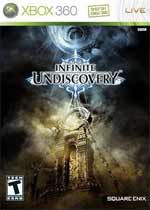
Chained to Convention
Tri-Ace and Square Enix have, once again, come together to create an involved JRPG for a worldwide audience. After creating successful franchises such as Star Ocean and Valkyrie Profile, we expected a lot from the team’s latest offering. Unfortunately, Infinite Undiscovery doesn’t deliver the way I had hoped it would.
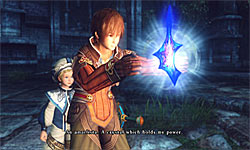
The fast-paced combat is interesting and the main storyline is solid, but the tacked on side quests, unwieldy team combat mechanic, and incessant party management makes this a title for the JRPG hardcore and not a broader audience.
Infinite Undiscovery tells an interesting story of a world and its moon. The moon is responsible for keeping balance and harmony on the planet and bestows powerful magical talents to the majority of the people. The story in Infinite Undiscovery follows a young musician named Capell, who looks identical to the world’s prophesied savior, Sigmund, but who has, at least initially, none of his warrior spirit. As such, Capell is thrust into dangerous situations for which he is simply not prepared. Capell’s ensuing struggle against a cult known as The Order of Chains and their leader, Leonid the Dreadknight, will test the youth’s resolve and the previous notions he had of himself and his life’s path.
The Order of Chains is powerful force that has captured the moon for itself, trying to harness its power to pave the way for their leader’s ascension to godhood, while denying the rest of the world’s inhabitants their right to be blessed by the moon. Moreover, the unnatural chains that have tethered the moon are throwing of the balance and unleashing foul creatures upon the lands. It is up to Capell, the hero Sigmund, and an eclectic group of heroes called the Liberation Force to put an end to the chaining of the moon and the machinations of the Dreadknight.
Sadly, though players will enjoy the interesting world and engaging characters, they will be hard-pressed to find any fun extras. You see, the side quests in Infinite Undiscovery are little more than glorified errands that do little in the way of rewarding your characters. Consequently, these quests are a dispensable waste of time. That means players interested in achieving 100% completion will be bogged down in a river of dull and superfluous missions that have no substantial bearing on the main quest. This definitely hampers the amount of genuine content to be found in the game, despite the fact it is spread over two disks.
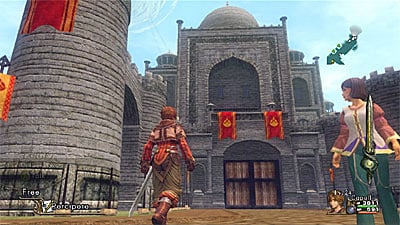
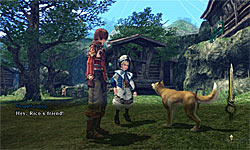
Concerning presentation, the smooth animations, interesting character models, varied, detailed environments, and flashy magic and combat effects are great. Plus, the preponderance of excellently crafted cutscenes really help to convey the tale for those who enjoy Japanese storytelling. On the downside, the intensity of the visuals and the hectic battles can lead to extensive clipping and slowdown. This definitely was an eyesore and even impeded gameplay. This is an unfortunate, major blemish on an otherwise pretty game. Graciously, the presentation is bolstered by the solid delivery of the lines by the actors (even if the words didn’t quite match the characters’ lips). Moreover, the musical score successfully communicates the intensity of the battles and the mystery of the world.
The combat system in Infinite Undiscovery is unique and interesting. I thoroughly enjoyed the mechanic, but, at the same time, I wouldn’t be surprised to find out that others were put off by it. That’s because the scheme tries to tackle not only individual combat actions, but also dual, connected attacks and full party control in real-time. It can be a bit overwhelming at first and remains a bit cumbersome throughout.
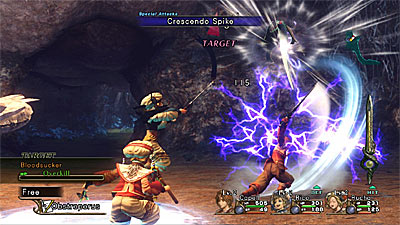
First, players will play the entire game as Capell, the reluctant hero. Making attacks is as simple as pressing the A and B buttons for Quick and Power attacks, respectively. For example, combinations, called Special Attacks, are easily executed by linking a series of Quick attacks with a finishing Power attack.
If executed in concert with the AP Gauge (a meter that fills with successive strikes), players will be rewarded with special bonuses and more devastating effects, assuming the meter is greater than the target’s rating. This is also true of Battle Skills. By holding down on either of the buttons, players can execute Battle Skills (magical attacks that use both the MP [magic points] and AP gauges).
Additionally, players can map various Battle Skills they acquire to either the Quick or Power Attack buttons. Assigned skills will be more or less powerful and use more or less MP depending on the slot that is chosen. In this way, players can measure and control the amount of damage they want dish out and how much MP they will consume. Also, targeting enemies is easily executed; simply by clicking the R stick, targets will be selected. Using LB will toggle between the enemies. In addition, blocking in Infinite Undiscovery with LT is a very important technique, as opponents will be stunned, giving you an opportunity to counter. Unfortunately, parrying attacks is ineffective unless you get the timing just right; expect to take a lot of damage. Nevertheless, the organization of the controls is straightforward and can quickly be mastered. Despite lackluster defensive capabilities, it doesn’t get much easier than beasting on the baddies with a Morse Code-like series of two-button combinations.
Though solo combat is user-friendly, the game begins to slip up a bit whilst giving tactical orders and connecting with additional party members. There are six tactical commands that can be issued to your party members via the D-pad that serve to manage their actions. These commands include Free, Combo, Focus, Spread, Wait, and Save MP. Having the six tactical options is nice, but some of them are redundant. For instance, Combo and Focus both tell team members to concentrate on the selected target. The only difference between the two is that Combo will have them try and chain attacks together (something you always want them to do anyway). This wouldn’t be such a concern except for the fact that employing them mid-battle is wonky. Why? Because having six instead of four means you have to scroll through the list of tactical options by hitting up or down on the D-pad rather than being able to instantly access the a specific command by pressing up, down, left, or right. It seems like this could have been alleviated by condensing Focus and Combo and Free and Spread, so we’d be left with four, easily accessible options.
What’s more, players can link Capell directly to other characters. These attacks, skills, and actions are executed by holding down the RB button and pressing the button associated with the character (X, A, or B). Then, pressing X or Y will initiate the Connect Actions (CAs), which, like Battle Skills, can be adjusted under the Connect tab in the main menu. Implementing CAs is easy both in and out of combat, but making adjustments to mapped skills during a fight is next to impossible. In fact, menu navigation is very cumbersome in this game. This is accentuated by the fact that the game constantly progresses in real-time. You can pause the game at anytime, but you can’t access these menus from the pause screen. As such, monsters and the like will take advantage while you’re distracted. So, make sure your Battle Skills, Equipment, Connect Actions, etc. are fine-tuned before getting into action or you’ll pay the price. This real-time feature was meant to add some realism and challenge, but, in the end, it’s just frustrating and superfluous and may curb some of your enjoyment during combat.
However, outside of battle, navigating and adjusting settings via the menu is intuitive, if not boring and tedious. The expansive menus allow players to tailor the way their party fights by determining exactly which items, magic, skills, etc. can be used during battle. That way, the best items can be saved for use at the exact right moment and not needlessly wasted by the friendly A.I. The ability to customize your party in this way is both one of the game’s great strengths and weaknesses; this is a JRPG that requires constant, attentive management from its players. If you don’t enjoy endlessly fine-tuning your party, you will likely be frustrated or bored by all the nuances of party management. This is only heightened by the sheer number of party members you’ll have to deal with. After a while, buying equipment, changing skills, modifying connect actions, etc. for 15+ characters can get very annoying.
Along those lines, there are a lot of other extra things you can do in Infinite Undiscovery that will seem unnecessary to many, yet absolutely essential to JRPG buffs. Things like having Capell play his flute to access neat abilities, enchanting items to give your party temporary buffs, and linking up with characters outside of combat to get access to their unique skills such as speaking to animals, cooking, and writing adds complexity but becomes wearisome.
In fact, that’s the best way to describe this title: it’s complex, yet boring. There is a lot here for JRPG hardcore fans to gush over, but the rest of you will likely tire of the game. Notwithstanding, the title has definitely seen its fair share of polish and, for fans of Tri-Ace, is still worth picking up before the release of Star Ocean: The Last Hope.
RATING OUT OF 5 RATING DESCRIPTION 3.8 Graphics
The visuals, including cutscenes, combat effects, animations, and characters are all quite nice but are seriously hampered by a preponderance of clipping and shuddering. 3.2 Control
Standard combat controls are easy and intuitive, but accessing menus and team-based skills are unwieldy. 4.5 Music / Sound FX / Voice Acting
The music and voice acting are excellent and nicely convey the story. 3.1 Play Value
The real-time nature of combat is a mixed bag. The constant party management across over 15 characters is tiresome. This is a JRPG for hardcore fans of the genre. 3.5 Overall Rating – Good
Not an average. See Rating legend above for a final score breakdown.
Game Features: