
Archer MacLean’s Mercury game is the equivalent of a Salvador Dali version of a pinball game. This game was published by Ignition Entertainment in 2005 for PlayStation Portable. Instead of a silver ball you guide a silver mass of molten metal through a playfield. Everyone will be simply fascinated by this game but not everyone will feel compelled to take on the challenge to complete it.
Archer MacLean’s Mercury Has a Familiar Feel
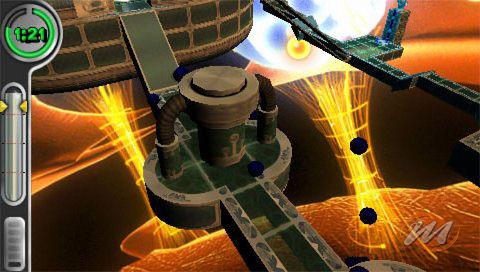
Similar to that of
Super Monkey Ballexcept with molten metal.
©
Archer MacLean is an independent developer and he and his team have come up with a great puzzle concept that doesn’t have any correlation to Tetris. Instead, Archer MacLean’s Mercury could be seen as a rip-off of Super Monkey Ball as the gameplay dictates that you must maneuver a glob through various obstacles by tilting the playfield.
This liquid metal is Mercury which remains in such a state at room temperature. The blob is not always silver and it’s not always just a blob. Different colors are included to solve different puzzles, and, in many levels, there is more than one blob, sometimes up to four or more. It can become quite a process to multitask all of these blobs and puzzles at the same time.
Challenges within Archer MacLean’s Mercury
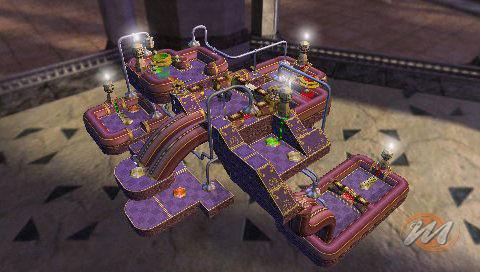
gameplay.
©
Challenges are twofold. First you have to navigate each stage without losing your blob over the edge and then you replay the level for best time and high score. You’ll have to go through the level first to figure out what to do and then go back and try to do it faster. This is what will separate the casual gamers from the hardcore since some of these levels are so tough that many players won’t want to go through them again.
Of the more than 70 different levels they are all imaginatively designed with different challenges including switch throwing, maze navigating and the opening of different colored gates with similar colored globs. At times you will have to combine different colored globs to open gates. Responding nicely to physics the globs will be influenced by gravity and speed. If you go too fast each glob could break down into a series of bubbles. Go too slow and you won’t complete the level in time. If you tilt the playfield too far in any direction the blob may leave the edge and its game over.
Simple Gameplay
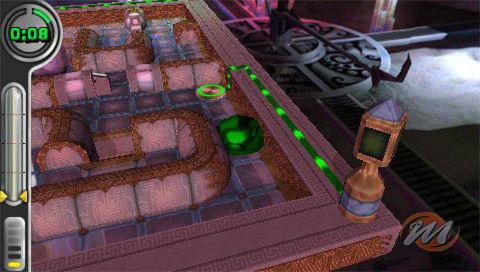
gameplay mechanics.
©
Learning how to play the game is as simple as making a phone call – though not related in any way. Many of the playfield’s float and resemble multi-tiered oil refineries with various stairs and ramps. Other levels look like waterslide parks complete with multiple curved paths to follow in an effort to escape the labyrinth. Then there are levels that feature moving machinery in a meshwork of gears like a giant clock. You have to figure out the patterns of the gears and such and make your moves accordingly. Your mind will be very busy processing information.
Normally the camera is adequate when left on automatic pilot. The more glob balls on screen the further away the view will get so that you see more of the playfield. At times when you need to focus on a particular glob it’s no problem to manually zoom the camera in. It would have been nice to see real-time reflections on the glob since they are metallic and not plastic. At least the developers did get the flow of the Mercury looking and responding realistically.
Final Thoughts
Heavy rhythmic oriented music is a perfect choice for a game like this. There aren’t any sound effects to speak of and certainly no cutscenes. The multiplayer modes are really nothing more than competitions that could have been facilitated by one game system. Don’t forget to save the game after you complete a level as there is no automatic save which I found out the hard way.
I highly recommend renting Archer MacLean’s Mercury first to see if you’ll play it longer than a couple of hours. It’s not for everyone but puzzle fans looking for something fresh are bound to embrace this original concept.